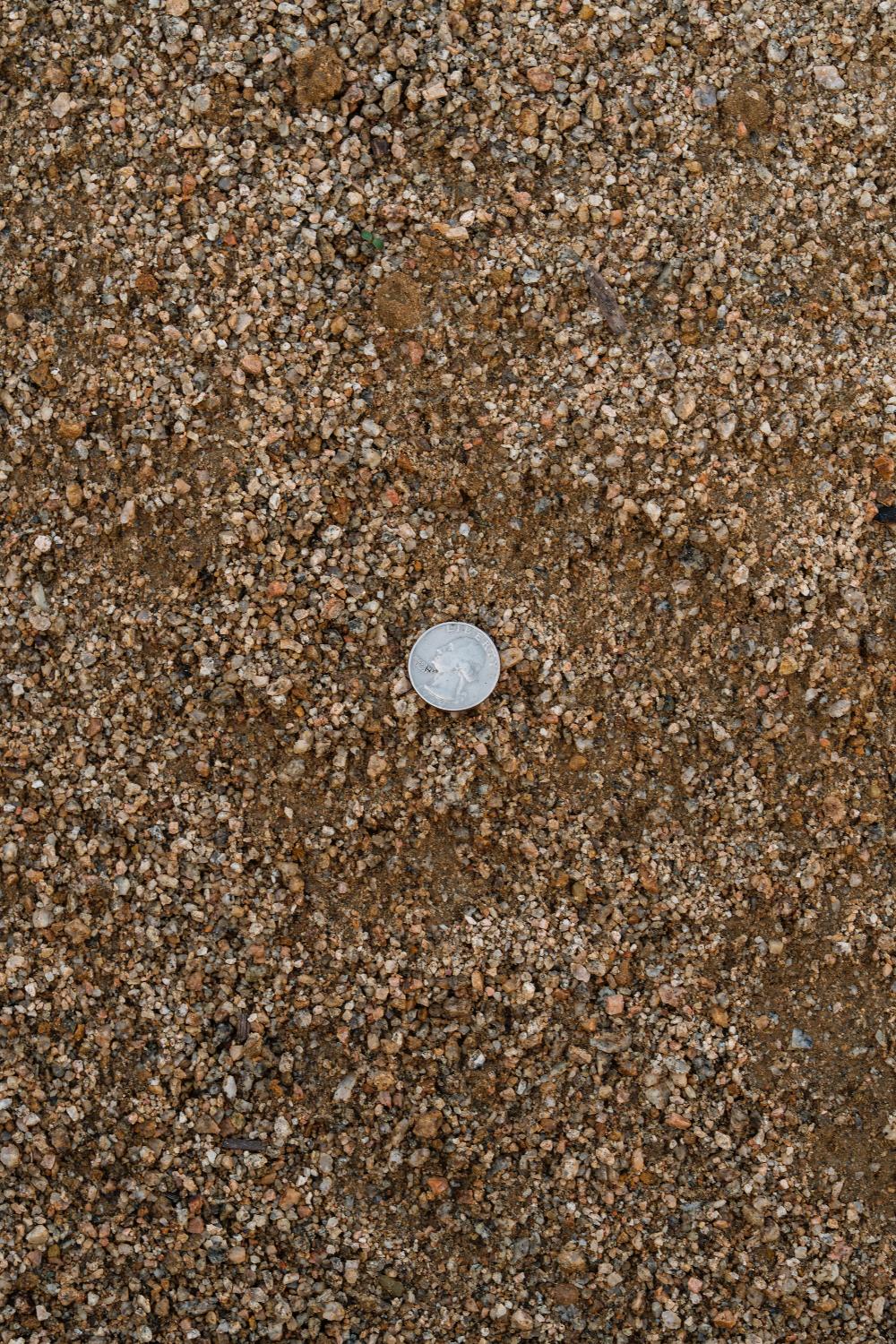
3/8" Minus California Gold DG
90 sqft per ton @ 2″ Depth
Closed
Hours:
Mon-Sat: 6:30 AM - 4:00 PM
Sunday: Closed
3/8" Minus California Gold DG? Use Cases and Performance
3/8" Minus California Gold DG is a decomposed granite product that includes everything from 3/8" pieces down to fine granite dust, sold as one graded material rather than a single screened size. The "minus" in the name is the important word. A minus product keeps the fines in the mix instead of washing or screening them out, and those fines are what let the material pack down into a tight, walkable surface once it is compacted. Straight 3/8" crush granite, by comparison, is a clean, screened, mostly single-sized product with the fines removed, which is why it drains well but never locks into a hard surface the way a minus product does.
California Gold refers to the color, a warm tan and gold blend with some rust and brown flecking, rather than a separate quarry grade. It reads warmer than the neutral gray of standard crush granite and pairs naturally with tan and terracotta stucco, warm-toned pavers, and the desert and Mediterranean planting palettes common around Fresno and Clovis. The blend of fine and coarse material in a natural earth tone is also why this is the product most people mean when they say decomposed granite path or DG patio.
Where 3/8" Minus California Gold DG is the right call
- Garden paths and walking trails, where you want a firm, natural-looking surface that compacts underfoot instead of shifting like loose gravel.
- DG patios and seating areas, a lower-cost, permeable alternative to pavers or concrete with a warm, natural look.
- Dog runs and side yards, since a compacted minus surface sheds mud better than bare dirt and is gentler underfoot than sharp crushed rock.
- Between flagstone or stepping stones as a jointing and fill material that locks the stones in place once compacted.
- Xeriscape and drought-tolerant beds, as a fine, warm-toned ground cover around succulents, ornamental grasses, and Mediterranean plantings.
- Golf cart paths, orchard rows, and light-duty access lanes that need a firm surface without the cost of paving.
Where it is not the right call
Two situations call for a different product. The first is anywhere heavier vehicle traffic is expected, a real driveway or a parking area. A minus DG surface compacts well underfoot and under light traffic, but repeated car and truck loading grinds the fines into dust faster than a structural aggregate, and a driveway spec is better served by 3/4" Crush Granite over a proper base. The second is anywhere you want a clean, dust-free, loose decorative rock look with sharp definition, such as a modern gray gravel bed against a light stucco wall. That job calls for a screened, minus-free product like 3/4" Crush California Gold or 3/8" Crush Granite, not this one.
Not sure how much you need?
Run your square footage and depth through our material coverage calculators before you call. It saves time on the quote and avoids the two most common ordering mistakes: guessing on depth and forgetting compaction loss.
Buying it in Fresno
3/8" Minus California Gold DG is sold by the ton out of our yard at 3562 South Elm Avenue in Fresno. Load it yourself, have us load your truck or trailer, rent a dump trailer to self-haul, or have it delivered and dumped where you want it. Call 559-233-6603 to confirm current pricing and availability. Aggregate pricing moves with fuel and quarry costs, so we quote it live rather than publishing a number that goes stale.
3/8" Minus California Gold DG: Guidance for Your Situation
Pick the description that fits you best. Specs, steps, and pricing questions differ for a weekend project versus a bid or a compliance inspection.
For homeowners and designers
Installing and Designing With Minus California Gold DG
A DG path or patio is one of the more forgiving weekend projects in the yard, and it is also one where a shortcut shows up fast. The three things that separate a path that stays firm for years from one that ruts, dusts off, or grows weeds are depth, compaction, and edge containment. None of the three take special skill, but skipping any one of them is what people usually blame on the material.
How much depth do I actually need?
| Application | Recommended depth | Notes |
|---|---|---|
| Decorative ground cover in beds | 2" | Standard depth for coverage and weed suppression. |
| Garden paths, light foot traffic | 2"-3" | Compact each lift; do not just rake and walk away. |
| Patios and seating areas | 3" | Compact in two lifts over a stripped, level subgrade. |
| Jointing between flagstone or steppers | Fill to grade | Sweep in, wet, and compact around the stones. |
| Dog runs and side yards | 3" | Deeper section resists paw digging and holds up to daily traffic. |
Step-by-step: a DIY DG path or patio
- Strip the organics. Remove grass, weeds, and loose topsoil down to firm subgrade. Leftover organic material decomposes and settles, and a path built over it develops dips within a year.
- Grade for water. Build in a slight crown on a path, or a gentle slope away from the house on a patio. Fresno rain is infrequent but can be intense, and a flat or bowl-shaped section holds water.
- Install edge restraint first. Steel edging, plastic landscape edging, or a stone or timber border keeps the minus material from spreading outward. This matters more with DG than with clean rock, because the fines that make it compact well also make it easy to track onto adjacent surfaces without a hard edge.
- Spread in lifts. Place the material in two lifts of roughly half your target depth each rather than one deep dump. A single thick lift will not compact evenly at the bottom.
- Compact each lift. A plate compactor or hand tamper knits the fines and coarse pieces together. Lightly wetting the material before compacting helps it lock instead of just vibrating loose.
- Water and let it set. A final light watering after compaction helps the surface cure into a firmer crust over the following days.
- Top off as needed. Very light raking and a thin top-dress restores the surface look after a season of weather and traffic.
Design: what California Gold DG looks like in a Fresno yard
This material reads as a warm tan and gold blend with some rust flecking, closer to natural earth than to gray gravel. It is the color most people picture when they imagine a decomposed granite path winding through a drought-tolerant garden, and it tends to look intentional rather than utilitarian once it is compacted and edged.
- Against tan, terracotta, and warm stucco, the color blends rather than contrasts, which reads as calm and cohesive on most Fresno and Clovis homes.
- With drought-tolerant plantings such as agave, lavender, rosemary, and ornamental grasses, the warm tone complements silver and green foliage without the stark look of gray rock.
- As a patio surface, it pairs well with a flagstone or paver border and a simple steel edge, giving a defined, finished look without the cost of a full hardscape pour.
- For a path winding through beds, keep the width consistent, usually 3 to 4 feet for a comfortable two-person walk, and taper the edging into corners rather than squaring them off.
- If you want a cooler, more neutral tone instead, 3/4" Minus Grey DG is the closest match with the same minus, compactable behavior.
What DIY installs typically cost
DG is priced by the ton and moves with market conditions, so call 559-233-6603 for a current number. Beyond the material, budget for edging, a hand tamper or a one-day plate compactor rental for anything larger than a small bed, and either a delivery fee or a trailer rental. For most homeowner-sized paths and patios, self-hauling in a rented dump trailer is the cheaper option; once you are past a few tons, delivery usually wins on both cost and effort.
The single most common DIY mistake
Skipping compaction because the material already looks settled after raking. Loose minus DG looks firm on day one and then tracks, ruts, and dusts within weeks. Run a compactor or a hand tamper over it while it is slightly damp, every time.
Maintenance
- Weeds: DG does not feed weeds on its own, but dust and windblown organic debris settle into the surface over time. A pre-emergent applied in spring and fall handles most of it.
- Dust: a properly compacted surface sheds far less dust than a loose one. If dust becomes an issue in a dry, high-traffic area, a light misting before sweeping keeps it down.
- Leaf litter: a leaf blower on a low setting works fine; a high setting will start moving the surface fines.
- Top-dressing: expect to lightly top-dress a path or patio every two to four years depending on traffic, less often in low-traffic decorative beds.
For contractors, landscapers, and property managers
Specs, Bulk Ordering, and Job-Site Logistics
DG volume from contractors runs heavily toward pathway, patio, and common-area work, so the yard is set up for fast staged pickups rather than retail hand-holding. Mon through Sat, 6:30 AM to 4:00 PM, with first loads out early. Call 559-233-6603 the day before on anything over a couple tons and we will have it staged and ready.
Working specs
| Property | Working value / behavior |
|---|---|
| Nominal size | 3/8" minus, full range from fines to 3/8" pieces |
| Sold by | The ton; loaded at our Fresno yard or delivered |
| Color | Warm tan and gold blend with rust flecking |
| Fracture | Angular fines and coarse fraction combined, locks under compaction |
| Typical use | Pathways, patios, jointing material, decorative ground cover, light-duty access surfaces |
| Compaction | Place and compact in lifts; the fines are what let this product bind, unlike a clean, screened product |
| Drainage | Compacts to a semi-bound surface; specify a clean, screened rock instead where full drainage is required |
| Coverage | Calculated at 2" depth, see our calculators for takeoffs |
Placement and compaction
- Prep the subgrade. Strip organics and proof-roll. Fresno-area clay subgrade holds water and pumps under a compacted surface if it is placed over a wet, unproofed section.
- Set restraint before spreading. Edge restraint on every path and patio job keeps the minus material from migrating onto adjacent turf or hardscape.
- Build in lifts. Place in roughly 2" compacted lifts rather than one deep dump. A full-depth single lift will not compact evenly through the section.
- Manage moisture at compaction. This product compacts best slightly damp. Bone-dry minus DG in July will vibrate without knitting; a light water pass before rolling or tamping makes a measurable difference.
- Finish the surface. A final light rolling or hand tamp after watering gives a tighter, more even wearing surface than stopping after the first compaction pass.
Job-site logistics and hauling
- Yard pickup: we load trucks and trailers on site at 3562 South Elm Avenue, Fresno, Mon through Sat, 6:30 AM to 4:00 PM.
- Delivery: dump truck delivery for bulk quantities, including staged deliveries on multi-phase jobs.
- Self-haul: dump trailer and truck rentals when your own equipment is committed elsewhere.
- Multi-material orders: DG plus edging base, plus decorative rock for adjacent beds on the same delivery run is normal. Bundle it and we will sequence the loads to match your install order.
- Access: flag tight residential access, gated HOA entries, or low overhead lines when you order, not when the truck shows up.
Bulk and account pricing
We quote bulk and repeat-account pricing directly rather than publishing rates, since aggregate cost moves with fuel and quarry pricing and since volume, haul distance, and load count all affect the total. Call 559-233-6603 or send us the job details and we will price the material and freight together. If you are bidding recurring work such as HOA path maintenance or production landscape installs, ask about standing pricing so you are not re-quoting on every draw.
Commercial and HOA applications
This is one of the more requested materials for HOA and multifamily pathway systems in the Fresno and Clovis area, mainly because it reads as a finished, natural surface rather than a construction material once it is compacted, and because it costs far less than paving over the same linear footage. Property managers like it for the maintenance profile too: a well-built section holds up to foot traffic and periodic maintenance-crew access without the rutting problems a loose gravel path develops. For heavier equipment or maintenance-yard access, ask about 3/4" Crush Granite or a base-rock product instead, since those hold up to repeated vehicle loading better than a minus surface.
Contractor accounts
If you buy from us regularly, see our contractor page for how accounts, staged loads, and repeat pricing work.
For HOA boards, property managers, and commercial grounds crews
Common-Area Paths, Budgets, and Long-Term Upkeep
For an HOA board or a property manager, the decision usually comes down to three things: install cost against a paved alternative, how much ongoing maintenance a path will actually require, and whether the finished look matches the rest of the property. DG paths score well on all three when they are built correctly, and poorly when they are built as an afterthought over bare dirt.
Where it fits in a common-area plan
- Interior walking paths through greenbelts and common landscape areas, where the warm tone reads as a designed feature rather than a maintenance shortcut.
- Connector paths between buildings, mailboxes, and amenity areas that see steady foot traffic but not vehicles.
- Perimeter paths around clubhouse or pool landscaping, where a soft, permeable surface is preferred over concrete.
- Transition zones between turf areas being converted to drought-tolerant landscaping, since it reads as a finished ground plane rather than bare dirt during a phased renovation.
Budgeting against paving
A compacted DG path costs less to install than a concrete or asphalt path of the same length, and it is permeable, so it does not add to a property's stormwater load the way paving does. The tradeoff is maintenance frequency: a well-built DG path holds up for years with light periodic top-dressing, while a poorly built one, thin, uncontained, or dumped straight on dirt without compaction, will need constant attention and start looking like a maintenance liability within a season. Ask your landscape contractor to spec depth, edge restraint, and compaction explicitly in the scope of work rather than leaving it to be assumed.
Maintenance planning for boards
| Task | Typical frequency | Notes |
|---|---|---|
| Weed pre-emergent application | Twice yearly, spring and fall | Cheaper than a crew pulling weeds by hand on a path. |
| Top-dress and re-compact | Every 2 to 4 years | More often on high-traffic connector paths, less on low-traffic decorative paths. |
| Edge restraint inspection | Annually | Damaged or sunken edging is the leading cause of a path spreading onto turf. |
| Drainage check | Before winter storm season | Confirm the path still sheds water rather than ponding after grade shifts. |
For larger properties running multiple phases of path or common-area work, we can bundle DG with base materials, decorative rock for adjacent beds, and delivery scheduling around your contractor's timeline. Call 559-233-6603 or reach out through our contact page to set up recurring or phased orders tied to your maintenance calendar.
Getting bids apples to apples
If you are comparing landscape contractor bids for a path project, confirm each bid specifies the same depth, the same edge restraint, and compaction as a line item. A low bid that skips compaction and edging will look identical to a proper install on paper and fail within a year.
How 3/8" Minus California Gold DG Compares to the Alternatives
The useful comparison for most customers is not this material against something exotic. It is this minus, compactable DG against the clean, screened rock products sitting next to it in the yard, since the two categories solve different problems even when they look similar in a photo.
| Material | Surface behavior | Best for | Trade-off vs. Minus California Gold DG |
|---|---|---|---|
| 3/8" Minus California Gold DG | Compacts into a firm, semi-bound surface, warm tan and gold color | Paths, patios, jointing material, light-duty surfaces | N/A |
| 3/8" Crush Granite | Loose, clean, screened, drains freely | Decorative beds, drainage areas, jointing where drainage matters more than a hard surface | Will not compact into a firm surface the way a minus product does |
| 3/4" Crush California Gold | Loose, coarser, same warm color family | Decorative ground cover, larger beds, coarser texture with better weed suppression | Coarser underfoot, not intended as a compacted walking surface |
| 3/4" Minus Grey DG | Compacts similarly, coarser and cooler gray tone | Paths and patios where a gray palette fits the property better than warm tan | Same compaction behavior, different color and slightly coarser fraction |
| 3/4" Crush Granite | High, angular, hard, compacts and locks under vehicle loading | Driveways, parking areas, commercial access surfaces | Not a warm decorative color, and coarser than what most patios or garden paths want underfoot |
Minus DG vs. straight crush granite, which one do I need?
This is the comparison people get wrong most often, because a bag or a small pile of each can look similar at a glance. The presence or absence of fines changes the outcome completely.
| Question | 3/8" Minus California Gold DG | 3/8" Crush Granite |
|---|---|---|
| Compacts into a firm surface? | Yes, that is the point of the fines | No, stays loose since fines are screened out |
| Good for a walking path or patio? | Yes, this is the standard choice | Passable but stays loose underfoot |
| Drains freely? | Limited once compacted | Yes, clean and free-draining |
| Best decorative ground cover? | Yes, warm color, finer texture | Yes, if drainage or a loose look matters more |
| Jointing material for flagstone? | Yes, compacts and locks stones in place | Workable but less locking action |
DG vs. pavers, flagstone, or a concrete path
For a garden path or a small patio, the comparison comes down to cost, permeability, and the amount of ongoing care you are willing to put in. A compacted DG surface installs for a fraction of the cost of pavers, flagstone, or a poured concrete path over the same square footage, and it is permeable, so water infiltrates rather than sheeting off. What you give up is the completely hard, dust-free surface of a paved path and the ability to run a wheelbarrow or a wheeled bin across it without some give underfoot. Many properties use DG for the bulk of a path system and reserve pavers or flagstone for entry points, seating pads, or high-wear thresholds.
Minus California Gold DG in Central Valley Conditions
Material behavior is local. A product that holds up in a mild, wet climate can behave differently in Fresno, where summer surface temperatures run extreme, annual rainfall is low but arrives in a handful of concentrated winter storms, and the native soil is heavy on clay. Here is what that means for a minus DG product specifically.
Summer heat
A warm tan and gold surface in full Fresno sun absorbs more heat than a bright white rock and less than a dark aggregate like black lava, putting it roughly in the middle of the catalog for radiant heat underfoot. Keep large expanses of any compacted rock surface away from where bare feet or paws will be in July, and give plants along a DG path a mulch ring rather than running the compacted surface directly against tender stems, since compacted DG holds heat against a stem differently than loose organic mulch.
Clay soil and subgrade behavior
Much of the Fresno and Clovis area sits on soil with a significant clay fraction. Clay expands when wet and shrinks when dry, and a compacted surface built directly over saturated clay can pump and crack over time. For a path or patio, that means stripping to firm subgrade and proof-rolling before placing the DG, rather than dumping the material straight onto native ground and compacting on top of a soft spot. On sites with particularly heavy, poorly draining clay, a thin compacted base course under the DG wearing layer adds real stability, though most residential paths do well with a well-prepared subgrade alone.
Winter storms and drainage
Fresno gets most of its annual rain in a short list of winter events rather than steady drizzle, so a path or patio needs to shed a concentrated volume of water rather than handle constant light moisture. A properly compacted DG surface with a slight crown sheds water without ponding, but a flat or bowl-shaped section will hold puddles after a storm and soften under foot traffic while wet. Grade every path with a defined high point and a place for water to go, and keep DG drainage routes clear of leaf litter heading into winter.
Water conservation and rock landscaping
Rock and DG ground cover have become the standard response to Central Valley water restrictions, and a compacted DG surface is a reasonable long-horizon choice for paths and patios because it does not decompose or need replacing on the schedule organic mulch does. Two honest notes: a compacted DG surface does not feed the soil, so keep an organic mulch like walk-on bark or black humus around plantings that need biological activity, and a very large unbroken expanse of any compacted surface raises the local surface temperature of a yard, so break it up with plantings or shade where you can.
Dust and air quality
The Valley has real air-quality constraints, and a poorly compacted minus product is one of the more common local sources of yard-level dust, since the same fines that let it bind can also become airborne if the surface is never properly compacted or is allowed to dry out and get walked or driven on loose. A well-compacted, lightly watered surface sheds far less dust than a loose pile of the same material, which is the strongest practical argument for not skipping the compaction step on any DG install.
Local delivery area
We deliver 3/8" Minus California Gold DG throughout Fresno, Clovis, Sanger, Selma, Kingsburg, Madera, and the surrounding Central Valley. Call 559-233-6603 to confirm delivery to your address, or rent a trailer and haul it yourself.
3/8" Minus California Gold DG: Frequently Asked Questions
Have questions? We've got answers. If you don't see your question below, give us a call at (559) 233-6603.