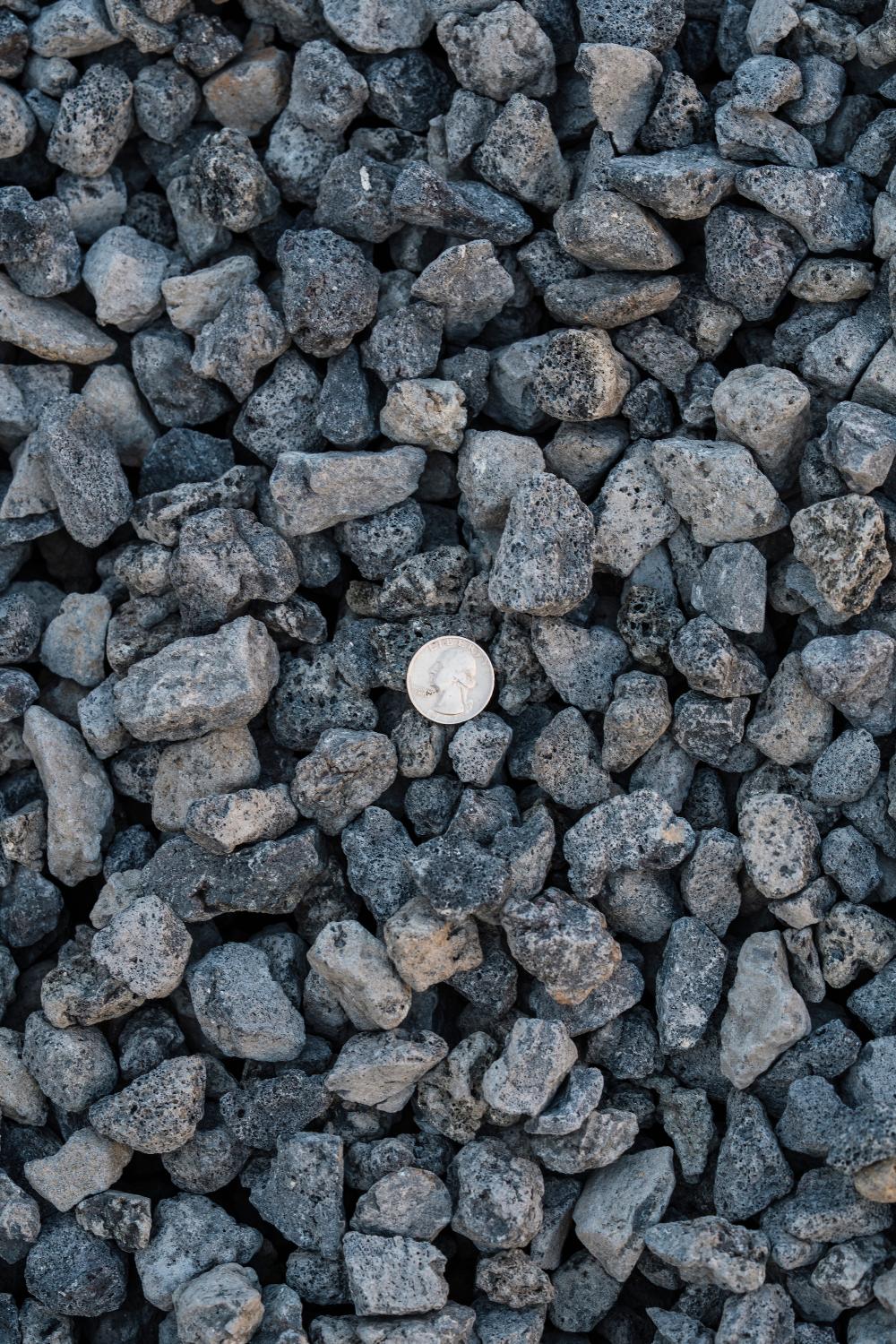
3/4" Black Lava
150 sqft per Yard @ 2″ Depth
Closed
Hours:
Mon-Sat: 6:30 AM - 4:00 PM
Sunday: Closed
Why 3/4" Black Lava? Use Cases and Performance
3/4" black lava is a volcanic scoria, a lightweight, porous, deep-black stone crushed and screened to a nominal three-quarter-inch size. It is not dyed and it is not a granite or river-rock product with color added. The black comes from the mineral makeup of the rock itself, mostly iron and magnesium-rich volcanic glass, and it holds that color permanently because there is no coating to wear off. That is the single biggest thing separating it from the handful of black-looking landscape rocks people sometimes ask us about, and it is worth knowing before you buy.
The stone is also genuinely lightweight compared to granite or river rock of the same size, because it is full of small trapped gas bubbles from when it cooled after the eruption that formed it. That porosity cuts both ways. It makes the material easy to move and spread by hand, it lets water pass through quickly, and it means a given weight covers noticeably more ground than a dense stone would. It also means the individual pieces are softer and more brittle than granite, so it is not the material to pick for a driveway or anywhere it will be run over or ground underfoot against concrete.
Where 3/4" black lava is the right call
- Decorative ground cover in beds, especially where the design calls for strong, dark contrast against plants, stucco, or hardscape.
- Modern and desert-style landscapes, where a flat matte black reads as intentional and architectural rather than rustic.
- Mulch replacement around drought-tolerant and succulent plantings, where a mineral top dressing that will not decompose or blow around is preferred over bark.
- Fire feature surrounds and gas fire pits, where a lightweight, non-combustible volcanic rock is a common and visually clean choice, though always confirm sizing and clearance with your fire feature manufacturer rather than assuming any rock is rated for direct flame contact.
- Erosion control on light-duty slopes and drainage areas, where the angular, vesicular surface helps it sit in place better than smooth rounded gravel of similar size.
- Container and potted-plant top dressing, where its light weight is an advantage over hauling heavier rock into raised planters or rooftop containers.
Where it is not the right call
Black lava is not a base material and it is not a driveway or parking surface material. It is softer and more brittle than crushed granite or base rock, and vehicle weight or repeated foot traffic will crush pieces down into smaller fragments and grit over time. For any surface that carries a car, a golf cart, or heavy wheeled equipment, use 3/4" Crush Granite or 3/4" Blue Base Rock instead. It is also not the best choice for a pool deck or bare feet area, since the vesicular surface can be a little rough, and its dark color runs hotter in direct sun than a lighter stone, a point worth weighing for any area where people or pets will walk barefoot.
Not sure how much you need?
Run your square footage and depth through our material coverage calculators before you call. It speeds up the quote conversation and heads off the two most common ordering mistakes: under-ordering on depth and forgetting compaction loss.
Buying it in Fresno
We sell 3/4" black lava by the yard out of our yard at 3562 South Elm Avenue in Fresno. You can load it yourself, we can load your truck or trailer, we can rent you a dump trailer to self-haul, or we can deliver and dump it where you want it. Call 559-233-6603 to confirm current pricing and availability. Lava rock supply and pricing can move more than common granite or river rock because it is sourced from a narrower set of volcanic deposits, so we quote it live rather than publishing a number that goes stale.
3/4" Black Lava: Guidance for Your Situation
Pick the description that fits you best. Specs, steps, and pricing questions differ for a weekend project versus a bid or a compliance inspection.
For homeowners and designers
Installing and Designing With Black Lava
Black lava is one of the more forgiving landscape rocks to install yourself, mostly because it is light. A wheelbarrow load feels noticeably easier to move than the same volume of river rock or granite. What trips people up instead is depth, weed prep, and choosing the wrong spot for a hot, dark rock.
How much depth do I actually need?
| Application | Recommended depth | Notes |
|---|---|---|
| Decorative ground cover in beds | 2" | Standard depth for good coverage and weed suppression. |
| Top dressing around established plants | 1.5"-2" | Keep rock pulled back a few inches from stems and trunks. |
| Container and potted-plant top dressing | 1" | A thin layer is enough since the goal is a finished look, not weed control. |
| Fire pit surrounds | 2"-3" | Confirm sizing and safe clearance with your fire feature manufacturer first. |
| Slopes and light drainage channels | 2"-3" | Angular pieces resist rolling better than round gravel, but steep grades still need edging or check dams. |
Step-by-step: a DIY black lava bed
- Clear the area. Pull weeds and existing ground cover down to bare soil. Any grass or weed roots left behind will grow straight through a thin layer of decorative rock.
- Install a weed barrier. A quality landscape fabric under a decorative bed like this earns its keep, unlike under a driveway. It slows weed germination and keeps the lava from working its way down into native soil over time.
- Set your edges. Steel edging, poly edging, or a header board keeps the lightweight rock from migrating into lawn or walkways. Because lava is lighter than granite or river rock, it moves more easily in a heavy downpour or under a leaf blower without containment.
- Spread the lava. Pour piles roughly every few feet and rake it out to an even depth rather than dumping one big pile and dragging it thin, which leaves inconsistent coverage.
- Rake and settle. A light rake pass evens out the surface. Unlike granite, this material does not need mechanical compaction; it is not meant to be a load-bearing course.
- Rinse if needed. A gentle hose-down settles dust and fines from the crushing process and freshens the color right after install.
Design: what black lava looks like in a Fresno yard
Black lava reads as a flat, matte, true black, not the charcoal-gray you get from some darker granites. It is one of the highest-contrast materials in the yard, which is exactly why designers reach for it in modern and desert-style landscapes where the goal is drama rather than a blended, natural look.
- Against white, cream, or light gray stucco, the contrast is stark and reads as modern architectural design, common on newer builds around Fresno and Clovis.
- With silver and blue-green foliage, agave, aloe, blue fescue, and lavender, the black background makes the plant color pop far more than a neutral gray rock would.
- As a banding or accent material, a strip of black lava against 3/4" White Rock or 3/4" Crush California Gold creates a clean visual break between zones without adding hardscape.
- Around raised metal planters and corten steel edging, black lava tends to disappear into the material rather than compete with it, which is a common professional trick for keeping a bed looking intentional.
- For a softer, warmer look with the same performance, 3/4" Red Lava is the direct sibling product, same stone, same behavior, different mineral color.
What DIY installs typically cost
Aggregate is priced by the yard and moves with market conditions, so call 559-233-6603 for a live number. Lava rock often runs at a premium over common granite or river rock because of where it comes from and how far it has to travel, so budget accordingly and confirm current pricing before you finalize a design. For most homeowners, self-hauling a yard or two in a rented dump trailer is the cheapest path, since the material's light weight makes it easy to haul without maxing out a trailer's rated capacity.
The single most common DIY mistake
Skipping the weed barrier because the rock looks so different from the soil that weeds seem unlikely. Windblown dirt and seed still land on top of any rock bed, lava included, and germinate there over a season or two if nothing is underneath to block roots from reaching soil.
Maintenance
- Weeds: a fabric barrier plus a spring and fall pre-emergent handles most of what shows up.
- Leaf litter: leaves and debris show up sharply against black rock, so this material shows dirt and litter faster than a lighter stone. A leaf blower on a low setting is usually enough since the pieces are light but still heavier than leaves.
- Dust and mineral film: irrigation overspray leaves a pale mineral film on dark rock that is more visible than on lighter stone. Aim heads away from the bed or rinse periodically.
- Breakage: avoid walking on it regularly or dragging heavy pots across it. The porous structure that makes it light also makes individual pieces more prone to chipping under concentrated weight.
For contractors, landscapers, and property managers
Specs, Bulk Ordering, and Job-Site Logistics
Black lava moves in smaller volumes per job than granite or base rock, since it is almost always a finish material rather than structural fill, but it shows up constantly on design-build jobs, model homes, and HOA accent beds where a client wants a specific look. Monday through Saturday, 6:30 AM to 4:00 PM, first load out the gate early. Call 559-233-6603 ahead on larger orders since lava supply can be tighter than common aggregates.
Working specs
| Property | Working value / behavior |
|---|---|
| Nominal size | 3/4" crushed volcanic scoria |
| Sold by | The yard (bulk); loaded at our Fresno yard or delivered |
| Weight | Notably lighter per cubic yard than granite, river rock, or base rock, due to internal porosity |
| Color source | Natural mineral color, permanent, not dyed or coated |
| Structural use | Not a base or wearing-course material; decorative and top-dressing use only |
| Drainage | Highly permeable due to porous, vesicular texture |
| Coverage | Calculated at 2" depth, see our calculators for takeoffs |
Placement notes
- Prep the bed. Clear vegetation and install a weed barrier suited to the bed, not the load path, since this is not a compacted structural application.
- Set containment first. Because the material is light, edge restraint matters more here than with heavier aggregate. Wind and irrigation runoff move loose lava more readily than they move granite of the same size.
- Spread by hand or with a light-duty spreader. Heavy equipment traffic over a lava pile before it is placed will crush a noticeable percentage of the pieces, wasting material.
- Do not compact. There is no benefit to running a plate compactor over decorative lava, and it will crush the vesicular pieces rather than lock them together the way it would with angular granite.
- Keep it off traffic paths. Specify a transition material, pavers, decomposed granite, or a hardscape band, anywhere the bed meets a walkway that will see regular foot traffic.
Job-site logistics and hauling
- Yard pickup: we load trucks and trailers on site at 3562 South Elm Avenue, Fresno, Monday through Saturday 6:30 AM–4:00 PM.
- Delivery: dump truck delivery for bulk quantities, useful for larger commercial accent-bed installs.
- Self-haul: dump trailer and truck rentals when your own equipment is on another site; the material's light weight means you can often move more volume per trip than with denser rock before hitting a weight limit.
- Multi-material orders: lava plus edging plus fabric plus a companion aggregate on the same delivery run is common on design-build jobs. Bundle it and we will sequence the loads to match your install order.
- Handling: because pieces are more brittle than granite, minimize the number of times the material is scooped, dumped, and re-scooped between the yard and final placement to reduce breakage.
Bulk and account pricing
We quote bulk and repeat-account pricing directly rather than publishing rates, because lava rock pricing tracks its own supply chain separately from common granite and river rock, and because volume, haul distance, and load count all change the number. Call 559-233-6603 or send us the job details and we will price the material and the freight together. If you spec black lava regularly for model homes or repeat HOA accent work, ask about standing pricing so you are not re-quoting on every draw.
Commercial and HOA applications
Black lava shows up most often in commercial work as an accent material at entry monuments, signage beds, and model-home landscaping where a striking, low-maintenance look matters more than square footage. It holds its color without fading, which is an advantage over dyed mulches for accounts that get inspected on a schedule. The trade-off property managers need to plan for is that it is a finish material only, so any bed spec needs a companion structural or edging plan, and it should be called out separately from base rock or fill in a takeoff so nobody tries to substitute it into a load-bearing line item.
Contractor accounts
If you buy from us regularly, see our contractor page for how accounts, staged loads, and repeat pricing work.
For landscape designers and property managers planning finished looks
Specifying Black Lava for Design and Common Areas
For a designer, black lava is a color and texture decision more than an engineering one. It is one of the few landscape rocks in the yard where the visual statement is the whole point, so the practical questions worth answering up front are how much heat and glare the finished bed will produce, how it will read at night, and how it holds up under a maintenance contract that may not be as attentive as a homeowner would be.
Heat, glare, and plant placement
Dark rock absorbs more solar radiation than light rock and re-radiates it as heat through the afternoon and evening. In a Fresno summer that matters for two reasons: it raises the surface and near-surface air temperature over the bed, and it can stress tender plant material placed directly against it. Specify a mulch ring or a soil gap between lava and any plant that is not a true drought-tolerant, heat-adapted species, and avoid running large unbroken lava fields directly against south- or west-facing windows or walls where reflected heat adds measurable summer load.
Lighting and nighttime appearance
Black lava reads almost invisibly at night without supplemental lighting, since it absorbs rather than reflects light. That is an advantage for uplighting plant silhouettes against a dark, non-competing background, and a liability if the design relies on ambient path lighting bouncing off the ground plane the way it would off a lighter rock. Plan fixture placement and wattage with that difference in mind rather than assuming the same lighting layout that works over granite or white rock will read the same way here.
Maintenance-contract specifications
- Call out lava beds separately from granite or base rock areas on maintenance specs, since blowing debris off lava at high fan speed will scatter the lighter pieces along with the leaves.
- Specify a periodic rinse cycle for beds near sidewalks or entries, since dust and irrigation mineral film show more visibly on black rock than on lighter aggregate.
- Note edge-restraint condition as an inspection item. Because the material is light, a failed or missing edge shows up faster as visible migration than it would with heavier rock.
- Set a top-dress interval based on visible thinning rather than a fixed schedule; well-contained lava beds hold their look for years since the stone itself does not decompose or fade.
Pairing with irrigation and drip systems
Lava's porosity makes it a reasonable top dressing over drip line in a decorative bed, since water passes through quickly rather than pooling on the surface. Keep spray heads, if any are used nearby, angled away from the bed itself. Overspray settles as a pale mineral crust on black rock far more visibly than on a lighter material, and it is one of the most common callback complaints on commercial lava installations that otherwise look fine.
Sourcing consistent color across a large job
If a job spans multiple deliveries over several weeks, order what you expect to need in as few pulls as possible or ask us to hold material from the same run. Natural volcanic stone can show minor run-to-run variation in tone, and it is far easier to manage at the ordering stage than to patch later. Call 559-233-6603 to discuss a phased order for a large common-area job.
How 3/4" Black Lava Compares to the Alternatives
The comparisons that matter for black lava are less about competing rock sizes and more about which finish material fits the look and the job, since lava is not trying to be a base or driveway product in the first place.
| Material | Weight | Color permanence | Best for | Trade-off vs. black lava |
|---|---|---|---|---|
| 3/4" Black Lava | Light, porous | Permanent, mineral color | Decorative beds, accents, fire surrounds, containers | N/A |
| 3/4" Red Lava | Light, porous | Permanent, mineral color | Same uses, warmer rust-red tone | Identical behavior and handling, purely a color choice |
| 3/4" Crush Granite | Heavy, dense | Permanent, mineral color | Driveways, parking, structural ground cover | Handles vehicle traffic and compaction, but reads as gray rather than black and costs more to haul per yard |
| 3/4" Crush River Rock | Heavy, dense | Permanent, mineral color | Dry creek beds, family and pet areas | Rounded and comfortable underfoot, but a lighter, warmer palette than black lava's stark contrast |
| 1/2" Medium Deco Bark | Very light, organic | Fades and grays over one to two seasons | Traditional planting beds, moisture retention | Feeds the soil as it breaks down, but needs replacing on a cycle that lava never does |
Black lava vs. red lava, which color is the right call?
These two are the same stone with different mineral coloring, so the install method, weight, drainage, and durability are identical. The choice comes down entirely to the palette. Black lava gives the highest contrast against light stucco, pale hardscape, and silver-green drought-tolerant foliage, and it tends to read as more modern and architectural. Red lava sits closer to the warm earth tones common in Central Valley stucco and brick, and it blends rather than contrasts with terracotta roofing and tan block walls. Neither is more durable or more weather-resistant than the other; it is purely a design decision.
Black lava vs. dyed or colored mulch
Dyed bark and rubber mulch products aim for a similarly dark, uniform look but rely on a colorant that fades under UV exposure over a season or two, especially in Fresno's intense summer sun. Black lava's color is mineral, not applied, so it does not fade, bleed onto adjacent concrete or stucco during watering, or need re-dyeing. What dyed mulch offers instead is a lighter material that is easier to move by hand in very large quantities and a softer, cooler surface underfoot. For a permanent accent bed with minimal upkeep, lava is the longer-term choice; for a bed that gets refreshed yearly anyway as part of a broader maintenance cycle, dyed mulch remains a reasonable, lower-cost option.
Black lava vs. crushed granite for a driveway
This comparison comes up occasionally from homeowners who like the black color and assume any rock can be driven on. It cannot, at least not this one. Lava's porous, brittle structure crushes down under repeated vehicle loading in a way dense granite does not, so a lava driveway will visibly break down and turn to grit within a season or two of regular use. If the goal is a dark driveway surface, asphalt grindings or a dark granite blend is a far better answer; save black lava for the beds, borders, and accents alongside it.
Black Lava in Central Valley Conditions
Material behavior is local. A rock that looks great in a mild coastal climate can behave differently once it sits in Fresno's summer sun and Central Valley clay soil for a few years. Here is what that means for black lava specifically.
Summer heat
Black lava is the darkest common rock in the yard, and dark, matte surfaces absorb more solar heat than lighter stone like 3/4" White Rock or mid-tone granite. In a Fresno summer with regular triple-digit days, a black lava bed in full sun can get noticeably hot to the touch by mid-afternoon and stays warm well after sunset. Keep it out of areas where bare feet or paws will land, give it distance from tender plants that do not tolerate reflected heat, and think twice about a large unbroken lava field directly against a sun-facing wall or window.
Clay soil and hardpan
Much of the Fresno–Clovis area sits on clay-heavy soil, and some sites have a hardpan layer not far below grade. For a decorative lava bed this matters less than it does for a driveway, since lava is not a structural material, but drainage still counts. If a bed sits in a low spot with poor infiltration, water can pond under the lava layer and the weed fabric, and standing water there causes root rot in plantings faster than it hurts the rock itself. Grade beds so water has somewhere to go, and consider a French drain or dry well for a low corner rather than relying on the rock layer to solve a drainage problem it was never meant to handle.
Winter rain and lightweight material movement
Fresno's rain arrives concentrated in a handful of winter storms rather than steady drizzle, and lava's light weight means it moves more readily in heavy runoff than denser rock of the same size. On a slope or anywhere water sheets across a bed toward a low point, solid edge restraint and a defined drainage path matter more with lava than with granite or river rock. On flat, well-contained beds this is a minor concern; on a sloped bed next to a driveway or walkway, plan containment before you order the rock, not after the first storm moves it.
Wind and dust
At 3/4" size, black lava is too large and heavy to blow around under normal Central Valley wind, including the north winds that pick up in fall and spring. What does move is fine dust generated during handling, which settles on top of the rock along with windblown Valley dust generally. Because that dust is pale against black rock, it shows more visibly here than on a lighter stone, and it is the main reason a periodic rinse keeps a black lava bed looking sharp far more than it matters on granite or tan-toned rock.
Irrigation and mineral staining
Central Valley irrigation water carries dissolved minerals that leave a pale film wherever spray or drip water evaporates on a hard surface, and that film reads as a visible chalky haze against black rock in a way it barely registers against lighter stone. Point spray heads away from lava beds where possible, favor drip irrigation for plantings within the bed, and expect to hose the surface down occasionally in beds that get regular overspray.
UV and color stability
Fresno gets close to full sun exposure for much of the year, which is hard on dyed and pigmented landscape products. Black lava's color comes from the mineral content of the stone, not a surface coating, so UV exposure that fades dyed bark or colored decorative concrete has essentially no effect on lava's color over time. What fades in appearance is the surface sheen from dust accumulation, not the underlying color, and that is solved with a rinse rather than a replacement.
Local delivery area
We deliver black lava throughout Fresno, Clovis, Sanger, Selma, Kingsburg, Madera, and the surrounding Central Valley. Call 559-233-6603 to confirm delivery to your address, or rent a trailer and haul it yourself.
3/4" Black Lava: Frequently Asked Questions
Have questions? We've got answers. If you don't see your question below, give us a call at (559) 233-6603.