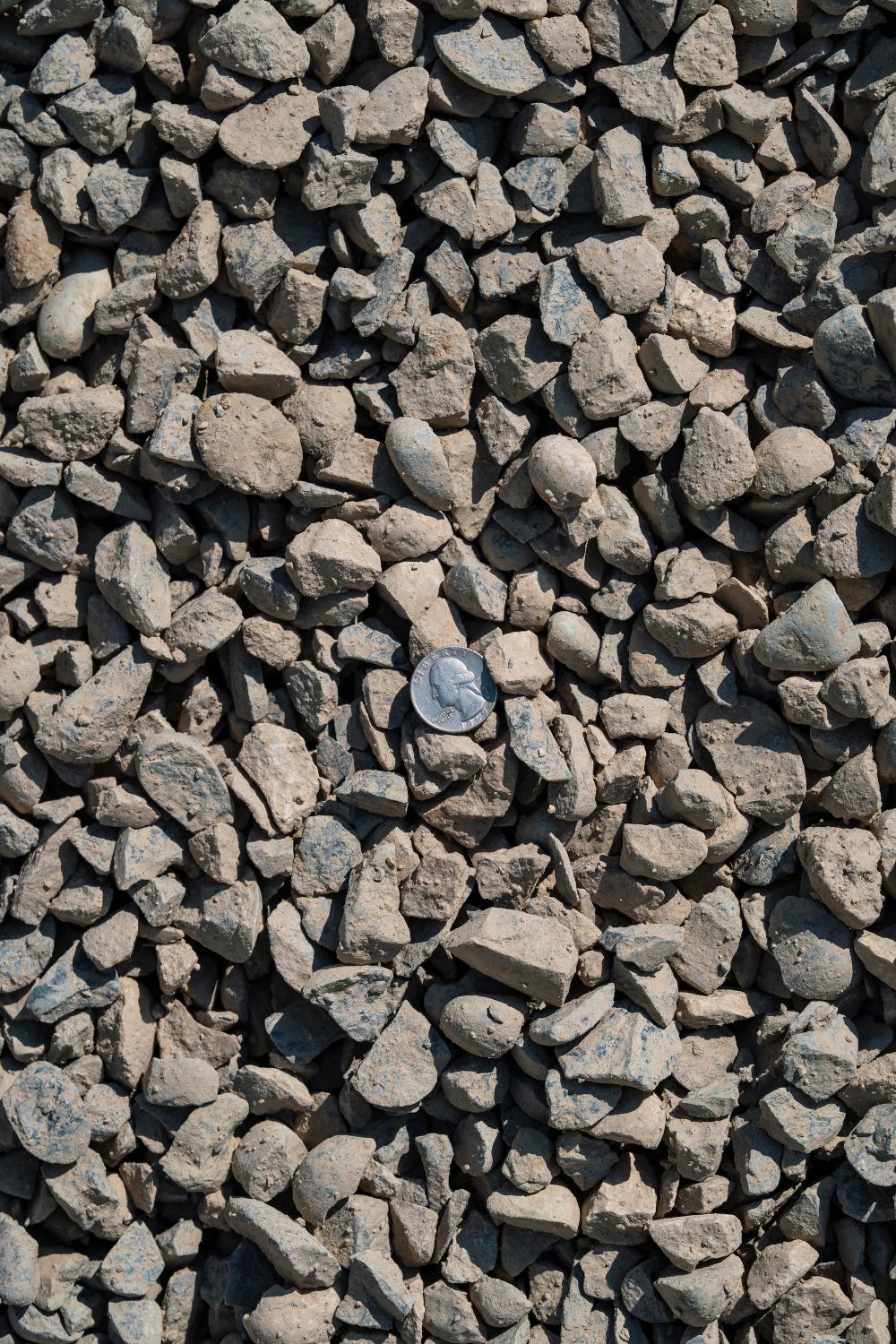
3/4" Crush River Rock
120 sqft per ton @ 2″ Depth
Closed
Hours:
Mon-Sat: 6:30 AM - 4:00 PM
Sunday: Closed
Why 3/4" Crush River Rock? Use Cases and Performance
3/4" crush river rock is the smooth, rounded cousin of the angular crushed aggregates in our Fresno yard. It starts as natural river rock, worn round over time by water rather than a crusher, and gets screened down to a nominal three-quarter-inch size. That rounded shape is the whole story of how this material behaves and where it belongs on a property. It does not lock together under a plate compactor the way 3/4" Crush Granite does, and it is not meant to. It is meant to sit loose, look natural, drain well, and feel comfortable to walk or dig through.
That trade-off, softer underfoot in exchange for less surface stability, is the reason people choose it. Rounded rock reads as a stream bed or a natural stone accent rather than a paved surface. It does not develop the sharp edges that make angular crush granite a poor choice for bare feet and paws. And because the individual stones are rounded rather than fractured, it tends to hold a more even, consistent gray tone across a bed than mixed crushed material.
Where 3/4" crush river rock is the right call
- Dry creek beds and drainage channels are the signature use. The rounded shape and natural gray tone read as a real streambed, and the material handles moving water without sharp edges catching debris.
- Pool surrounds, dog runs, and play areas benefit from the rounded profile, which is far more comfortable underfoot and on paws than any angular crushed product.
- Decorative ground cover in beds, borders, and foundation plantings holds its look for years and does not need the compaction that driveway aggregate requires.
- Drainage at downspouts, French drains, and low spots where water needs to disperse rather than pool or wash a channel bare.
- Accent bands and transition zones between lawn, hardscape, and planting beds, where a softer visual texture than crushed granite is wanted.
- Container and potted plant top-dressing for a clean, finished look that also helps with moisture retention at the soil surface.
Where it is not the right call
Two situations call for a different product. The first is any surface that carries vehicle traffic or needs to stay firm under repeated foot traffic, such as a driveway, parking pad, or a heavily used path. Rounded rock does not interlock, so it migrates and ruts under that kind of load; 3/4" Crush Granite or 3/4" Blue Base Rock is the correct call there. The second is a steep slope with no containment. Rounded stone rolls downhill under its own weight and under runoff in a way angular rock does not, so on grade you either flatten the slope, add checks or containment, or switch to an angular product that locks in place.
Not sure how much you need?
Run your square footage and depth through our material coverage calculators before you call. It heads off the two most common ordering mistakes: guessing at depth and forgetting that irregular bed shapes eat more material than a straight rectangle.
Buying it in Fresno
We sell 3/4" crush river rock by the ton out of our yard at 3562 South Elm Avenue in Fresno. You can load it yourself, we can load your truck or trailer, we can rent you a dump trailer to self-haul, or we can deliver and dump it where you want it. Call 559-233-6603 to confirm current pricing and availability. Aggregate pricing moves with fuel and quarry costs, so we quote it live rather than publishing a number that goes stale.
3/4" Crush River Rock: Guidance for Your Situation
Pick the description that fits you best. Specs, steps, and pricing questions differ for a weekend project versus a bid or a compliance inspection.
For homeowners and designers
Installing and Designing With Crush River Rock
Most homeowner projects with this material are decorative beds, dry creek beds, and pet or play areas, and all three come down to the same three basics: get the depth right, contain the edges, and put down a barrier under it if you are trying to suppress weeds. Skip any of those and you end up re-raking the same bed every spring.
How much depth do I actually need?
| Application | Recommended depth | Notes |
|---|---|---|
| Decorative ground cover in beds | 2" | Standard depth for weed suppression and full soil coverage. |
| Dry creek beds | 3"-4" | Deeper in the channel bottom, tapering thinner at the banks. |
| Dog runs and play areas | 3" | Deeper cushion holds up to digging and daily traffic better than 2". |
| Pool surrounds | 2"-3" | Keep it shallow enough that a broom or blower can manage it near the deck. |
| Drainage at downspouts | 4"-6" in the splash zone | Tapering out to 2"-3" as it moves away from the discharge point. |
Step-by-step: a DIY dry creek bed or decorative rock installation
- Lay out the shape. Use a hose or marking paint to sketch the bed or channel before you dig. Curves that follow the natural low points of the yard look more convincing than straight lines.
- Excavate to depth. Remove sod and topsoil to the planned depth plus about an inch to leave room for a weed barrier if you are using one.
- Grade the bottom. For a creek bed, the channel should actually carry water toward a real outlet, a drain, a swale, or a low point in the yard, not just look like it does.
- Set edging. Steel edging, stone, or a soldier course of larger rock keeps the rounded rock from spreading into the lawn or planting beds over time.
- Add landscape fabric if desired. Skip it in the channel bottom of a working drainage feature, since fabric can clog and defeat the drainage purpose; use it in static decorative beds where weed suppression matters more than infiltration.
- Spread the rock. Dump in small piles across the area rather than one big pile, then rake and shovel to depth. Rounded rock does not compact, so raking level is the only finishing step needed.
- Add accent boulders or plantings. A few larger cobbles or 2"-4" Noiyo River Cobble placed along the edges of a creek bed break up the uniform size and look far more natural than an evenly sized field of rock.
Design: what crush river rock looks like in a Fresno yard
Crush river rock reads as a soft, mixed gray with the occasional tan or rust-toned stone mixed in, a natural, weathered palette rather than the more uniform tone of a crushed product. It pairs easily with almost anything because it looks like it came from a stream rather than a quarry.
- In a dry creek bed, mixing this size with larger 1x4 River Rock or 2"-4" Noiyo River Cobble along the banks reads far more convincingly than a single uniform size.
- Against stucco in any tone, the mixed gray palette is neutral enough not to clash, which is part of why it shows up in so many Fresno and Clovis front yards.
- With drought-tolerant plantings such as ornamental grasses, salvia, and succulents, the softer color variation complements plant texture rather than competing with it.
- Around a pool deck, it pairs well with concrete or pavers as a low-maintenance planting buffer that will not scratch bare feet the way angular rock can.
- As a transition between lawn and a bark-mulched bed, a band of river rock gives a clean visual break and doubles as a mow strip.
What DIY installs typically cost
Aggregate is priced by the ton and moves with market conditions, so call 559-233-6603 for a live number. Beyond the rock itself, plan for edging material, landscape fabric if you are using it, and either a delivery fee or a trailer rental. For most homeowners doing a bed or a small creek feature, self-hauling in a rented dump trailer is the cheapest path for a ton or two; larger dry creek beds or full-yard makeovers usually make more sense with delivery.
The single most common DIY mistake
Skipping edge containment on a dry creek bed. Without a defined edge, rounded rock spreads into the lawn every time a sprinkler runs or a dog runs through it, and the bed slowly gets smaller while the surrounding area gets rockier.
Maintenance
- Weeds: river rock does not feed weeds itself, but windblown dirt and leaf litter that settle into the gaps eventually will. A pre-emergent in spring and fall handles most of it.
- Leaf litter: a leaf blower on low works fine on a rounded rock bed since there is little to dislodge, unlike lighter decorative bark.
- Top-dressing: with edging in place, expect to add a light top-dress occasionally as material settles into the soil below, more often in a heavy-traffic dog run than in a static bed.
- Rinsing: a hose rinse a couple of times a year keeps the natural stone color from dulling under dust and mineral deposits from sprinkler overspray.
For contractors, landscapers, and property managers
Specs, Bulk Ordering, and Job-Site Logistics
River rock volume on the contractor side tends to be decorative and drainage work rather than structural, so the yard workflow is built around fast loadout for smaller repeat quantities as much as full truckloads. Mon-Sat, 6:30 AM to 4:00 PM, first load out the gate early. Call 559-233-6603 the day before on anything over a few tons and we will have it staged.
Working specs
| Property | Working value / behavior |
|---|---|
| Nominal size | 3/4" rounded river rock |
| Sold by | The ton (bulk); loaded at our Fresno yard or delivered |
| Shape | Water-worn, rounded on all faces, does not interlock under compaction |
| Typical use | Decorative ground cover, dry creek beds, drainage, pet and play areas |
| Compaction | Not applicable; loose placement and raking to grade is the finish step |
| Drainage | Free-draining, clean product with minimal fines |
| Coverage | Calculated at 2" depth, see our calculators for takeoffs |
Placement
- Prep the bed. Strip organics and grade to the finished contour. For drainage features, confirm the channel actually routes water to a real outlet before placing rock over it.
- Set containment first. Edging, header board, or a soldier course goes in before the rock, not after. Retrofitting edging around a spread bed means moving material twice.
- Place landscape fabric where appropriate. Use it under static decorative beds; skip it in an active drainage channel where it can clog and reduce infiltration.
- Spread and rake to depth. No compaction step is needed or useful. Distribute from multiple drop points to avoid one deep pile that has to be moved by hand.
- Check drainage function after a rain event on any feature that is doing real water conveyance, not just decorative work, and adjust the channel if water is bypassing it.
Job-site logistics and hauling
- Yard pickup: we load trucks and trailers on site at 3562 South Elm Avenue, Fresno, Mon-Sat 6:30 AM-4:00 PM.
- Delivery: dump truck delivery for bulk quantities, including staged deliveries when a job needs multiple loads across different areas of a property.
- Self-haul: dump trailer and truck rentals when your own equipment is committed on another site.
- Multi-material orders: river rock alongside bark, soil amendments, or base rock for a full landscape renovation is common. Bundle it and we will sequence loads to match your install order.
- Access: tell us about tight residential access, low lines, or gated HOA entries when you order, not when the truck arrives.
Bulk and account pricing
We quote bulk and repeat-account pricing directly rather than publishing rates, because aggregate cost moves with fuel and quarry pricing and because volume, haul distance, and load count all change the number. Call 559-233-6603 or send us the job details and we will price the material and the freight together. If you are running recurring landscape maintenance or production installs, ask about standing pricing so you are not re-quoting on every job.
Commercial and HOA applications
River rock shows up most often in commercial common-area planting beds, entry monument landscaping, and drainage swales along parking lots and building perimeters. The rounded shape means less concern about injury claims in areas with foot traffic near beds, and the neutral color holds up visually in beds that do not get regular attention. For areas that also see foot traffic or need a firmer surface, such as a path through the bed, pair it with a firmer material like 3/8" Crush Granite rather than expecting the river rock itself to hold a walking surface.
Contractor accounts
If you buy from us regularly, see our contractor page for how accounts, staged loads, and repeat pricing work.
For landscape designers and property managers planning long-term maintenance
Long-Term Planning: Water Features, Drainage, and Low-Maintenance Beds
For anyone responsible for how a property looks and drains five years from now, not just at install, the questions are different from a one-time DIY project. They center on what happens as the property settles, as irrigation changes, and as maintenance crews rotate through.
Drainage design with river rock
A dry creek bed or rock-lined swale is only as good as the grading underneath it. Rock does not create drainage, it protects a drainage path that already has to work. Before specifying river rock for a swale, confirm the grade actually carries water to a legitimate outlet, whether that is a storm drain, a daylight point at the property edge, or a dry well. Rock placed in a flat area with no real fall will hold standing water after a storm regardless of how it looks on the plan.
- Size the channel for the largest storm event you expect it to handle, not just everyday irrigation runoff.
- Use a deeper rock section, closer to 4"-6", at concentration points like downspout discharges and culvert outlets, where velocity is highest.
- Mix in larger cobble at bends and drop points, where 3/4" rock alone will migrate under higher-velocity flow.
- Reassess the feature after the first significant winter storm and adjust before the second one; most drainage failures show themselves in year one.
Reducing long-term maintenance calls
Rock beds get chosen over shrub beds specifically to cut maintenance hours, and that only holds up if the install anticipates the failure points. Weed pressure from windblown soil, rock migration from irrigation spray or foot traffic, and dust accumulation are the three complaints that generate return visits.
- Confirm sprinkler heads are not spraying directly onto the rock bed. Overspray both encourages weed growth in the fines that collect and leaves mineral staining on the stone.
- Specify edge containment on every bed, even ones that look self-contained on paper. Maintenance crews with mowers and string trimmers move material over time even when homeowners do not.
- Where a bed sits under trees, expect more frequent blowing and occasional hand-raking, since organic litter breaks down into the rock and is harder to remove than off a hard surface.
- Where crews will walk through a bed regularly for access, consider a firmer path material through the middle rather than relying on loose rock to hold a walking surface.
Working with HOA and commercial expectations
Property managers care about two things above the design intent: how often the bed needs attention, and how it looks between attention cycles. River rock scores well on both if the underlying grading and containment were done correctly, and poorly on both if they were not. When specifying for common areas, err toward slightly deeper placement and stronger edge containment than a residential job would use, since commercial beds get less frequent, less careful maintenance attention over their life.
Planning a phased or multi-property order
If you are specifying this material across multiple properties or phases, call 559-233-6603 to talk through consistent sourcing and staged delivery so color and size stay consistent across the portfolio.
How 3/4" Crush River Rock Compares to the Alternatives
The useful comparison for most customers is not river rock against some exotic product, it is river rock against the other rounded and crushed aggregates sitting near it in the yard, since the differences between them decide the job more than any marketing distinction does.
| Material | Shape / surface stability | Best for | Trade-off vs. crush river rock |
|---|---|---|---|
| 3/4" Crush River Rock | Rounded, moderate stability, does not compact | Dry creek beds, decorative beds, pet and play areas | N/A |
| 3/4" Crush Granite | Angular, high stability, compacts and locks | Driveways, parking areas, commercial hardscape | Firmer underfoot for vehicles, but sharp and uncomfortable for bare feet and paws |
| 1"-1.5" River Rock | Rounded, larger, low stability | Larger accent areas, bigger dry creek beds | Bigger stones read as a larger-scale feature but suppress weeds less densely at the same depth |
| 1x4 River Rock | Rounded, mixed larger sizes | Creek bed banks, accent boulders mixed with smaller rock | Better for visual variety along a channel edge, not for full-bed coverage |
| 38" Pea Gravel | Rounded, small, very low stability | Fine decorative beds, potted plant top-dressing, small paths | Finer texture and lower cost per bed, but migrates more readily and suppresses weeds less at shallow depth |
| 3/4" Black Lava | Angular, lightweight, moderate stability | High-contrast decorative beds, fire-safe landscaping | Bold dark color and lighter weight, but rougher and hotter underfoot in full sun |
River rock vs. crush granite, which one do I need?
This is the comparison people get wrong most often, because both are three-quarter-inch aggregate at a glance. The shape, not the size, decides the job.
| Question | 3/4" Crush River Rock | 3/4" Crush Granite |
|---|---|---|
| Comfortable for bare feet and pets? | Yes, rounded and smooth | No, sharp fractured edges |
| Vehicle or heavy foot traffic? | No, migrates under load | Yes, over a compacted base |
| Natural, streambed look? | Yes, that is the intended look | No, reads as a manufactured surface |
| Stays put on a slope? | Rolls more readily | Holds better on grade |
| Compacts into a firm surface? | No, and it is not meant to | Yes, that is the point of the product |
River rock vs. pea gravel for decorative beds
For a straightforward decorative bed with no drainage or accessibility requirement, the choice between 3/4" crush river rock and 3/8" pea gravel usually comes down to scale and budget. Pea gravel is finer, generally lower cost per ton, and reads as a smoother, more uniform texture. River rock at 3/4" reads as a bolder, more natural texture and holds its position better against wind and light foot traffic because the individual stones are larger and heavier. Neither compacts, so containment matters equally for both.
Crush River Rock in Central Valley Conditions
Material behavior is local. A rock that performs one way in a mild, wet coastal climate behaves differently in Fresno, where summer surface temperatures are extreme, annual rainfall is low but arrives in a handful of concentrated winter storms, and the native soil is heavy on clay. Here is what that means for crush river rock specifically.
Summer heat
Any rock surface in full Fresno sun gets hot, that is physics rather than a product defect. The mixed gray tones of river rock sit in the middle of the catalog for radiant heat, cooler than dark black lava and hotter than white rock. For pool surrounds and dog runs specifically, where this material is often chosen for its comfort underfoot, plan on some shaded coverage or a rinse-down option during peak afternoon heat in July and August, since even a comfortable shape gets uncomfortably hot in direct sun.
Clay soil and drainage behavior
Much of the Fresno and Clovis area sits on soils with a significant clay fraction, which matters most for dry creek beds and drainage features built from this material. Clay compacts and sheds water rather than absorbing it, so a swale or creek bed dug into raw clay can end up moving more water, faster, than expected during a storm. Grading the channel with enough capacity for a real storm event, not just everyday irrigation runoff, prevents the rock from being scoured out of the channel bottom in the first heavy rain.
Winter storms and rock migration
Fresno gets most of its rain in a handful of intense winter events rather than steady drizzle, which is exactly the condition that moves loose rounded rock. A dry creek bed sized correctly for the site will carry that water without disturbing the rock much. A bed on a slope with no containment, or a creek bed that is more decorative than functional and undersized for real flow, will show rock pushed downhill or out of the channel after the first big storm. Check any river rock drainage feature after the first significant rain of the season and correct any migration before it becomes a pattern.
Water conservation and rock landscaping
Rock ground cover is the default answer to Central Valley water restrictions, and river rock is a reasonable long-horizon choice for it since it does not decompose or blow away the way organic mulch does. Two honest caveats apply here just as they do with any rock cover: rock does not feed soil biology, so keep organic mulch such as walk-on bark or black humus around plantings that need it, and a large unbroken rock field raises local surface temperature, so break it up with plantings or shade where practical.
Dust, tule fog, and wind
The Valley's winter tule fog and the dust that builds up over a dry summer both settle onto rock surfaces over time, and river rock's rounded shape has more surface texture to catch it than a smooth paved surface would. A hose rinse a couple of times a year keeps the natural stone color visible instead of dulled under a layer of fine dust. Because the rock does not compact, occasional wind events can shift the lightest surface particles, though the 3/4" size is heavy enough that this is a minor issue compared to lighter decorative products.
Local delivery area
We deliver crush river rock throughout Fresno, Clovis, Sanger, Selma, Kingsburg, Madera, and the surrounding Central Valley. Call 559-233-6603 to confirm delivery to your address, or rent a trailer and haul it yourself.
3/4" Crush River Rock: Frequently Asked Questions
Have questions? We've got answers. If you don't see your question below, give us a call at (559) 233-6603.