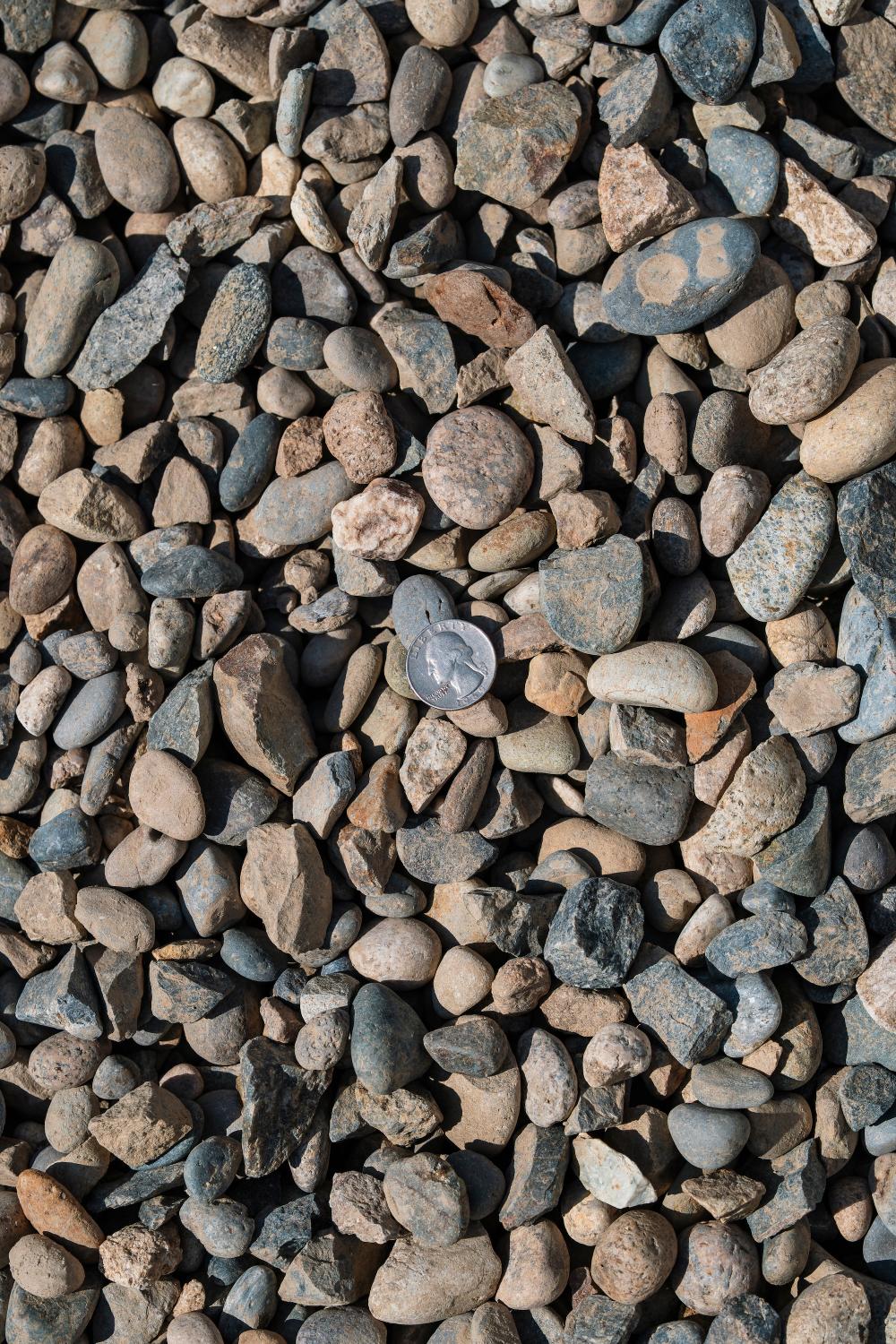
1 x 4 River Rock
100 sqft per ton @ 2″ Depth
Closed
Hours:
Mon-Sat: 6:30 AM - 4:00 PM
Sunday: Closed
Why 1 x 4 River Rock? Use Cases and Performance
1 x 4 River Rock is a large-format, naturally rounded stone that runs from about 1 inch up to 4 inches across, pulled from river-worn deposits rather than crushed at a quarry. Because it is water-tumbled instead of mechanically fractured, every piece has smooth, rounded faces and no sharp edges. That single fact drives almost everything about how this rock behaves and where it belongs on a property: it is comfortable underfoot and around pets, it reads as a natural creek-bed stone rather than an engineered surface, and it moves more easily under traffic than an angular crushed product does.
The size range is the other half of the story. At 1 to 4 inches, this is a mixed, chunky rock, not a fine decorative gravel and not a boulder. Individual stones are large enough to see and feel underfoot, which is exactly why it dominates dry creek beds, drainage channels, and accent borders where a fine pea gravel would look flat and a cobble would look too heavy. It covers ground fast, so a bed that would take pallets of smaller decorative rock fills in with noticeably fewer tons of 1 x 4.
Where 1 x 4 River Rock is the right call
- Dry creek beds and drainage swales are the classic use. The mixed size and rounded shape mimic what water actually deposits in a real streambed, and the larger stones resist being carried off by moderate flow the way pea gravel is.
- Erosion control on mild slopes and at the outlet of downspouts, French drains, and yard drains, where you need rock heavy enough to stay put but permeable enough to let water pass through.
- Accent borders and large decorative beds where you want visual weight and texture rather than a fine, uniform ground cover.
- Around water features, ponds, and fountains, where the rounded shape and natural look read correctly against water and the size stands up to occasional splashing.
- Filling large open areas quickly and at reasonable tonnage, since bigger stones mean fewer pieces and fewer tons per square foot than a fine decorative rock at the same depth.
- Pet-friendly and barefoot-adjacent areas, such as side yards and dog runs, where the rounded profile is far more forgiving than 3/4" Crush Granite or other angular aggregate.
Where it is not the right call
Three situations call for a different product. If you need a compacted, load-bearing surface for a driveway or parking pad, this rock is the wrong tool: it is round, it does not interlock, and it will roll under tire weight instead of locking into a firm crust the way an angular product does. If you need a fine, walkable surface for a garden path or a patio joint, the pieces here are too large and too irregular underfoot; look at 1"-1.5" River Rock or a smaller crushed product instead. And if budget is tight and you are covering a large area purely for weed suppression with no design intent, a smaller and cheaper rock or a bark product will stretch your money further per square foot.
Not sure how much you need?
Run your square footage and depth through our material coverage calculators before you call. It heads off the two most common ordering mistakes on this product: underestimating depth for a creek bed, and forgetting that larger rock needs a bit more depth than pea gravel to actually look full.
Buying it in Fresno
We sell 1 x 4 River Rock by the ton out of our yard at 3562 South Elm Avenue in Fresno, Monday through Saturday, 6:30 AM to 4:00 PM. You can load it yourself, we can load your truck or trailer, we can rent you a dump trailer to self-haul, or we can deliver and dump it where you want it. Call 559-233-6603 to confirm current pricing and availability. Rock pricing moves with fuel and supply costs, so we quote it live rather than publishing a number that goes stale.
1 x 4 River Rock: Guidance for Your Situation
Pick the description that fits you best. Specs, steps, and pricing questions differ for a weekend project versus a bid or a compliance inspection.
For homeowners and designers
Installing and Designing With 1 x 4 River Rock
Most weekend installs of this rock are dry creek beds, drainage fixes, or decorative border beds, and the difference between a natural-looking result and a pile of rock in a ditch shape comes down to shaping the bed, sizing the depth correctly, and controlling the edges before the rock ever goes in.
How much depth do I actually need?
| Application | Recommended depth | Notes |
|---|---|---|
| Decorative accent beds | 3" | Larger stones need more depth than pea gravel to look full and hide the soil underneath. |
| Dry creek beds | 3"-4" | Vary the depth slightly along the run so it reads as natural, not uniform. |
| Drainage swales and downspout outlets | 4" | Deeper placement resists water pushing the rock aside during a heavy storm. |
| Border strips against turf or beds | 3" | Edge it well or the rock and the soil next to it will migrate into each other. |
| Around ponds and water features | 3"-4" | Match depth to what conceals your liner or edging material. |
Step-by-step: a DIY dry creek bed with 1 x 4 River Rock
- Lay out the path. Use a hose or marking paint to trace the creek bed's curves before you dig. A dry creek bed that meanders reads as natural; one that runs straight reads as a drainage ditch.
- Excavate the channel. Dig a shallow, saucer-shaped trench, deeper in the center and tapering to the banks, following the grade water would actually take across your yard.
- Set landscape fabric if the bed is purely decorative. Skip fabric if the bed is doing real drainage work, since fabric can clog with silt over time and defeat the purpose.
- Place larger accent stones first. A handful of oversized rocks or small boulders placed intentionally, not evenly spaced, anchors the design before you fill in around them.
- Fill with the 1 x 4 River Rock. Spread it 3 to 4 inches deep through the channel, working from one end to the other so the depth stays consistent.
- Vary the banks. Feather the rock thinner at the edges where it transitions into planting beds or turf so there is no hard visual line.
- Rinse and settle. A hose-down after placement knocks dust off the stones and helps them settle into their final resting position.
Design: what 1 x 4 River Rock looks like in a Fresno yard
This rock carries a warm, mixed earth-tone palette, tans, grays, and rust tones in the same load, since it is a natural river blend rather than a single sorted color. It has enough visual weight that it reads well on its own, without needing a border of a different material to define it.
- Against drought-tolerant plantings like ornamental grasses, agave, and rosemary, the mixed earth tones complement rather than compete with silver and green foliage.
- In a dry creek bed running from a downspout to a planting area, it does double duty as a design feature and functional drainage path.
- As a transition material between a lawn and a larger decorative bed of 3/4" Crush River Rock or bark, a band of 1 x 4 adds scale variation instead of one flat texture across the whole yard.
- Around boulders or large specimen plants, the size of this rock is proportionate, where a fine gravel would look out of scale next to a large feature.
- In side yards and utility strips, it reads as intentional landscaping rather than bare ground, at a lower cost than pavers or a poured surface.
What DIY installs typically cost
Rock is priced by the ton and moves with market conditions, so call 559-233-6603 for a live number. Beyond the material itself, budget for edging if the bed borders turf, landscape fabric if you are using it, and either a delivery fee or a trailer rental. For most homeowners doing a single creek bed or accent area, one to three tons is a common order, and self-hauling in a rented dump trailer is usually the cheapest way to get it home.
The single most common DIY mistake
Ordering enough tonnage for a fine gravel depth and ending up with a thin, patchy-looking bed. Because the stones are large, a shallow layer leaves gaps where soil or fabric shows through. Plan on 3 to 4 inches, not 2, for this size rock.
Maintenance
- Weeds: rock does not feed weeds, but windblown dirt and leaf litter settling between the stones eventually will. A pre-emergent applied in spring and fall handles most of it.
- Leaf litter: a leaf blower works fine here since the stones are heavy enough not to move around, unlike a fine decorative gravel.
- Settling: expect some settling into soft ground in the first season. A light top-off after the first winter is normal, not a sign of a bad install.
- Algae or mineral staining near water features: an occasional hose rinse keeps the natural coloring visible.
For contractors, landscapers, and property managers
Specs, Bulk Ordering, and Job-Site Logistics
Most of our 1 x 4 River Rock volume goes into drainage work, dry creek beds on production landscape jobs, and large decorative areas on commercial and HOA properties. Mon through Sat, 6:30 AM to 4:00 PM, first load out the gate early. Call 559-233-6603 the day before on anything over a few tons and we will have it staged.
Working specs
| Property | Working value / behavior |
|---|---|
| Nominal size | 1" to 4", mixed and rounded |
| Sold by | The ton (bulk); loaded at our Fresno yard or delivered |
| Shape | Naturally rounded, water-tumbled, no sharp edges |
| Typical use | Dry creek beds, drainage swales, erosion control, large decorative beds |
| Compaction | Not a compacting product; does not lock into a load-bearing surface |
| Drainage | Free-draining and permeable, well suited to channels and swales |
| Coverage | Larger stone requires more tonnage per square foot than fine decorative gravel at the same depth; use our calculators for takeoffs |
Placement on drainage and erosion-control work
- Establish grade and flow direction before placing rock. On drainage swales, the rock follows the water path, it does not create one, so get the excavation and slope right first.
- Use fabric selectively. On decorative-only sections, fabric under the rock reduces weed pressure. On active drainage channels, weigh fabric against long-term silt clogging; many crews skip it on channels that see real flow.
- Place in a single lift for most applications; this is not a compacted product, so lift thickness for compaction purposes does not apply the way it does with crushed base rock.
- Anchor transition points. Where a swale meets a pipe outlet, a catch basin, or a hardscape edge, use larger accent stone or a rock apron to prevent scour at that specific point.
- Verify slope stability on anything steeper than a gentle grade. On real slope work, pair this rock with a proper erosion-control plan rather than relying on rock weight alone.
Job-site logistics and hauling
- Yard pickup: we load trucks and trailers on site at 3562 South Elm Avenue, Fresno, Mon-Sat 6:30 AM-4:00 PM.
- Delivery: dump truck delivery for bulk quantities, including staged multi-load deliveries on larger drainage or creek-bed jobs.
- Self-haul: dump trailer and truck rentals when your own equipment is committed on another site.
- Multi-material orders: river rock plus fill sand plus base rock on the same delivery is common on drainage retrofit work. Bundle it and we will sequence the loads to match your placement order.
- Access: tell us about tight residential access, low lines, or gated HOA entries when you order, not when the truck arrives.
Bulk and account pricing
We quote bulk and repeat-account pricing directly rather than publishing rates, because material cost moves with fuel and supply pricing and because tonnage, haul distance, and load count all change the number. Call 559-233-6603 or send us the job details and we will price the material and the freight together. If you are bidding recurring drainage retrofits or HOA common-area work, ask about standing pricing so you are not re-quoting on every draw.
Commercial and HOA applications
Property managers reach for this rock most often for retention basin edges, drainage swales between buildings, and large common-area beds where a fine decorative rock would need constant top-dressing after irrigation runoff or wind. The larger stone size holds position better under water movement and foot traffic near catch basins than pea gravel does, and the rounded shape avoids the trip-hazard and sharp-edge complaints that come with angular rock in high-traffic common areas.
Contractor accounts
If you buy from us regularly, see our contractor page for how accounts, staged loads, and repeat pricing work.
For designers and crews focused on drainage and erosion work
Using 1 x 4 River Rock for Drainage and Erosion Control
Drainage is where this rock earns its keep beyond looks. A downspout dumping straight onto bare dirt or turf erodes a channel within a season or two in Fresno's clay soils, especially where a hardpan layer sits close to the surface and forces water to run rather than infiltrate. Rock large enough to resist being carried by moderate flow, placed in a properly graded channel, solves that without pipe, concrete, or ongoing maintenance.
Common drainage applications
- Downspout splash pads and short discharge channels that carry roof water away from the foundation before it has a chance to pool or erode a path through mulch.
- French drain and yard drain outlets, where the rock disperses concentrated flow at the pipe exit instead of letting it blow out a crater in the lawn.
- Swales between properties or along fence lines that carry sheet flow during winter storms and need to hold their shape from one season to the next.
- Retention and detention basin side slopes, where rounded rock resists erosion from fluctuating water levels without the sharp profile of crushed rock.
- Culvert inlets and outlets on rural and semi-rural Central Valley properties, where a rock apron reduces scour at the pipe end.
Designing a channel that actually works
A dry creek bed that is purely decorative can be shaped for looks. One that is doing real drainage work needs to be sized and graded like the drainage feature it is: continuous fall from inlet to outlet, no low spots that trap standing water, and enough width and depth to carry your worst expected storm event without overtopping the banks. On a property with real grading challenges, that is a conversation for a licensed civil or landscape designer rather than a rule of thumb from a rock yard, but the rock itself performs the same job either way, slowing and containing flow while staying in place.
| Drainage need | 1 x 4 River Rock role | Pair with |
|---|---|---|
| Downspout discharge | Splash pad, dissipates energy | Solid pipe extension to move discharge away from foundation |
| French drain outlet | Visible, permeable daylight point | Perforated pipe and gravel backfill upstream |
| Sheet flow across a yard | Defined channel, resists scour | Grading to establish continuous fall |
| Basin side slopes | Erosion resistance, permeable | Filter fabric or a coarser rock at the waterline if flow is significant |
When rock alone is not enough
On steep slopes, high-volume flow, or anywhere a failure would affect a structure or a neighboring property, rock supplements a properly engineered drainage plan, it does not replace one. Call 559-233-6603 to talk through material sizing once your grading and pipe design are set.
Sourcing for larger drainage jobs
Drainage retrofits often need river rock alongside fill sand, filter fabric, and sometimes a coarser base product for a French drain trench. We can bundle those materials on one delivery and sequence the loads so the trench backfill arrives before the surface rock. Call 559-233-6603 or send us the job details with your quantities and we will price it as one order.
How 1 x 4 River Rock Compares to the Alternatives
The useful comparison for most customers is not this rock against an exotic decorative stone. It is 1 x 4 River Rock against the other rounded and crushed rock products sitting next to it in the yard, each suited to a different scale of job.
| Material | Shape | Typical size | Best for | Trade-off vs. 1 x 4 River Rock |
|---|---|---|---|---|
| 1 x 4 River Rock | Rounded, natural | 1"-4" | Dry creek beds, drainage, large accent beds | N/A |
| 1"-1.5" River Rock | Rounded, natural | 1"-1.5" | Smaller-scale beds, tighter spaces, more uniform look | Less visual weight, covers ground with more pieces and less drama per stone |
| 3/4" Crush River Rock | Semi-rounded, smaller crushed river stone | 3/4" | General decorative beds, family and pet areas needing a finer look | Finer texture but less erosion resistance in a real flow channel |
| 2"-4" NOIYO River Cobble | Rounded, large cobble | 2"-4" | Bold accent placement, boulder-adjacent scale features | Similar size range but a distinct cobble look and higher cost per ton |
| 3/4" Crush Granite | Angular, crushed | 3/4" | Driveways, parking, load-bearing surfaces | Compacts and locks in place; river rock does not and should not be used for vehicle traffic |
1 x 4 River Rock vs. smaller river rock, which one do I need?
Both are rounded and both come from the same family of natural stone, so the decision is really about scale and job, not shape. A fine decorative bed around a small planting area or a tight side yard usually looks better with the smaller 1 inch to 1.5 inch material, while a dry creek bed, a drainage swale, or a large open area calls for the bigger, chunkier 1 x 4 mix, both because it covers ground faster per ton and because the larger stones resist being moved by water or wind.
| Question | 1"-1.5" River Rock | 1 x 4 River Rock |
|---|---|---|
| Real drainage channel or swale? | Workable for light flow | Better, holds position under higher flow |
| Small, tight planting bed? | Better proportioned | Can look oversized in a small space |
| Large open decorative area? | More tons needed for the same visual coverage | Covers ground faster, fewer tons per square foot |
| Around a water feature? | Fine for shallow edges | Better for larger features, more natural scale |
1 x 4 River Rock vs. crushed rock for drainage
Crushed rock like 3/4" crush granite or a base-rock product compacts and can be used to build a firm, permeable base under a French drain trench or a driveway. It is not the right choice as the visible, exposed surface of a drainage channel because angular pieces do not shed water the way a rounded stone does and the sharp edges are a poor match for anywhere feet, paws, or hoses touch it regularly. The two products often work together on the same drainage job: crushed rock in the buried trench backfill, river rock as the visible surface treatment.
1 x 4 River Rock in Central Valley Conditions
Material behavior is local. A rock that looks the same in a catalog photo performs differently depending on the soil it sits on, the heat it sits in, and the way water moves across the property. Here is what that means for 1 x 4 River Rock specifically in Fresno, Clovis, and the surrounding Central Valley.
Summer heat
Any rock in full Fresno sun gets hot in a 100 degree-plus summer; that applies to river rock as much as any other aggregate. The natural earth-tone mix on this product runs lighter overall than a dark decorative rock like 3/4" Black Lava, so it absorbs somewhat less radiant heat, but it is not a cool-touch surface in July. Keep it out of direct barefoot paths during peak afternoon heat, and give plantings a mulch ring rather than butting rock directly against tender stems that can scorch from reflected heat.
Clay soil and hardpan
Much of the Fresno-Clovis area sits on clay-heavy soil, and many lots have a hardpan layer within a foot or two of the surface that resists water infiltration. That combination is exactly why drainage features built with this rock matter here: water that cannot soak in has to go somewhere, and an unplanned path across clay soil erodes quickly. A properly graded channel lined with 1 x 4 River Rock gives that water a defined route instead of letting it cut its own path through a lawn or a bed.
Winter storms and drainage
Fresno gets most of its annual rainfall in a handful of concentrated winter storms rather than steady rain through the season, so drainage features here are designed around short bursts of high volume, not constant light flow. This is the exact condition 1 x 4 River Rock is sized for: heavy enough to stay in place during a hard downpour, permeable enough to let water pass through rather than sheet across the surface. Confirm your channel has continuous fall to a real outlet before the rock goes in, since even the right rock will not fix a channel with no place for the water to go.
Tule fog and irrigation
Winter tule fog leaves a fine layer of moisture on everything overnight, which is not a problem for the rock itself but can accelerate algae or mineral buildup near water features and irrigation heads that stay damp. Aim sprinkler heads away from direct contact with the rock where possible, since mineral deposits from hard Central Valley water leave a chalky residue that dulls the natural coloring over time. An occasional hose rinse handles it.
Wind, dust, and settling
Valley wind events carry a fair amount of dust, and that dust settles into the gaps between larger stones the same way it settles anywhere else outdoors. Because this rock is large and heavy, wind does not move the stones themselves the way it can with lighter decorative gravel, but dust and windblown organic debris will build up between pieces over a season or two and can support weed germination. A pre-emergent applied in spring and fall keeps that in check with minimal effort.
Local delivery area
We deliver 1 x 4 River Rock throughout Fresno, Clovis, Sanger, Selma, Kingsburg, Madera, and the surrounding Central Valley. Call 559-233-6603 to confirm delivery to your address, or rent a trailer and haul it yourself.
1 x 4 River Rock: Frequently Asked Questions
Have questions? We've got answers. If you don't see your question below, give us a call at (559) 233-6603.