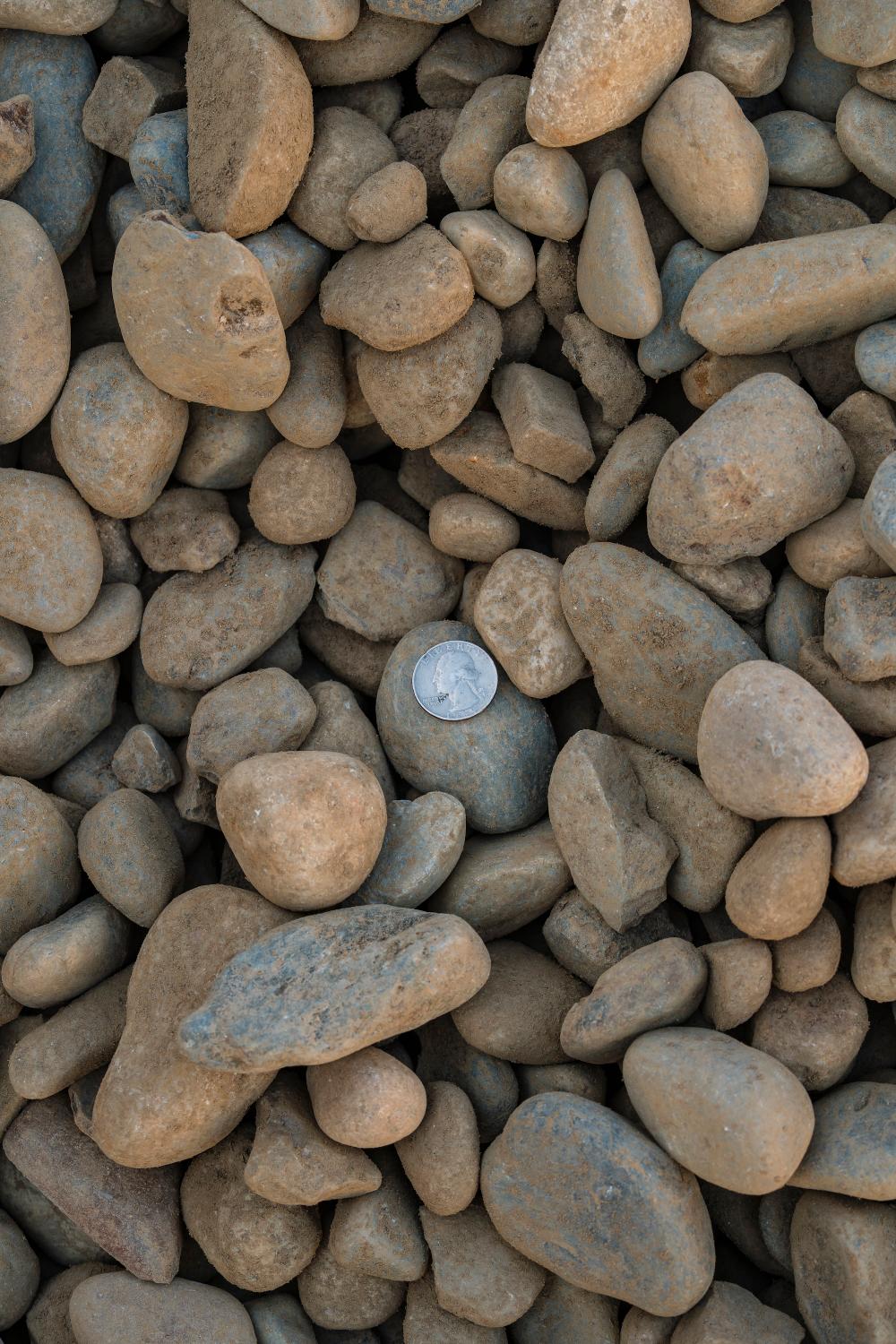
2"-4" Noiyo River Cobble
60 sqft per ton @ 2″ Depth
Closed
Hours:
Mon-Sat: 6:30 AM - 4:00 PM
Sunday: Closed
Why 2"-4" Noiyo River Cobble? Use Cases and Performance
2"-4" Noiyo River Cobble is a rounded river cobble sold at our Fresno yard in a size range that sits between decorative accent rock and true boulders. Each stone in this range has been smoothed by water over a long period, so the pieces are naturally rounded rather than angular, with no sharp edges and no crushed faces. That shape is the defining trait of the product, and it is what separates a cobble bed or dry creek from a crushed-rock installation of the same size.
Rounded stone in this size range reads as a natural feature rather than a paved surface. It is heavy enough to stay put once it is set, but it does not compact the way angular gravel does, and it is not meant to. Cobble at this size is placed by hand or by shovel, one layer deep, as a decorative and functional ground treatment, not spread and rolled like a base course.
Where 2"-4" Noiyo River Cobble is the right call
- Dry creek beds and drainage swales are the classic use. The rounded shape and mixed size within the range mimic what water naturally leaves behind, and the stone sheds concentrated flow without washing away the way smaller gravel does.
- Border and transition zones between a lawn, a planting bed, and a hardscape use cobble as a visual and physical edge that reads as intentional rather than leftover space.
- Accent placement around drainage inlets, downspout discharge points, and sump areas gives water somewhere to land without eroding bare soil.
- Foundation perimeters and drip lines under eaves benefit from a rock band that absorbs splash-back from roof runoff instead of letting it churn bare dirt into mud.
- Mixed with boulders and plantings, cobble fills the middle scale in a rock garden or xeriscape design, the size that keeps a boulder placement from looking like a single rock dropped in a bed of mulch.
- Erosion control on moderate slopes and embankments, where a single layer of heavy, rounded stone slows surface water without the maintenance of a retaining structure.
Where it is not the right call
Cobble at this size is not a walking surface and not a driveway material. It shifts underfoot because it is round, not because it is undersized, and no amount of compaction changes that. If you need a surface people or vehicles travel across regularly, look at an angular product such as 3/4" Crush Granite or a compactable base rock instead. It is also not the right scale for a fine decorative bed cover next to small plantings, where a smaller product like 1"-1.5" River Rock reads better and does not overwhelm the planting. And if the design calls for a genuinely large feature stone as a focal point, step up to 4"-8" Noiyo River Cobble or ask us about boulders.
Not sure how much you need?
Run your square footage and depth through our material coverage calculators before you call. Cobble coverage is figured differently than gravel because it sits as a single layer rather than a compacted depth, so a quick call to confirm quantity saves a second trip.
Buying it in Fresno
We sell 2"-4" Noiyo River Cobble by the ton out of our yard at 3562 South Elm Avenue in Fresno. You can load it yourself, we can load your truck or trailer, we can rent you a dump trailer to self-haul, or we can deliver and dump it where you want it. Call 559-233-6603 to confirm current pricing and availability. Because it is sold by weight and priced live, the number you get on the phone will reflect current market conditions rather than a stale published rate.
2"-4" Noiyo River Cobble: Guidance for Your Situation
Pick the description that fits you best. Specs, steps, and pricing questions differ for a weekend project versus a bid or a compliance inspection.
For homeowners and designers
Designing and Placing River Cobble Yourself
Cobble is one of the more forgiving materials to install yourself because there is no compaction step and no tight tolerance to hit. The work that matters is underneath the rock and around its edges, not the rock placement itself.
How much do I need?
| Application | Typical coverage | Notes |
|---|---|---|
| Dry creek bed, single layer | 60 sq ft per ton | Figured at roughly 2" of effective depth for a single layer of this size range. |
| Accent border or edging band | Less per linear foot than a full bed | Order by running length times a band width of 1'-2'. |
| Drainage inlet or downspout apron | Small quantity, often under a ton | Call with dimensions rather than guessing on a small order. |
| Slope or embankment cover | 60 sq ft per ton as a baseline | Add stone at the toe of the slope where flow concentrates. |
Step-by-step: a DIY dry creek bed or cobble border
- Lay out the shape with a hose or marking paint before you dig. A creek bed should have gentle curves and a variable width, not a straight ditch.
- Excavate to a shallow basin, generally 3"-6" deep depending on how much of the cobble you want sitting proud versus recessed.
- Install landscape fabric across the bottom and up the sides. This is the step people skip, and it is the reason cobble beds sprout weeds and sink into the soil within a year or two.
- Set larger cobbles and any boulders first along the edges and at bends, where water naturally slows and larger stone belongs.
- Fill in with the remaining cobble by hand, working for a natural, uneven distribution rather than a uniform single layer.
- Tuck the fabric and rock over the bed edges into the adjoining lawn or mulch line so there is no visible seam.
- Rinse the finished bed with a hose to settle dust and show the true color of the stone.
Design: what Noiyo river cobble looks like in a Fresno yard
This is a mixed, natural river-tone cobble with grays, tans, and browns in the same load rather than a single flat color. That variation is what makes it read as a natural feature instead of a manufactured product, and it is worth embracing rather than trying to sort for a uniform look.
- Against drought-tolerant plantings like ornamental grasses, sage, and manzanita, the mixed earth tones sit quietly in the background instead of competing for attention.
- Paired with boulders of a similar tone, cobble fills the transition scale so a boulder placement does not look like a single rock stranded in mulch.
- As a dry creek bed feature, it works best when it appears to originate from somewhere, such as a downspout, a slope, or a hardscape edge, rather than starting and stopping in the middle of a lawn.
- Bordering a bark or mulch bed, a cobble band roughly one to two feet wide gives a clean visual break without the cost of hardscape edging.
- Around a fire feature, cobble is non-combustible and reads as an intentional design element rather than filler.
The single most common DIY mistake
Skipping landscape fabric under a cobble bed. Without it, weeds root between the stones and the cobble slowly sinks into the soil, both of which turn a one-day project into an annual maintenance chore.
Maintenance
- Weeds: fabric underneath handles most of it. Windblown dirt that settles between stones over the years will eventually host weeds regardless, and a spring pre-emergent keeps that in check.
- Leaf litter and debris: a leaf blower works fine on cobble since the stones are far too heavy to move with air.
- Mineral staining: sprinkler overspray can leave white mineral deposits over time. Redirecting irrigation heads away from the rock prevents most of it, and a hose rinse restores the look.
- Settling: a dry creek bed will settle slightly after the first heavy rain as fines wash down through the fabric. A light top-off in year one is normal and not a sign of a bad install.
For contractors, landscapers, and property managers
Specs, Bulk Ordering, and Job-Site Logistics
Cobble moves through the yard differently than crushed aggregate. It is bulkier per ton, it is usually a smaller total quantity per job, and it is almost always paired with fabric, boulders, and drainage work rather than ordered on its own. Mon-Sat, 6:30 AM to 4:00 PM, call 559-233-6603 the day before on anything over a few tons and we will have it staged.
Working specs
| Property | Working value / behavior |
|---|---|
| Nominal size | 2"-4", rounded river cobble |
| Sold by | The ton (bulk); loaded at our Fresno yard or delivered |
| Shape | Naturally rounded, no crushed faces, sizes vary within the stated range |
| Typical use | Dry creek beds, drainage features, borders, accent placement, slope cover |
| Placement | Hand or shovel placed in a single layer over fabric; not compacted |
| Load bearing | Not a wearing course, not rated for foot or vehicle traffic |
| Coverage | 60 sq ft per ton at roughly 2" effective single-layer depth |
Placement and drainage design
- Grade the drainage path before ordering rock. Cobble is the finish material for a swale or creek bed, not the thing that creates the grade.
- Fabric first, always, on decorative and low-flow drainage applications. On higher-flow channels, confirm with the project engineer whether fabric or a filter layer is specified, since fast-moving water can undermine fabric at the edges.
- Set larger stones and any boulders at bends, drops, and the outlet, where flow concentrates and erosion risk is highest.
- Distribute cobble unevenly and in clusters rather than a uniform single layer. A natural creek does not have evenly spaced stones.
- Verify the outlet. A cobble swale that empties onto bare soil or a neighboring property will move the erosion problem instead of solving it.
Job-site logistics and hauling
- Yard pickup: we load trucks and trailers on site at 3562 South Elm Avenue, Fresno, Mon-Sat 6:30 AM-4:00 PM.
- Delivery: dump truck delivery for bulk tonnage, staged across multiple loads on larger jobs.
- Self-haul: dump trailer and truck rentals when your own equipment is committed elsewhere. Cobble is dense, so confirm payload before loading a trailer full.
- Multi-material orders: cobble alongside fabric, boulders, and drainage pipe on the same delivery run is common. Bundle the order and we will sequence loads to match your install sequence.
- Access: flag tight residential gates, low overhangs, or HOA access restrictions at order time, not when the truck shows up.
Bulk and account pricing
We quote bulk and repeat-account pricing directly rather than publishing rates, because cobble is sold by weight and pricing moves with quarry and fuel costs. Call 559-233-6603 or send us the job details and we will price the material and freight together. For recurring work, such as HOA drainage retrofits or production landscape installs, ask about standing pricing so you are not re-quoting every job.
Commercial and HOA applications
Property managers reach for river cobble most often to solve a recurring drainage or erosion complaint at a lower cost than a hardscape or pipe solution. A cobble swale along a common-area slope or a cobble apron under a downspout is a one-time material and labor cost that removes an ongoing mud and erosion issue. It also reads as a landscape feature rather than a maintenance patch, which matters for curb appeal on HOA and multifamily properties.
Contractor accounts
If you buy from us regularly, see our contractor page for how accounts, staged loads, and repeat pricing work.
For landscape designers and drainage-focused property owners
Using Cobble as a Design and Drainage Element
For a designer, cobble at this size is a middle-scale tool. It is bigger and more sculptural than a decorative gravel bed, but it does not carry the visual weight or the cost of a placed boulder feature. That makes it useful for filling transitions, softening hard drainage infrastructure, and giving a bed a sense of scale variation.
Scale and composition
- Layer sizes for visual depth. A bed built entirely from one cobble size looks flatter than one that mixes this 2"-4" range with a smaller accent rock and an occasional larger boulder.
- Use cobble to anchor the base of a boulder placement. A boulder set directly into mulch or bare soil looks staged; the same boulder surrounded by cobble looks like it settled there naturally.
- Vary the density of coverage. A dense, tightly packed cobble field reads as hardscape; a looser, more scattered placement with visible soil or fabric between stones reads as a natural rock outcrop.
- Consider sightlines from the primary viewing point, whether that is a front door, a patio, or a street-facing window, and put the largest, most interesting stones there.
Drainage as a design opportunity
Most residential and light commercial sites in Fresno already have a drainage path, whether it is a downspout, a low spot, or a slope that channels water toward a fence line. Rather than routing that water into a plain pipe or a bare ditch, a cobble-lined swale turns a functional necessity into a visible landscape feature. This works particularly well on properties converting from lawn to drought-tolerant planting, since the swale can double as the organizing line for the new bed layout.
Plant pairing
- Ornamental grasses along a cobble creek bed move in the wind and soften the hard edge of the stone.
- Low, spreading groundcovers planted at the bed's outer edge blur the transition between cobble and lawn or mulch.
- Native and Mediterranean shrubs such as manzanita, ceanothus, rosemary, and lavender tolerate the reflected heat off rock better than moisture-loving plants and pair well tonally with the mixed earth colors in this product.
- Avoid planting directly into the cobble bed itself. Roots compete with the drainage function, and maintenance access for weeding gets harder around established plants sitting in stone.
Specifying quantity for a design plan
For bid or plan quantities, use 60 sq ft per ton as the baseline for a standard single-layer bed and add a contingency for boulder-heavy sections, since large individual stones consume more tonnage per square foot than they do in a flat coverage calculation. Call 559-233-6603 to confirm before finalizing a takeoff.
How 2"-4" Noiyo River Cobble Compares to the Alternatives
The right comparison for cobble is usually another rounded rock product at a different size, or a crushed product for the jobs where compaction and load-bearing matter more than natural appearance.
| Material | Shape / behavior | Best for | Trade-off vs. 2"-4" cobble |
|---|---|---|---|
| 2"-4" Noiyo River Cobble | Rounded, single-layer placement, no compaction | Dry creek beds, drainage features, borders, mid-scale accents | N/A |
| 1"-1.5" River Rock | Rounded, smaller, denser bed cover | Decorative bed cover, tighter spaces, smaller plantings | Reads finer and less sculptural; less effective at slowing concentrated water flow |
| 1" x 4" River Rock | Rounded, elongated, mixed size | Mixed decorative beds wanting more texture than a single uniform size | Less consistent coverage math than a single-range product |
| 4"-8" Noiyo River Cobble | Rounded, larger, boulder-adjacent | Focal points, larger drainage channels, bigger-scale features | Costs more per ton to move the same area; overwhelms smaller beds |
| 3/4" Crush River Rock | Rounded but crushed and smaller, some compaction | Paths and areas wanting a walkable rounded surface | Not a single-layer feature stone; behaves as a spread ground cover instead |
| 3/4" Crush Granite | Angular, compacts, load-bearing | Driveways, parking, any surface carrying regular traffic | Angular and hard-edged, wrong look and feel for a natural drainage feature |
Cobble vs. crushed rock for drainage
This is the comparison people get wrong most often on drainage jobs. A crushed, compactable aggregate is the right choice when you are building a French drain trench or a structural base that needs to pack tight and drain through voids. A rounded cobble is the right choice when the water is moving across the surface, such as a swale, a creek bed, or splash protection at a downspout, and the goal is to dissipate energy and resist erosion rather than compact into a bound layer. Using crushed rock on a surface drainage feature looks out of place next to plantings and does not shed flowing water the way a rounded stone does. Using cobble inside a subsurface drain trench leaves gaps that let fines migrate and clog the system.
Cobble vs. concrete or hard-edged drainage channels
A poured concrete swale or a metal trench drain moves water more predictably in a heavy, sustained flow than a rock feature does, and it is the right call on a commercial site with an engineered drainage requirement. For typical residential and light commercial surface drainage, a well-graded cobble swale handles the intermittent, storm-driven flow pattern Fresno actually sees, costs less to install, and does not read as infrastructure sitting in the middle of a landscape.
River Cobble in Central Valley Conditions
Material behavior is local. Fresno's climate and soil profile create a specific set of conditions, extreme summer heat, low but concentrated winter rainfall, and heavy clay soil in much of the area, and each of those shapes how a rounded river cobble performs and holds up over time.
Summer heat
Stone left in direct Fresno sun through a 100°F-plus summer gets hot to the touch regardless of color, and cobble at this size holds that heat longer than a thin gravel layer because there is more mass in each stone. Keep cobble features away from areas where bare feet or paws are likely to contact it, and give nearby plants a few inches of separation or a mulch ring so the radiant heat off the stone does not stress tender stems and roots.
Clay soil and drainage design
Much of the Fresno-Clovis area sits on soil with a significant clay fraction, which sheds water quickly once saturated rather than absorbing it. That is exactly the condition a cobble-lined swale or dry creek bed is built for: a defined path that carries a short, intense volume of surface water away from structures and low spots instead of letting it pond and turn clay soil to mud. On sites where the clay is severe enough that water sits for days after a storm, pair the cobble feature with a French drain or an area drain rather than expecting a surface swale alone to handle it.
Winter storms and tule fog season
Fresno's rain arrives in a handful of concentrated winter storms rather than steady rain through the season, so a drainage feature needs to handle a short burst of volume, not a slow trickle. A properly graded cobble creek bed with larger stone at bends and outlets manages that kind of flow well. Tule fog season brings heavy morning moisture without rainfall, which is generally a non-issue for cobble beyond normal dampness; it does not affect the stone itself, though it can slow drying time on the fabric and soil underneath after a storm.
Wind and dust
Cobble at this size is far too heavy to move in Central Valley wind, which is an advantage over smaller decorative gravel in exposed locations. It also collects less windblown dust into the rock itself than a fine aggregate does, since there is less surface area and no compacted matrix for dust to settle into. What does happen over time is fine dust and dirt building up in the gaps between stones and on top of them, which a hose rinse or a occasional light pressure wash clears.
UV exposure and long-term appearance
As a natural mineral stone, cobble does not fade the way a dyed or painted product can under sustained Central Valley sun. What changes the look over years is surface buildup, mineral deposits from irrigation overspray, dust, and organic debris, rather than the stone breaking down or losing color. Periodic rinsing and keeping sprinkler heads from spraying directly onto the feature keeps it looking close to the day it was installed.
Local delivery area
We deliver river cobble throughout Fresno, Clovis, Sanger, Selma, Kingsburg, Madera, and the surrounding Central Valley. Call 559-233-6603 to confirm delivery to your address, or rent a trailer and haul it yourself.
2"-4" Noiyo River Cobble: Frequently Asked Questions
Have questions? We've got answers. If you don't see your question below, give us a call at (559) 233-6603.