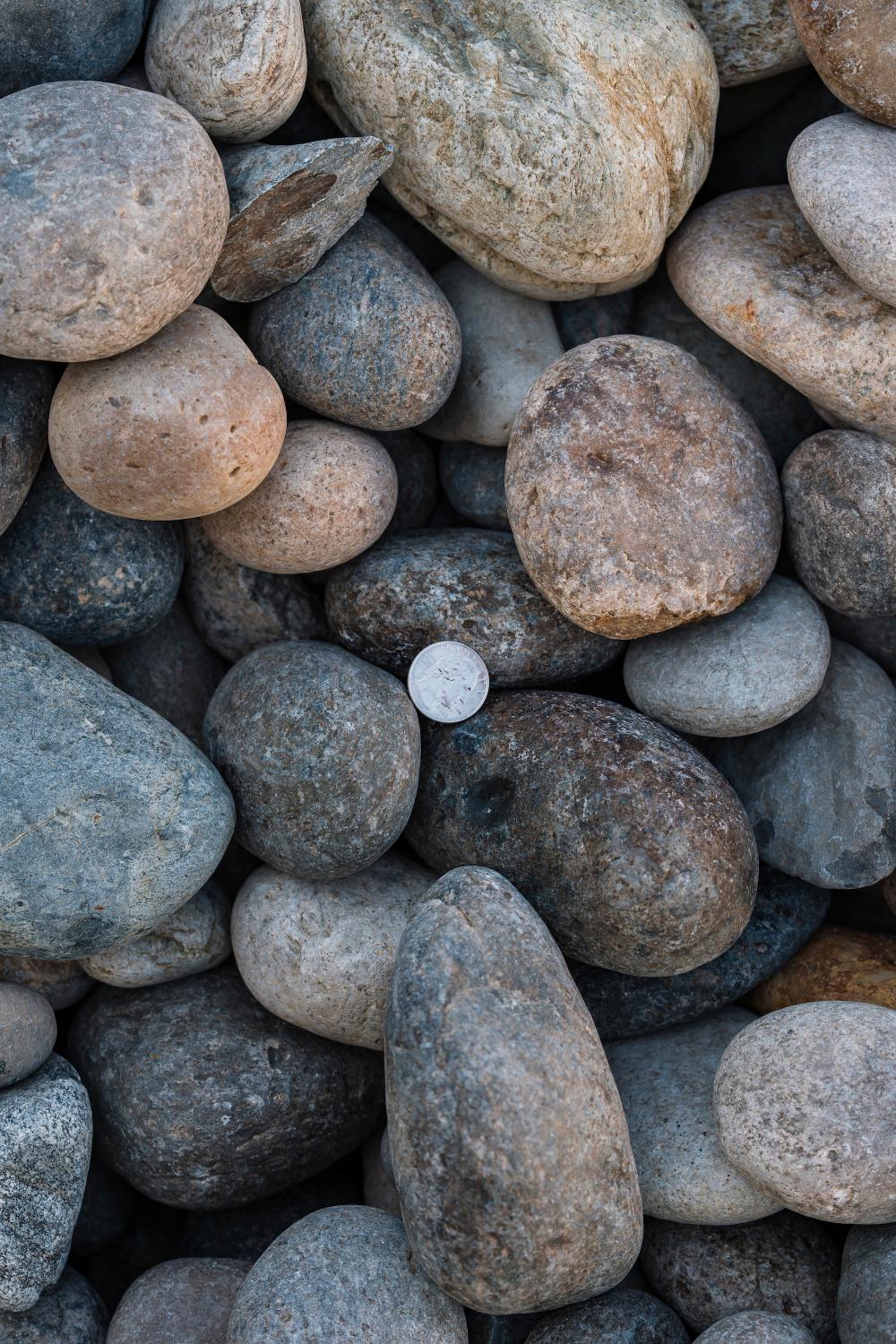
4"-8" Noiyo River Cobble
60 sqft per ton @ 2″ Depth
Closed
Hours:
Mon-Sat: 6:30 AM - 4:00 PM
Sunday: Closed
Why 4"-8" Noiyo River Cobble? Use Cases and Performance
4"-8" Noiyo River Cobble is the large end of the cobble lineup at our Fresno yard, a rounded river cobble sized from about four inches up to eight inches across. It is a natural, water-tumbled stone, not a crushed or manufactured product, so every piece has the smooth, worn shape you get from a stone that has spent time moving in a river channel. That shape is the whole story with this material. Rounded cobble sits differently than angular rock, reads differently in a landscape bed, and gets used for a different set of jobs than the crushed aggregates sitting next to it in the yard.
At this size, the cobble stops being a ground cover in the way smaller decorative rock is and becomes more of a landscape feature in its own right. A single 6" cobble has real visual weight and real physical weight, and both matter when you are planning a project. You are not spreading this material thin over a bed the way you would with a 3/8" or 3/4" product. You are placing individual pieces, or a shallow layer of them, to do a specific job: line a dry creek bed, armor a slope, ring a drainage structure, or build a natural-looking border.
Where 4"-8" Noiyo River Cobble is the right call
- Dry creek beds and seasonal drainage channels look most convincing with a mix of larger cobble at the banks and edges, transitioning down to smaller rock in the channel itself. This size does the bank and edge work.
- Slope stabilization and erosion control on drainage swales, hillside cuts, and the outlets of downspouts and drain lines, where a larger, heavier stone resists being moved by concentrated flow the way smaller rock will not.
- Accent boulders and focal points in a bed, at a property entrance, or flanking a walkway, where a handful of large cobbles placed intentionally reads as natural stone rather than as spread gravel.
- Water feature and pond edging, where large rounded stone hides pond liner and pump equipment while looking like it belongs there.
- Border and edge definition between a lawn and a bed, or along a fence line, using the cobble as a durable, low-maintenance edge that does not need trimming.
- Gabion baskets and retaining structures where a large, uniform rounded stone fills the cage cleanly.
Where it is not the right call
This is not a material for covering flat ground the way smaller decorative rock is. At four to eight inches per piece, a full bed coverage job would take an enormous tonnage and leave large gaps between stones that expose soil and invite weeds. If you want a rock-covered bed with even coverage, 1"-1.5" River Rock or 1"x4" River Rock does that job at a fraction of the tonnage and cost. It also is not a walking surface or a driveway material, the pieces are too large and too irregular underfoot for either. And if you want a smoother-looking, tighter creek bed with less bank-to-bank size variation, the smaller 2"-4" Noiyo River Cobble is often the better companion or substitute for the interior of the channel.
Not sure how much you need?
Because this is a large-format, low-coverage material, ordering by weight for a specific number of pieces or a linear footage of creek bank is usually more useful than a blanket square-footage estimate. Run your project through our material coverage calculators as a starting point, then call 559-233-6603 and we will help you size the order against the actual layout.
Buying it in Fresno
We sell 4"-8" Noiyo River Cobble by the ton out of our yard at 3562 South Elm Avenue in Fresno. You can hand-select and load individual pieces if you have specific placement in mind, or take it by the ton for a larger creek bed or slope job. We can load your truck or trailer, rent you a dump trailer to self-haul, or deliver it by dump truck. Call 559-233-6603 to confirm current pricing and availability, since rock pricing moves with market conditions and we quote it live rather than publishing a number that goes stale.
4"-8" Noiyo River Cobble: Guidance for Your Situation
Pick the description that fits you best. Specs, steps, and pricing questions differ for a weekend project versus a bid or a compliance inspection.
For homeowners and designers
Designing and Placing Large River Cobble
Large cobble is more forgiving than a driveway aggregate in one sense, there is no compaction spec to hit and no base course to build, but it is less forgiving in another sense: placement is visible and permanent-feeling in a way that spread gravel is not. A poorly placed cobble bank looks like a pile of rocks. A well placed one looks like it has always been there. The difference is almost entirely in how you set the pieces, not in the material itself.
Planning a dry creek bed
A convincing dry creek bed uses at least two, ideally three, sizes of stone. The largest cobble, this 4"-8" size, goes at the banks, at bends, and at any point where real water would naturally deposit larger material, such as the outside of a curve or the base of a slope. Smaller rock, such as 2"-4" Noiyo River Cobble or 1"x4" River Rock, fills the channel bed itself. Mixing sizes this way mimics how an actual streambed sorts material by flow energy, and it reads as natural even to people who could not tell you why it looks right.
| Feature | Typical stone size | Placement notes |
|---|---|---|
| Creek bank / edge | 4"-8" cobble | Set individual pieces, partially buried, irregular spacing |
| Creek channel / bed | 1"-4" river rock | Fill between and around the larger bank stones |
| Focal boulders | 6"-8"+ cobble or larger | Place at bends, transitions, or the mouth of the channel |
| Slope armoring | 4"-8" cobble | Set into the slope face, not simply piled on top |
Step-by-step: setting large cobble
- Lay out the shape first, with a hose, spray paint, or stakes, before any rock arrives. Adjust the curve on the ground, it is much easier than moving cobble later.
- Excavate a shallow bed for a creek channel, typically a few inches deep, sloped to drain toward a real outlet, not a dead end that holds water.
- Lay landscape fabric under the channel if weed suppression matters to you, understanding that it will need cutting and patching wherever you set a large stone into the soil rather than on top of the fabric.
- Set the largest cobble first, at banks and focal points, partially burying each piece so it looks settled rather than dropped. A stone sitting fully on top of the fabric or soil reads as staged.
- Fill in with mid and small size rock around and between the large stones, working from the largest features down to the finest fill.
- Step back and look at it from the angles people will actually see it from, a window, a walkway, the street, and adjust before you consider it finished.
Handling and moving large cobble safely
An 8" river cobble is heavy, often well over the weight most people can comfortably lift alone repeatedly. Use a wheelbarrow or hand truck for moving quantities, and for larger accent boulders, ask about pickup with a pallet or bucket at the yard rather than hand-loading loose into a car trunk. Wear gloves and closed shoes. Bring a friend for anything you cannot lift with a straight back and bent knees.
What DIY projects typically cost
Cobble is priced by the ton, and pricing moves with market conditions, so call 559-233-6603 for a current number. Because coverage per ton is low at this size compared to smaller decorative rock, budget more per square foot of visual impact than you would for a bark or small gravel bed, and plan on delivery or a trailer rental for anything beyond a few hand-loaded pieces.
The single most common DIY mistake
Ordering enough rock to cover the ground like gravel. Large cobble is meant to be placed as individual features with soil, mulch, or smaller rock showing between and around pieces, not spread edge to edge. Order for the layout you actually plan to build, not for blanket coverage.
Maintenance
- Weeds: soil and windblown debris settle into gaps between stones over time. Pull them by hand or spot-treat, a pre-emergent helps in open areas but is less practical between tightly placed stones.
- Leaf litter: a leaf blower works fine around large cobble since the stones are far too heavy to move with airflow.
- Settling: expect large stones to settle slightly into soft or clay soil over the first year or two, this is normal and part of why they end up looking natural rather than staged.
- Cleaning: a hose rinse removes dust and mineral buildup; a pressure washer on a low setting works for stubborn algae in shaded, damp spots.
For contractors, landscapers, and drainage installers
Specs, Bulk Ordering, and Job-Site Logistics
Large cobble work for contractors splits into two categories: drainage and erosion control specified by an engineer or civil plan, and decorative or accent placement specified by a landscape designer. Both draw from the same pile in our yard, but the ordering conversation is different. Monday through Saturday, 6:30 AM to 4:00 PM, call 559-233-6603 ahead on anything over a couple of tons so we can have it staged and, if you need selected pieces, set aside.
Working specs
| Property | Working value / behavior |
|---|---|
| Nominal size | 4" to 8", rounded river cobble |
| Shape | Naturally rounded, water-worn, not crushed or angular |
| Sold by | The ton; loaded at our Fresno yard or delivered |
| Typical use | Dry creek beds, slope and drainage armoring, accent placement, gabion fill, pond edging |
| Placement | Individual or hand-placed for accent work; bulk-dumped and spread for drainage armoring |
| Weight | Heavy relative to volume; plan equipment and manpower accordingly |
| Coverage | Low per ton relative to smaller decorative rock, since pieces are large and gaps are intentional |
Placement for drainage and erosion control
- Confirm the design flow path and outlet before placing any rock. Cobble slows and spreads water; it does not redirect it on its own if the grading is wrong underneath.
- Place larger cobble where velocity is highest, typically at outlets, bends, and the base of slopes, and step down to smaller rock where flow energy drops.
- Set stones into the slope face rather than piling them loosely on top. A loosely piled layer migrates downhill under saturated conditions; an interlocked, partially embedded layer holds.
- Use filter fabric or a properly graded transition layer under armoring on erodible native soil, so fines are not washed out from underneath the cobble over time.
- Inspect after the first significant winter storm and touch up any areas where flow found a path the design did not anticipate.
Job-site logistics and hauling
- Yard pickup: we load trucks and trailers on site at 3562 South Elm Avenue, Fresno, Monday through Saturday 6:30 AM–4:00 PM.
- Delivery: dump truck delivery for bulk tonnage, including staged deliveries on larger drainage or creek bed jobs.
- Self-haul: dump trailer and truck rentals when your own equipment is committed elsewhere. Confirm trailer rating against the tonnage you plan to haul, cobble is dense and fills payload fast.
- Selected pieces: for accent boulders or hand-picked cobble where individual shape and size matter, plan a yard visit rather than a blind delivery order.
- Access: flag tight residential access, overhead lines, or gated entries when you order, especially for larger delivery trucks carrying heavy tonnage.
Bulk and account pricing
We quote bulk and repeat-account pricing directly, since tonnage, haul distance, and load count all move the number, and cobble pricing tracks broader material and fuel costs. Call 559-233-6603 or send us the job details and we will price the material and the freight together. If you run recurring drainage or erosion-control work, ask about standing pricing so you are not re-quoting cobble on every job.
Working with designers and engineers
On landscape architecture plans, large cobble is often called out generically as river rock or river cobble in a size range without a named product. We can help translate a plan spec into what is actually available in the yard, and flag early if a called-out size or quantity does not match what a delivery truck can reasonably carry per load, so it does not surface as a surprise on delivery day.
Contractor accounts
If you buy from us regularly, see our contractor page for how accounts, staged loads, and repeat pricing work.
For landscape designers and water feature installers
Using Large Cobble as a Design and Function Element
In water feature and naturalistic landscape work, this size of cobble is usually the workhorse stone that establishes scale before any planting or smaller rock goes in. It sets the visual anchor points that everything else in the design responds to, so getting the placement of the large pieces right early saves rework on the finer material later.
Pond and water feature edging
Large rounded cobble hides pond liner, skimmer boxes, and plumbing at the waterline while looking like it grew there, which is the whole point since a visible liner edge is the fastest way to make a water feature look artificial. Set the largest pieces at the waterline itself, angled slightly back into the bank so runoff and splash do not pool behind them, then step down in size moving away from the water. A mix of buried and partially exposed stones at varying heights reads more natural than a uniform ring of same-size cobble.
Scale and proportion in design
- Match stone scale to the scale of the space. A large residential backyard water feature or creek bed can carry 6"-8" cobble as the dominant size; a small courtyard bed usually looks better anchored with a few pieces at this size and filled with smaller rock around them.
- Group stones in odd numbers and irregular clusters rather than evenly spaced rows, which is a basic principle borrowed from naturalistic and Japanese-influenced garden design and applies directly to cobble placement.
- Vary the exposed height of each stone. A field of cobble buried to the same depth reads as a paved surface; varying depth reads as a natural deposit.
- Use cobble as a transition material between hardscape and planting beds, softening the edge of a patio, wall, or paver path without a hard line.
Pairing with plantings
Large cobble pairs well with plant material that has some scale and structure of its own, ornamental grasses, larger succulents like agave or yucca, and small specimen trees. It tends to overwhelm delicate, fine-textured plantings unless they are given generous space and their own soil or mulch area rather than being crowded against the stone. For the smaller decorative fill around and between accent boulders, 1"-1.5" River Rock or a fine bark such as walk-on bark keeps the transition from feeling abrupt.
Sourcing for specific placement
For projects where individual stone shape matters, an accent boulder at an entry, a focal stone in a water feature, a visit to the yard to hand-select pieces is worth the trip. For bulk erosion control or creek bed fill where uniformity of size matters more than individual character, ordering by the ton without hand selection is the more efficient and economical path. Tell us up front which kind of job you are ordering for and we will point you to the right approach.
Planning a larger design project
For multi-material jobs combining cobble, smaller river rock, boulders, and bark or mulch, contact us with the design intent and we can help sequence the sourcing and delivery so materials arrive in the order you place them.
How 4"-8" Noiyo River Cobble Compares to the Alternatives
The relevant comparison for large cobble is usually not another decorative rock, it is a decision between stone sizes and between rounded and angular material for a specific job like drainage, edging, or accent placement.
| Material | Shape | Best for | Trade-off vs. 4"-8" cobble |
|---|---|---|---|
| 4"-8" Noiyo River Cobble | Rounded, water-worn, natural | Creek beds, slope armoring, accents, pond edging | N/A |
| 2"-4" Noiyo River Cobble | Rounded, smaller | Creek bed channels, tighter spaces, finer transitions | Less visual weight, lower per-piece cost, less suited to slope armoring |
| 1"x4" River Rock | Rounded, mixed small sizes | Bed coverage, drainage fill, blending zones in a creek bed | Much higher coverage per ton, no use as a standalone accent or armoring stone |
| 1"-1.5" River Rock | Rounded, small | Decorative bed cover, pathways, general ground cover | Not suitable for structural or drainage armoring work |
| 3/4" Crush Granite | Angular, crushed | Driveways, parking, compacted surfaces | Angular shape locks under compaction but does not read as a natural creek stone |
4"-8" vs. 2"-4" Noiyo River Cobble, which one do I need?
Both are the same rounded river cobble, sold at different size ranges, so the choice comes down to scale and function rather than material quality.
| Question | 2"-4" Cobble | 4"-8" Cobble |
|---|---|---|
| Creek bed channel fill? | Yes, common choice | Better at the banks and bends than the channel itself |
| Slope or drainage armoring? | Light-duty only | Yes, better mass and stability |
| Small bed or courtyard scale? | Yes, fits smaller spaces | Can overwhelm a small space |
| Standalone accent stone? | Marginal, often too small to read as a feature | Yes, reads as a real accent stone |
| Coverage per ton? | Higher, more pieces per ton | Lower, fewer, larger pieces per ton |
Rounded cobble vs. crushed rock, when shape matters
Rounded and angular rock solve different problems. Angular rock like 3/4" crush granite interlocks under compaction, which is why it is the right choice for driveways and load-bearing surfaces, but it looks manufactured and feels sharp underfoot, which makes it the wrong choice for a naturalistic creek bed or a barefoot pool surround. Rounded cobble does the opposite: it will not compact into a stable driving surface, but it looks and feels like stone found in nature and is comfortable to walk near or stand on. If a project needs both a stable surface and a natural look, the two are often used together, crushed rock or a paver path through the middle of a bed edged and accented with large river cobble.
Large River Cobble in Central Valley Conditions
River cobble is one of the more stable materials you can put in a Fresno landscape, precisely because it is a dense, solid, naturally weathered stone rather than a manufactured or lightweight product. That said, local conditions still shape how you should plan around it.
Summer heat
Large stone in full Fresno sun heats up and holds that heat longer than smaller rock does, simply because it has more mass to warm through. Keep large cobble features away from spots where bare feet or paws will contact them directly in summer, and be aware that a big cobble field near a patio or window can re-radiate heat into the evening. This is a reason to place cobble as accents and edging rather than as a full-coverage surface in a Fresno yard, in addition to it not being intended for that purpose.
Clay soil and settling
Much of the Fresno-Clovis area sits on clay-heavy soil that expands when wet and shrinks when dry. Large cobble set into this soil, especially for accent placement or creek bank work, will often settle or shift slightly over its first year or two as the soil around it cycles through wet and dry seasons. This is normal and, if anything, helps a placed stone look more settled and natural rather than staged. For structural applications like slope armoring, a properly compacted base or filter layer under the stone matters more than it does for a simple accent boulder.
Winter storms and drainage
Fresno's rain arrives concentrated in a handful of winter storms rather than steady year-round precipitation, which is exactly the condition dry creek beds and drainage armoring are designed for. A dry creek bed sits empty most of the year and does real work during those storm events, moving concentrated roof and yard runoff to a defined outlet instead of letting it cut a new path across the yard. Size the largest cobble for the highest-velocity points, outlets, bends, and the base of slopes, since that is where undersized material gets displaced first.
Wind and dust
At four to eight inches, cobble is far too heavy for wind to move, which is an advantage over lighter decorative rock and bark in open, windy sites common around the Valley's agricultural edges. Dust settling on the stone from nearby fields or dry ground is mostly a cosmetic issue and rinses off with a hose.
Color stability and UV
As a natural stone, river cobble does not fade under UV exposure the way a dyed or pigmented product can. What changes with time is surface appearance rather than the rock's actual color: mineral deposits from sprinkler overspray and dust from dry summer conditions can dull the surface. Adjusting irrigation heads so they are not spraying directly onto cobble and an occasional rinse keeps the natural color and sheen visible.
Local delivery area
We deliver Noiyo River Cobble throughout Fresno, Clovis, Sanger, Selma, Kingsburg, Madera, and the surrounding Central Valley. Call 559-233-6603 to confirm delivery to your address, or rent a trailer and haul it yourself.
4"-8" Noiyo River Cobble: Frequently Asked Questions
Have questions? We've got answers. If you don't see your question below, give us a call at (559) 233-6603.