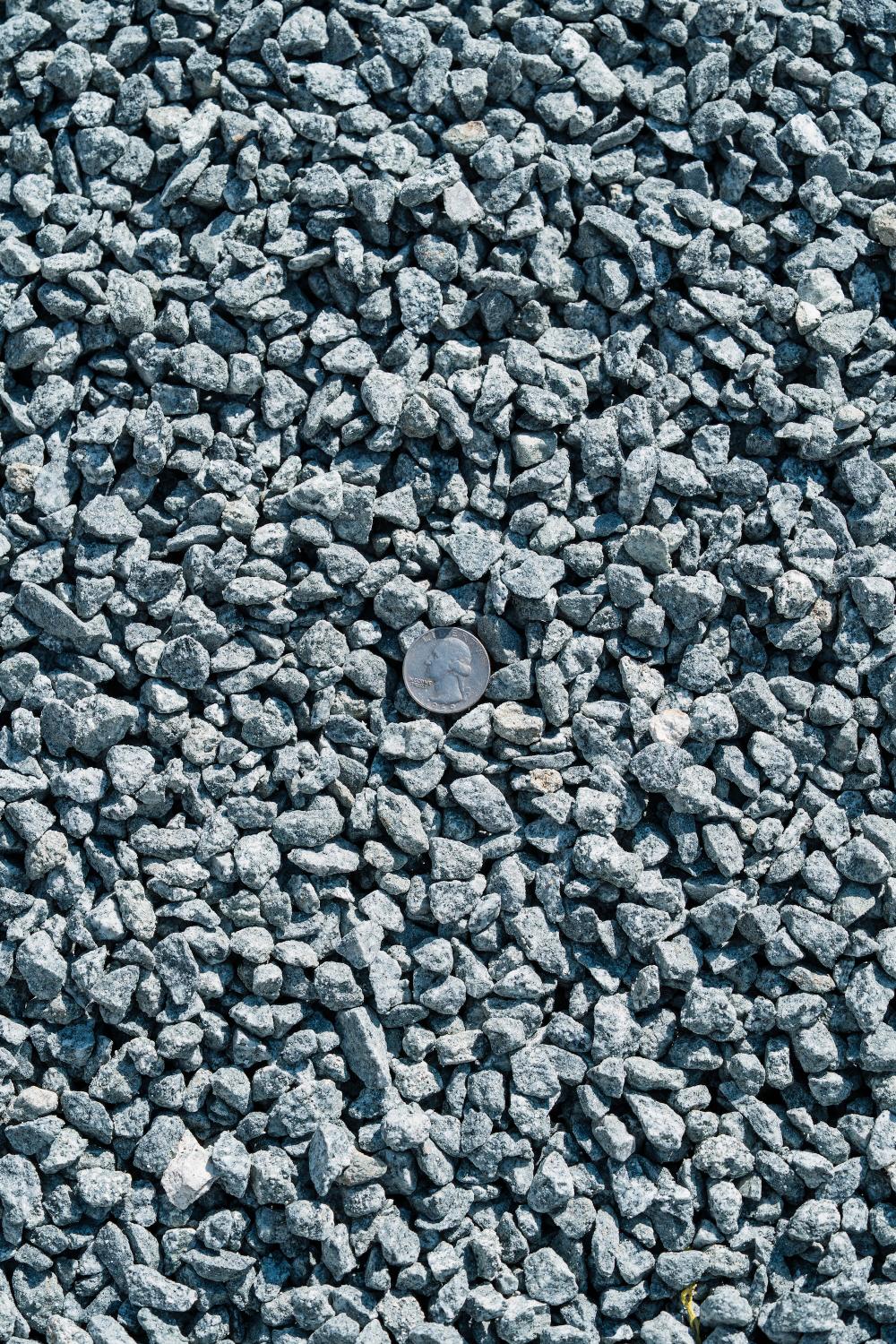
3/8" Crush Granite
90 sqft per ton @ 2″ Depth
Closed
Hours:
Mon-Sat: 6:30 AM - 4:00 PM
Sunday: Closed
Why 3/8" Crush Granite? Use Cases and Performance
3/8" crush granite is the fine cousin of the crushed-rock family in our Fresno yard. It is the same hard, angular granite mineral base as the coarser sizes, screened down to a nominal three-eighths-inch particle. That small size change moves it out of driveway-and-parking-lot territory and into a completely different set of jobs: garden paths, patio joints, tree wells, dog runs, and any spot where someone is going to walk on the surface barefoot or in socks and not want to feel gravel through their shoes.
The physical behavior is worth understanding before you order. Granite stays hard and angular at any size, so 3/8" crush still locks together and resists rutting far better than a rounded pea gravel of the same size. What changes with the smaller particle is compaction character and comfort underfoot. A finer angular material packs tighter, sheds fewer voids, and reads as a smoother, more even surface to a bare foot or a rolling suitcase wheel than 3/4" material does. That is the whole reason this product exists alongside its coarser sibling rather than replacing it.
Where 3/8" crush granite is the right call
- Garden paths and walkways where people move on foot regularly and want a firm, even surface rather than a coarse, chunky one.
- Jointing and leveling material between flagstone, natural stone steppers, and irregular pavers, since the fine particle fills gaps a 3/4" product cannot.
- Decomposed-granite-style patios and seating areas, where a compacted fine aggregate reads almost like a hardscape surface once it is set and watered in.
- Dog runs and pet areas that need better drainage and durability than bark but a gentler surface than coarse crushed rock.
- Tree wells, planting rings, and raised bed borders where a tidy, fine top dressing looks intentional against foliage.
- Utility trenching and narrow backfill strips where a coarse product would leave voids around pipe or conduit.
Where it is not the right call
The same fine particle size that makes this product comfortable underfoot makes it the wrong pick for anything carrying real vehicle weight. It compacts into a firm walking surface, but it does not build the load-bearing structure a driveway or parking pad needs. If you are putting cars, trucks, or heavy equipment on the surface, 3/4" Crush Granite is the product built for that job, ideally over a compacted base course. If your goal is a rounded, softer-edged look for a dry creek bed or a decorative accent rather than a compactable walking surface, 3/8" Pea Gravel is the better match, since it is smooth and rolls rather than locking together.
Not sure how much you need?
Plug your square footage and depth into our material coverage calculators before you call. It saves time on the phone and catches the two mistakes people make most often: guessing at depth and forgetting how much a compacted layer settles.
Buying it in Fresno
We sell 3/8" crush granite by the ton out of our yard at 3562 South Elm Avenue in Fresno, Monday through Saturday, 6:30 AM to 4:00 PM. Load it yourself, have us load your truck or trailer, rent a dump trailer to self-haul, or have it delivered and dumped where you need it. Call 559-233-6603 for current pricing. Aggregate cost tracks quarry and fuel pricing, so we quote it live instead of posting a number that goes stale.
3/8" Crush Granite: Guidance for Your Situation
Pick the description that fits you best. Specs, steps, and pricing questions differ for a weekend project versus a bid or a compliance inspection.
For homeowners and DIY gardeners
Installing a Path, Patio, or Bed With 3/8" Crush Granite
Most homeowner projects with this material fall into one of three shapes: a walking path, a jointing material for stone, or a decorative top dressing around plants. Each one wants a slightly different depth and a slightly different prep, and the difference between a path that stays firm and one that ruts into two dirt tracks usually comes down to what is underneath it, not the rock itself.
How deep should I install it?
| Application | Recommended depth | Notes |
|---|---|---|
| Decorative top dressing in beds | 2" | Standard depth for weed suppression and full soil coverage. |
| Garden and walking paths | 2"-3" over compacted base | Deeper on paths that see wheelbarrow or cart traffic. |
| Flagstone or paver joints | Fill to flush | Sweep in dry, then wet down; repeat once it settles. |
| Tree wells and planting rings | 1.5"-2" | Keep it pulled back a few inches from trunks and stems. |
| Dog run surface | 3"-4" over compacted base | A deeper section resists digging and drains faster than a thin layer. |
Step-by-step: a DIY path or patio surface
- Clear and grade. Strip grass and roots down to firm ground, and set a gentle slope so water has somewhere to go instead of pooling on the path.
- Compact the subgrade. A hand tamper works for a narrow path; a rented plate compactor is worth it for anything wider than a couple of feet.
- Set edging. Steel or aluminum landscape edging, brick, or a timber border keeps the fine material from spreading into lawn or beds. Skipping this step is the single biggest reason paths lose their shape within a year.
- Add a base layer for high-traffic paths. A thin compacted layer of 3/4" Minus Grey DG or base rock under the finish layer adds structure on paths that see regular foot or cart traffic.
- Spread the 3/8" crush granite. Rake it out in a 2" to 3" lift and level it by eye or with a screed board across the edging.
- Compact and wet. Run a plate compactor or hand tamper over the surface, then water it lightly so fines settle into the voids and knit the top layer together.
- Let it cure a day before heavy use. The surface firms up noticeably once it dries after the first wetting.
Using it as a jointing and leveling material
For flagstone, irregular pavers, or steppers set on a sand or DG base, 3/8" crush granite works well as the material you sweep into the gaps. Spread it over the finished surface, sweep it into the joints with a stiff broom, mist it with water, and repeat once it settles. The angular particles lock together in the joint instead of washing out the way sand does after a few winter rains.
Design: what 3/8" crush granite looks like in a Fresno yard
The color reads as the same mid-tone speckled gray as our 3/4" granite, just in a finer grain that looks almost sandy from a few feet away. That finer texture is part of the appeal for patios and paths, since it reads more like a finished hardscape surface than a gravel bed.
- Against stone steppers or flagstone, the fine gray granite disappears visually into the joints instead of competing with the stone.
- In a path winding through drought-tolerant plantings such as lavender, rosemary, and ornamental grasses, the finer texture keeps the path from looking like a construction access strip.
- As a top dressing in raised beds and tree rings, it gives a clean, finished edge without the coarse, chunky look of larger rock.
- For a warmer tone in the same fine size, 3/8" Minus California Gold DG is worth comparing side by side before you order.
What DIY installs typically cost
We price this material by the ton and quote it live, so call 559-233-6603 for a current number. Beyond the rock itself, budget for edging, a day's plate compactor rental if you are doing a path or patio, and either a delivery fee or a trailer rental. For a single small path or a few tree wells, most homeowners can haul what they need in a pickup; for a full patio or a longer path, delivery or a rented dump trailer usually works out cheaper than multiple truck trips.
The most common DIY mistake with this material
Skipping edge restraint because the path "isn't that big." Fine crushed granite migrates into adjacent lawn and beds faster than coarse rock does, simply because the particles are smaller and move more easily. Set edging before you spread the rock, not after you notice it creeping.
Maintenance
- Weeds: the material itself does not feed weeds, but windblown dust and organic litter settling into it eventually will. A pre-emergent applied in spring and fall handles most of it.
- Leaf litter: use a leaf blower on a low setting; a high setting will scatter the fine surface layer along with the leaves.
- Top-dressing: with good edging, expect to refresh a path lightly every few years, and a decorative bed even less often.
- Puddling: if water sits on the surface after irrigation, the compacted layer is too dense or the grade is off. Loosening a section and re-grading fixes it faster than adding more rock on top.
For contractors, landscapers, and hardscape crews
Specs, Bulk Ordering, and Job-Site Logistics for 3/8" Crush Granite
This material moves through the yard in smaller, more frequent quantities than our coarser aggregates, since it is usually spec'd for paths, patios, and detail work rather than whole-lot coverage. Monday through Saturday, 6:30 AM to 4:00 PM, and we can have multi-ton orders staged if you call ahead. 559-233-6603 for anything over a few tons.
Working specs
| Property | Working value / behavior |
|---|---|
| Nominal size | 3/8" crushed, angular |
| Sold by | The ton; loaded at our Fresno yard or delivered |
| Fracture | Angular, multiple crushed faces, packs tighter than round products at the same size |
| Typical use | Paths, patios, joints between stone, tree wells, dog runs, narrow backfill |
| Compaction | Compacts well as a walking surface; not a substitute for a base course under vehicle loads |
| Drainage | Free-draining as a clean product, tighter than 3/4" once compacted |
| Coverage | Calculated at 2" depth, see our calculators for takeoffs |
Placement and compaction
- Prep the subgrade. Strip organics and correct soft spots before placing. Local clay subgrade holds moisture and will telegraph through a thin fine-aggregate surface if it is not proofed first.
- Place a base course on high-traffic or commercial paths. A compacted DG or base-rock layer under the finish course reduces long-term settling on paths that see cart or equipment traffic.
- Place in a single 2" to 3" lift for most path and patio work; deeper sections should be built in lifts like any aggregate.
- Compact with moisture. A light water pass ahead of the plate compactor produces a noticeably tighter, more finished surface than compacting bone dry.
- Restrain the edges. Every linear path and patio perimeter should have defined edging. Without it, this material migrates faster than coarser products because the particles are smaller.
Job-site logistics and hauling
- Yard pickup: we load trucks and trailers at 3562 South Elm Avenue, Fresno, Mon-Sat 6:30 AM-4:00 PM.
- Delivery: dump truck delivery for bulk tonnage, including staged drops on larger hardscape jobs.
- Self-haul: dump trailer and truck rentals when your own equipment is committed elsewhere.
- Multi-material orders: 3/8" crush granite alongside DG, sand for setting beds, and base rock on the same delivery run is common on hardscape jobs. Tell us the placement order and we will sequence the loads.
- Access: flag tight side-yard gates or narrow HOA access when you order, since this material often goes to backyard patios and paths that a full-size dump truck cannot reach directly.
Bulk and account pricing
We quote bulk and repeat-account pricing directly rather than publishing rates, since tonnage, haul distance, and load count all move the number. Call 559-233-6603 or send us the job details and we will price material and freight together. If you run recurring hardscape or maintenance work, ask about standing pricing so you are not re-quoting every job.
Where landscapers spec this over the coarser product
The recurring reason crews choose 3/8" over 3/4" granite is client-facing comfort: patios, paths, and pool-adjacent areas where a customer or their guests will be walking in sandals or barefoot. It is also the practical choice for filling irregular joints between flagstone, where a 3/4" particle simply will not settle into a narrow gap. For anything a vehicle will drive on, including HOA parking areas or maintenance access roads, keep spec'ing 3/4" Crush Granite over a proper base instead.
Contractor accounts
If you buy from us regularly, see our contractor page for how accounts, staged loads, and repeat pricing work.
For gardeners, growers, and orchard or nursery operators
Using 3/8" Crush Granite Around Plants, Trees, and Growing Areas
Gardeners and small growers use this material differently than a homeowner building a patio or a contractor pricing a hardscape job. Here the questions are usually about drainage around root zones, keeping mud out of walking rows, and building a surface that holds up to a wheelbarrow and a hose without turning to muck every time it rains.
Tree wells and root zones
A shallow ring of 3/8" crush granite around a tree trunk, pulled back a few inches from the bark, sheds water away from the trunk flare while still letting irrigation reach the root zone through the voids between particles. Keep the layer to 1.5" to 2" here. A thick, packed layer of any rock against a trunk traps moisture against the bark and invites rot and pests, which is a bigger risk than the rock itself.
Walking rows and access paths in growing areas
Between raised beds, in a cutting garden, or through a small orchard, a compacted 2" to 3" layer over a stripped and leveled subgrade turns a muddy walking row into a stable surface you can push a loaded wheelbarrow across in January without sinking. The angular particles lock together under foot traffic in a way that pea gravel and mulch do not, and unlike bark, this material does not need annual replenishing as it breaks down.
Drainage around raised beds and containers
A band of this material around the base of raised beds or large containers keeps splash-back soil off the surrounding surface and gives excess irrigation water somewhere to go besides standing on bare dirt. It is not a substitute for drainage gravel inside a container or bed, where a coarser product or purpose-built drainage layer does that job better.
What to avoid
- Do not till it into planting soil. It is a hardscape and ground-cover material, not a soil amendment, and mixing crushed rock into a bed permanently changes the soil structure in a way that is hard to undo.
- Do not pile it directly against trunks, canes, or stems. Leave a gap so bark and crown tissue can breathe and dry out between waterings.
- Do not use it as a substrate inside pots or planters. For container growing, use potting soil mix instead.
Ordering for a growing operation
If you are laying out walking rows across a larger growing area, call 559-233-6603 with your total linear footage and target depth. We can price a bulk ton quantity and schedule delivery around your planting or harvest calendar rather than making you work around ours.
How 3/8" Crush Granite Compares to the Alternatives
The useful comparison here is not this product against some exotic option. It is this fine crushed granite against the handful of other fine and mid-size aggregates sitting in the same part of the yard, since a customer standing over three gravel piles that all look grayish and small needs to know which one actually does the job they have in mind.
| Material | Feel underfoot | Best for | Trade-off vs. 3/8" crush granite |
|---|---|---|---|
| 3/8" Crush Granite | Firm, angular, compacts tight | Paths, patios, stone joints, tree wells, dog runs | N/A |
| 3/8" Pea Gravel | Loose, smooth, shifts underfoot | Drainage layers, decorative accents, loose ground cover | Rolls and does not lock together, so it migrates more and does not build a firm walking surface |
| 3/8" Minus California Gold DG | Firm, similar to crush granite | Warm-toned paths and patios where color matters more than gray tone | Same performance profile, different color; pick by look rather than function |
| 3/4" Crush Granite | Coarse, chunky | Driveways, parking areas, vehicle traffic, larger decorative coverage | Too coarse to be comfortable barefoot or to fill fine joints; needed wherever vehicles are involved |
| 3/4" Minus Grey DG | Firm once compacted, slightly coarser fines mix | Wider paths and patios needing a bit more structural base | A broader particle range that compacts into a harder surface but reads slightly less refined underfoot |
3/8" vs. 3/4" Crush Granite, which one do I need?
This is the comparison people get wrong most often, since both products are the same stone and look nearly identical in a photo. The size difference decides the job.
| Question | 3/8" Crush Granite | 3/4" Crush Granite |
|---|---|---|
| Comfortable to walk on barefoot? | Yes, finer and firmer underfoot | Passable but chunky |
| Vehicle traffic? | Not on its own | Yes, over a compacted base |
| Joint or leveling material for flagstone or pavers? | Yes | No, too coarse |
| Decorative bed cover? | Yes, finer texture, tidier look | Yes, coarser texture, slightly better weed suppression per particle |
| Slopes and swales? | Washes more readily | Holds better on grade |
3/8" Crush Granite vs. decomposed granite (DG)
Customers sometimes ask for "DG" when what they actually want is a compactable fine aggregate for a path or patio, which is exactly the job this product does. Straight decomposed granite, sold locally as products like 3/4" Minus Grey DG, includes a wider range of particle sizes down to fine dust, which lets it compact into a harder, more sealed surface than a single-screened 3/8" crush. If you want the tightest, most trail-like surface, ask about our minus DG products. If you want a cleaner, more uniform look with slightly better drainage between particles, 3/8" crush granite is the better fit.
3/8" Crush Granite in Central Valley Conditions
How an aggregate performs depends heavily on local soil, heat, and rainfall patterns, and Fresno's conditions are specific enough that generic gravel advice does not always apply. Here is how those conditions affect a fine crushed granite path, patio, or planting surface.
Summer heat and barefoot comfort
Fresno regularly clears 100 degrees for weeks at a stretch in summer, and any rock surface in full sun gets hot enough to be uncomfortable barefoot by midday. A finer, more tightly compacted granite surface holds slightly less trapped heat than a coarse, chunky rock bed with more air gaps, but it is still stone in direct sun. For pool decks, dog runs, and paths that see bare feet in July, plan shade structures, overhead trees, or a shaded route, and expect the surface to need a hose-down before barefoot use on the hottest afternoons.
Clay subgrade and settling
Much of the Fresno-Clovis area sits on soil with a heavy clay fraction that swells when wet and shrinks and cracks when dry. A thin layer of fine aggregate placed directly on unprepared clay will telegraph every seasonal movement in the ground below it, showing up as low spots and hairline gaps at edging over a year or two. Stripping and lightly compacting the subgrade before placing this material, and adding a base course under any path that sees regular traffic, keeps the finish surface from tracking the clay's expansion and contraction.
Winter rain and drainage
Fresno's rain arrives concentrated in a handful of winter storms rather than as steady year-round drizzle, so paths and patios need to shed water quickly rather than absorb a slow trickle. A compacted, angular fine aggregate drains reasonably well as a clean product, but a section that has been packed hard by months of foot traffic can shed water almost like a hardscape surface, which is good for staying dry underfoot but means grading and a drainage path away from structures still matter as much as they would with pavers or concrete.
Tule fog and moisture cycling
Central Valley tule fog keeps ground-level humidity and surface moisture elevated for stretches of winter even without measurable rainfall. That moisture cycling, wet mornings and dry afternoons repeated for weeks, is part of what keeps a well-compacted fine granite surface knitted together through winter, since the periodic dampness helps fines settle rather than loosening. It is also a period when weed seed germination picks up in any dust that has settled on the surface, so a fall pre-emergent application pays off more here than in a drier month.
Irrigation, mineral deposits, and dust
Sprinkler overspray hitting a rock surface regularly leaves behind the mineral content of Valley irrigation water as a light film over time, which is a maintenance issue rather than a structural one. Aim heads so they water plants rather than the path or patio itself. On the dust side, this material's hard, angular structure resists breaking down into fines under foot traffic far better than a soft aggregate would, which matters both for appearance and for keeping loose dust out of a pool or off a patio table.
Local delivery area
We deliver 3/8" crush granite throughout Fresno, Clovis, Sanger, Selma, Kingsburg, Madera, and the surrounding Central Valley. Call 559-233-6603 to confirm delivery to your address, or rent a trailer and haul it yourself.
3/8" Crush Granite: Frequently Asked Questions
Have questions? We've got answers. If you don't see your question below, give us a call at (559) 233-6603.