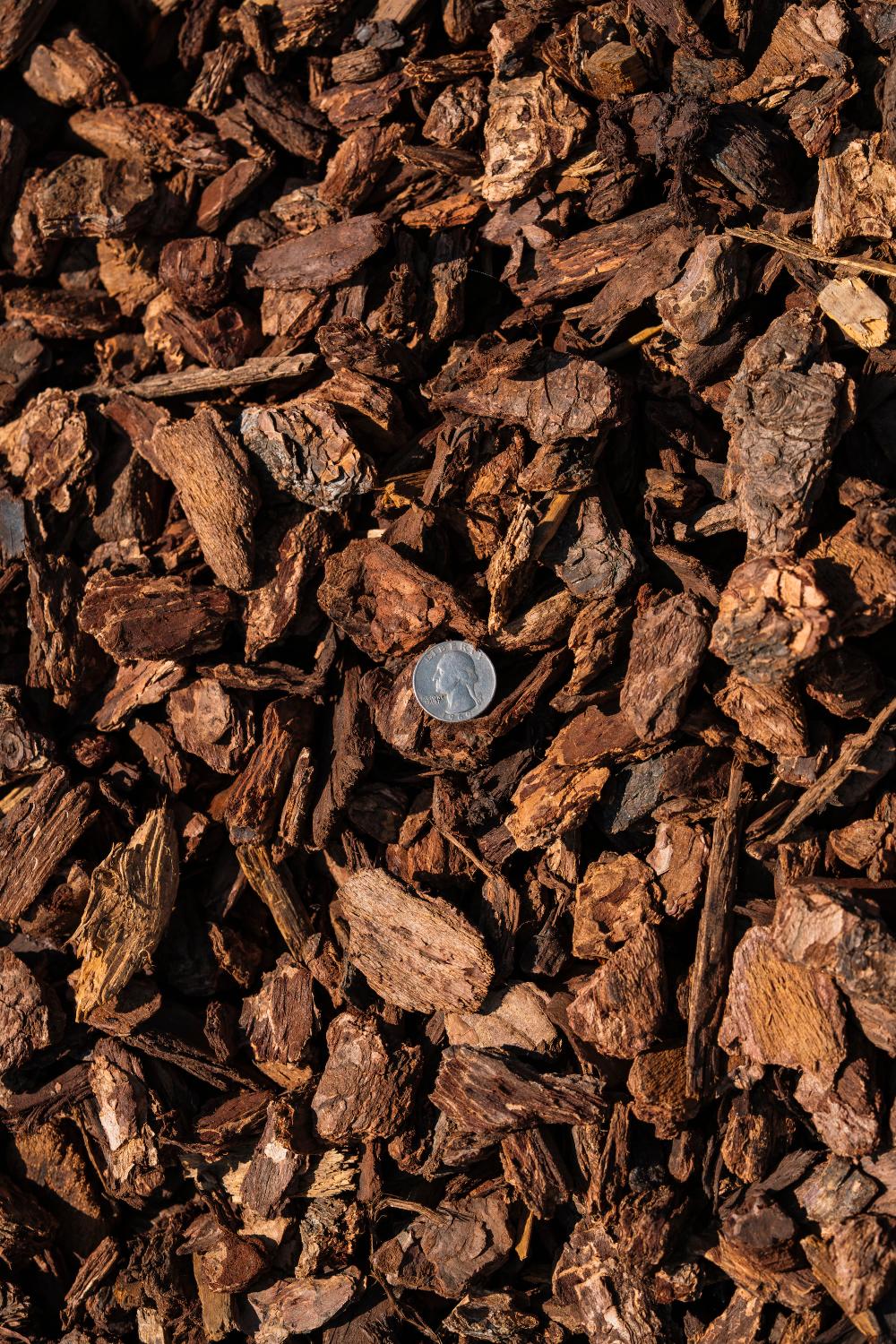
1"-2" Medium Deco Bark
120 sqft per yard @ 2″ Depth
Closed
Hours:
Mon-Sat: 6:30 AM - 4:00 PM
Sunday: Closed
Why 1"-2" Medium Deco Bark? Use Cases and Performance
1"-2" medium deco bark is the mid-size shredded and chipped bark product in our Fresno yard, sitting between the finer walk-on bark and the chunkier large bark products landscapers use for slopes and commercial beds. The medium size is the one most homeowners picture when they say "bark mulch." It is coarse enough to resist blowing around in a Central Valley north wind and staying put through a summer of irrigation cycles, but not so chunky that it looks industrial against a home foundation planting.
Bark mulch does two jobs at once, and both matter more in Fresno than in a mild coastal climate. It shades the soil surface, which cuts evaporation and keeps root zones cooler through a summer that routinely sits above 100 degrees for weeks at a time. It also suppresses weed germination by blocking light from reaching the soil, which matters because bare, irrigated Valley soil in full sun is close to ideal weed habitat. A 2 to 3 inch layer of medium deco bark addresses both problems without the ongoing cost of chemical weed control.
Where 1"-2" medium deco bark is the right call
- Foundation plantings and beds around the house, where a decorative, finished look matters and the bark will be seen up close.
- Shrub and perennial borders, where the bark needs to stay in place around root balls without smothering crowns.
- Tree rings and drip-line mulching, keeping mower and string-trimmer damage away from trunks while retaining soil moisture.
- Slopes and berms with moderate grade, where the coarser size resists washing downhill in a hard winter rain better than fine mulch does.
- Commercial and HOA common-area beds, where a uniform, natural-brown appearance needs to hold its look between maintenance visits.
- New landscape installs, where mulch is the last step that ties new plantings, irrigation lines, and bed edges together visually.
Where it is not the right call
Two situations call for a different product. Play areas and paths that see regular foot traffic are better served by walk-on bark, which is ground finer and packs down into a more comfortable, less shifting surface underfoot. Playground equipment areas specifically should use EWF certified playground bark, which carries a fall-height rating this decorative product does not. If you want a mineral, non-organic ground cover instead of bark, a decorative rock like 3/4" black lava or 3/4" red lava will not break down or need replenishing the way organic bark does.
Coverage math
One cubic yard of 1"-2" medium deco bark covers roughly 120 sq ft at 2" deep, about 108 sq ft at 3", and about 80 sq ft at 4" using the standard yard-to-square-foot conversion. Run your bed dimensions through our calculators to get an exact yardage before you call.
Buying it in Fresno
We sell 1"-2" medium deco bark by the yard out of our yard at 3562 South Elm Avenue in Fresno, Monday through Saturday, 6:30 AM to 4:00 PM. Load it yourself, have us load your truck or trailer, rent a dump trailer to self-haul, or have it delivered by dump truck straight to the bed. Bark is bulky rather than heavy, so most pickups can carry more volume of it than they can of rock or soil, but call 559-233-6603 to confirm current pricing and what will fit in your vehicle before you drive out.
1"-2" Medium Deco Bark: Guidance for Your Situation
Pick the description that fits you best. Specs, steps, and pricing questions differ for a weekend project versus a bid or a compliance inspection.
For homeowners and DIY gardeners
Mulching Your Beds With Medium Deco Bark
Mulching a bed correctly is one of the more forgiving DIY landscape projects. There is no compaction to get wrong and no grade to engineer. The mistakes that do happen come from piling bark too deep, too close to plant stems, or over ground that was never weeded first.
How deep should the layer be?
| Area | Depth | Notes |
|---|---|---|
| Shrub and perennial beds | 2"-3" | The standard depth for weed suppression and moisture retention without smothering shallow roots. |
| Tree rings | 2"-3", pulled back from the trunk | Keep bark several inches off the trunk itself to avoid trapping moisture against the bark. |
| Slopes and berms | 3" | Coarser texture and a slightly deeper layer resist washing in winter rain better than a thin layer. |
| Annual color beds | 1"-2" | Shallower, since these beds get replanted often and a thick layer just gets disturbed. |
| Refresh over existing, settled mulch | 1"-1.5" top-up | Most beds only need a top-up, not a full re-mulch, after the first year. |
Step-by-step: mulching a bed
- Pull existing weeds by the root. Mulch suppresses new weed seeds from germinating, it does not kill what is already established underneath it.
- Water the bed first if the soil is dry. Mulching over bone-dry soil traps that dryness in; a deep watering before you spread bark gets moisture into the root zone where it belongs.
- Edge the bed. A clean edge, whether steel, plastic, or a cut trench edge, keeps bark from migrating into the lawn and keeps the lawn from creeping into the bed.
- Spread bark 2" to 3" deep. Use a rake to level it rather than dumping and leaving mounds, which shed water instead of holding it.
- Keep bark off stems and crowns. Pull it back an inch or two from woody stems and further from the crowns of perennials, since bark piled against a stem holds moisture and invites rot and pests.
- Water it in. A light watering settles the layer and helps it knit together instead of floating during the next irrigation cycle.
Choosing color and texture
Medium deco bark reads as a natural, medium brown that darkens slightly with age and irrigation and lightens again as the surface weathers in the sun. It is a neutral background color that works with most stucco tones and most plant palettes, which is part of why it is the most common bark size sold. If you want a darker, more uniform color for a formal front-yard bed, ask about dyed bark options when you call, since not every load carries a colorant and we will tell you honestly what is in stock rather than guess.
Do not pile bark against the house or trunks
Bark held tight against stucco, wood siding, or tree trunks stays damp longer than bark spread out flat, and damp organic material against those surfaces invites rot, pests, and in some cases termite activity. Leave a few inches of clearance at the foundation and at every trunk.
How much will it cost and how do I get it home?
Bark is priced by the yard and we quote it live, so call 559-233-6603 for current numbers. On logistics, bark is light for its volume compared to rock or soil, so a full-size pickup bed can often carry 2 to 3 yards loose without exceeding a safe payload, but the load will be tall. Tarp it or expect to lose material on the freeway. For anything beyond what fits in one trip, renting a dump trailer or scheduling delivery saves the second trip.
When to refresh it
Organic bark breaks down over time, faster in a Fresno summer than in a cooler climate, since heat accelerates decomposition. Expect a visible fade and some volume loss within a year and a noticeable thinning by year two. Most beds do fine with an annual or every-other-year top-up rather than a full strip-and-replace, unless the old material has compacted into a dense mat, in which case raking it up before adding fresh bark works better than mulching over the mat.
For landscapers, contractors, and property managers
Bulk Bark Ordering, Placement, and Job-Site Logistics
Bark is one of the higher-volume, lower-margin-per-yard products we move, and most of the volume goes out on maintenance accounts refreshing existing beds rather than new installs. The logistics that matter here are staging enough material for a full crew day and keeping bark off hardscape and turf during placement, since cleanup eats labor hours fast.
Ordering and quantities
| Depth placed | Coverage per cubic yard | Typical application |
|---|---|---|
| 1" | ~324 sq ft | Light top-up over existing, settled mulch |
| 2" | ~160 sq ft | Standard maintenance refresh |
| 3" | ~108 sq ft | New bed install, standard depth |
| 4" | ~80 sq ft | Slopes, berms, or areas with heavy weed pressure |
Placement notes that affect callbacks
- Clear the bed first. Weeds, dead annuals, and debris under fresh bark defeat the purpose and generate a callback within a season.
- Keep bark off crowns and stems. Piled bark against a plant crown or a woody stem is one of the most common causes of dieback complaints traced back to a mulch job rather than the plant itself.
- Do not bury irrigation heads and emitters. Spread bark around drip emitters and pop-up heads rather than over them, and check head height against the new mulch depth before you leave the site.
- Watch for bark migration onto hardscape. Wind and irrigation overspray move loose bark onto walkways, patios, and pool decks, which reads as sloppy work even when the bed itself looks fine. Edge and contain accordingly.
- Sequence around irrigation and planting work. Mulch goes down last, after irrigation adjustments and plant installs are finished, not before.
Product selection by scope
| Scope | Specify | Why |
|---|---|---|
| Decorative bed refresh, homeowner-facing | 1"-2" Medium Deco Bark | Finished look, holds color, standard weed suppression |
| Paths and low-traffic walk areas | Walk-on bark | Finer, packs down, more comfortable and stable underfoot |
| Playground equipment fall zones | EWF certified playground bark | Carries a fall-height rating this decorative product does not |
| Soil improvement before mulching | Black humus or red humus | Amend the soil first, mulch goes on top, the two are not substitutes for each other |
| Non-organic, permanent ground cover | 3/4" Black Lava or 3/4" Red Lava | No decomposition, no annual replenishment |
Delivery, staging, and self-haul
- Bulk delivery: dump truck delivery across Fresno, Clovis, and the surrounding Valley, including staged drops for large multi-property maintenance routes.
- Yard loading: we load contractor trucks and trailers at 3562 South Elm Avenue, Monday through Saturday, 6:30 AM to 4:00 PM.
- Self-haul rentals: dump trailers and trucks when your own trucks are already committed on other routes.
- Combined loads: bark plus soil amendment plus rock accents on the same run is common on install jobs. Tell us the placement order and we will sequence the load.
- Route planning: property management and HOA maintenance routes benefit from standing weekly or biweekly pickup arrangements. Ask about scheduling recurring pickups ahead of your route days.
Bulk pricing and accounts
We quote bulk bark and repeat-account pricing directly at 559-233-6603 or through our contact page. Volume, haul distance, and load frequency all affect the number, and bark supply and cost shift seasonally, so we price it live rather than publish a rate that goes stale. For production landscape crews, property management turnovers, and recurring HOA maintenance, ask about standing pricing on our contractor page.
For HOA boards and property managers
Managing Bark Mulch Across Common Areas
Common-area bark is a visible, recurring line item, and the decisions that matter for a property manager are less about installation technique and more about consistency, cycle timing, and controlling the surprise costs that show up when a bed has been neglected too long.
Setting a maintenance cycle
Most Fresno-area common areas need a full or partial bark refresh once a year, timed for either spring, before the growing season and the summer heat accelerate breakdown, or fall, ahead of winter rain. Twice-a-year refreshes are more common on high-visibility entry beds and street-facing frontage where faded, thin mulch is the first thing a resident or prospective buyer notices. Back-of-property beds and side yards can often stretch to every 18 to 24 months without a visible complaint.
Budgeting for bed condition, not just square footage
- Beds that have gone two or more years without a refresh often need weeding and old-mulch removal before new bark goes down, which adds labor cost beyond the material itself.
- Beds with heavy weed pressure benefit from an application of pre-emergent under the fresh bark layer, which extends the interval before the next weeding pass is needed.
- Irrigation head height should be checked and adjusted at every refresh, since heads that were flush with the soil surface can end up buried under a new layer if depth is not managed.
- Standardizing on one bark size and color across a property, rather than letting different vendors mix products bed to bed, keeps the finished look consistent from the street.
Coordinating with landscape crews
The properties that avoid mid-cycle complaint calls are the ones where the bark order, the weeding pass, and the irrigation check happen on the same visit rather than three separate trips spread across a month. If you manage multiple properties on a route, consolidating bark orders into one delivery schedule with your maintenance contractor generally lowers per-yard delivery cost compared to ordering property by property.
Standing orders and route delivery
If you manage several properties or a large common-area footprint, ask about a standing delivery schedule tied to your maintenance route. Call 559-233-6603 or use our contact page to set it up.
1"-2" Medium Deco Bark vs. Other Ground Covers
Bark is one product in a family of ground covers, and the sizing and material choice change both the look and the maintenance schedule. Here is how the medium size compares to the other bark and mineral options in the yard.
| Product | Texture | Best for | Trade-off vs. medium deco bark |
|---|---|---|---|
| 1"-2" Medium Deco Bark | Coarse, natural brown, chunky pieces | General decorative beds, shrub and perennial plantings, slopes | N/A |
| Walk-on Bark | Finer, ground and shredded | Paths, play areas, anywhere with foot traffic | Packs down more comfortably underfoot but has less visual texture in a bed |
| EWF Certified Playground Bark | Fine, engineered wood fiber | Playground equipment fall zones specifically | Carries a fall-height rating this product does not; not a general decorative mulch |
| 3/4" Black Lava | Angular, lightweight volcanic rock | Permanent mineral ground cover, modern design palettes | Never decomposes or needs replenishment, but costs more up front and has no organic soil benefit |
| 3/4" Red Lava | Angular, lightweight volcanic rock | Permanent mineral ground cover with a warm reddish tone | Same trade-offs as black lava with a different color |
| 3/8" Pea Gravel | Small, smooth, rounded stone | Drainage areas, small accent beds | Does not suppress weeds as effectively and offers no organic soil benefit |
Bark vs. rock, which one is right for the bed?
The honest answer depends on what the bed needs. Organic bark like this product breaks down slowly over time, which sounds like a downside, but that breakdown adds a small amount of organic matter back into the soil and moderates soil temperature more effectively than rock does. Rock never needs replenishing and never decomposes, but it also does not improve the soil, it reflects and holds heat more than bark does, which can stress plant roots in a Fresno summer, and it is considerably more expensive per yard to install initially. For active planting beds with shrubs and perennials, bark is generally the better performer. For permanent, low-plant hardscape-style areas, mineral ground cover often makes more sense.
Medium bark vs. bagged mulch from a retail store
For a single small bed, bags are convenient. For anything measured in multiple cubic yards, which is most residential landscapes and every commercial property, bulk bark is dramatically cheaper per unit volume and involves far less handling and packaging waste. The break-even point where bulk becomes cheaper than bags typically arrives well under one full yard, so most projects are better served buying loose bark by the yard from the start.
Medium Deco Bark in Central Valley Conditions
Fresno and Clovis put organic mulch through a harder test than most climates. Summers run long and dry with weeks above 100 degrees, the wet season is short and occasionally intense, tule fog settles in for stretches in winter, and irrigation is doing most of the moisture work most of the year. Each of those conditions changes how bark behaves and how often it needs attention.
Heat and moisture retention
A 2 to 3 inch layer of bark measurably reduces evaporation from the soil surface compared to bare ground, which matters directly on an irrigation bill during a Fresno summer. Shaded, mulched soil also runs cooler at the root zone, which reduces heat stress on shallow-rooted shrubs and perennials during the hottest stretch of the year. The trade-off is that heat also accelerates the decomposition that eventually thins the layer, so a bed that would hold its mulch depth for two years in a mild coastal climate may need a top-up here after one summer.
Clay soil and drainage
Much of the Valley's native soil carries a heavy clay fraction that drains slowly and sheds water rather than absorbing it. Bark on top of clay slows evaporation from the surface but does not change the clay's drainage behavior underneath, so beds that already pond water after irrigation will still pond under mulch. If a bed has a standing-water problem, that is a grading and soil issue to address separately, not something a bark layer fixes on its own.
Wind, dust, and bark migration
Valley wind events move loose material, and finer mulches are more prone to blowing than a coarser 1"-2" product. The medium size resists wind displacement better than fine bark or shredded mulch, which is one reason it holds up well in open, exposed beds along streets and parking areas. It still benefits from edging to keep it contained during the stronger wind days that come through in spring and during dry cold fronts in winter.
Winter rain and tule fog
Fresno's rain is concentrated into a handful of months and can arrive as brief, intense storms rather than steady drizzle. On sloped beds, a properly depth-placed 1"-2" bark holds better against a hard rain event than fine mulch, which tends to slump and wash toward the low point of a slope. Extended tule fog periods in December and January keep beds damp and cool for days at a time, which slows plant activity but generally does not cause problems for the bark itself, since this product does not compact into a dense mat the way fine, wet mulch can.
UV fade and color
Fresno gets a high number of full-sun days, and UV exposure fades bark color over time regardless of the source. A fresh medium brown will noticeably lighten within a single summer season, faster on south and west-facing beds that get the most direct sun. This is a cosmetic change rather than a performance one, the weed suppression and moisture benefits continue after the color fades, but it is the main reason most properties settle into an annual refresh cycle for street-facing beds even when the material underneath is still functionally doing its job.
Frequently Asked Questions
Have questions? We've got answers. If you don't see your question below, give us a call at (559) 233-6603.