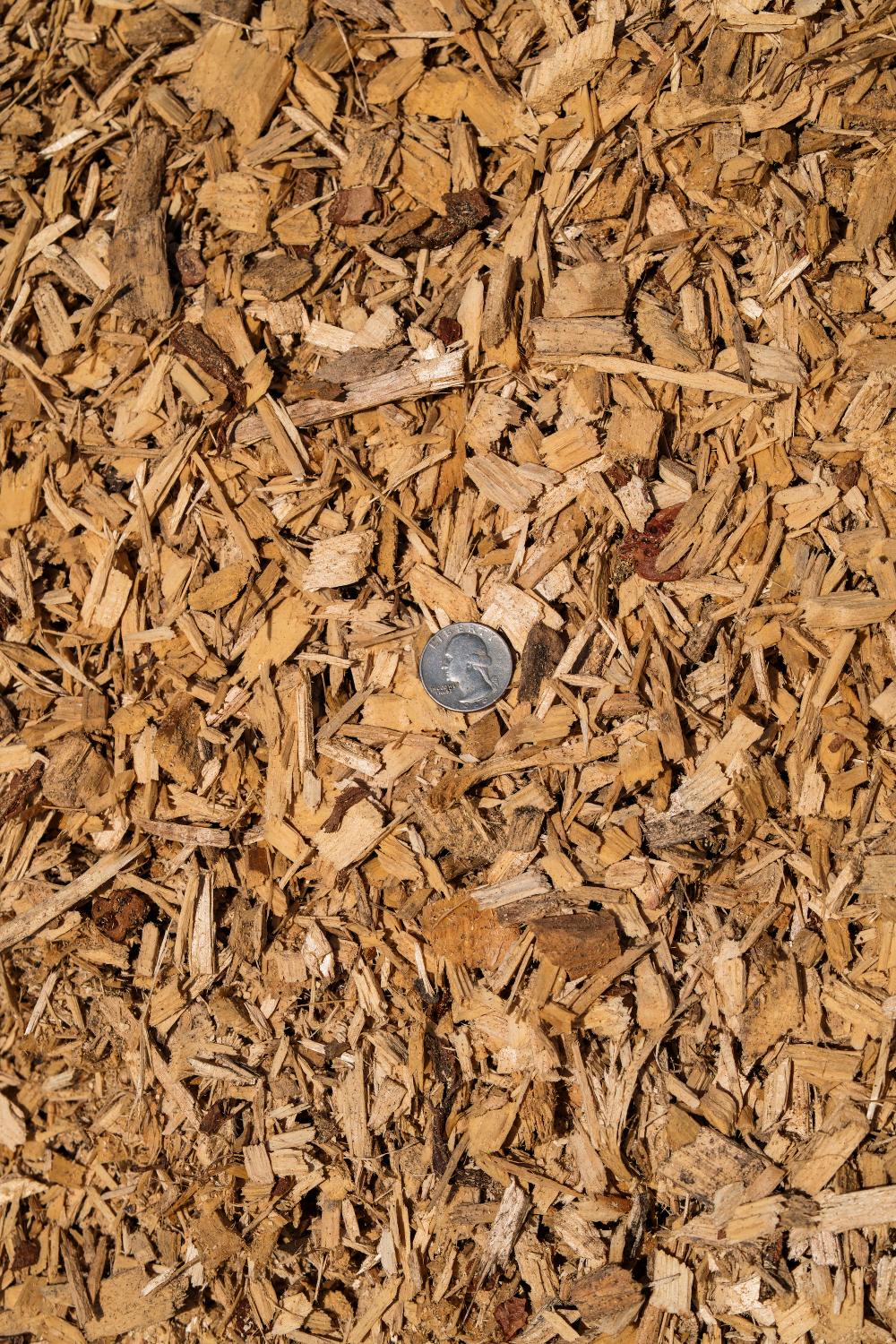
EWF Certified Playground Bark
130 sqft per yard @ 2″ Depth
Closed
Hours:
Mon-Sat: 6:30 AM - 4:00 PM
Sunday: Closed
Why EWF Certified Playground Bark? Use Cases and Performance
EWF stands for engineered wood fiber, and the distinction matters more here than with any other product in our yard. It is not landscape bark that happens to be used on a playground. It is a purpose-manufactured surfacing material, wood fibers processed to a controlled size and shape so that, when installed at the correct depth and maintained, the fibers knit together into a surface that is firm enough to walk and roll across and resilient enough to absorb the impact of a fall from play equipment.
A playground surface has one job that ordinary mulch does not: reducing the severity of head injuries when a child falls off equipment. The industry standard governing that performance is ASTM F1292, which defines impact attenuation testing and the critical fall height a surfacing system provides at a given installed depth. IPEMA operates the third-party certification program most public agencies rely on to verify those claims. Accessibility on public playgrounds is governed separately, under ADA and the associated accessibility standards for play areas, which is where the firm, stable, slip-resistant surface requirement comes from.
About depth and fall-height figures
Critical fall height depends on the specific product, the tested system, and the installed and maintained depth. It is not a number we can quote generically, so we do not publish a depth-to-fall-height table here. If you need certified figures for a bid, a plan check, an insurance file, or a school district submittal, call 559-233-6603 and we will provide the current manufacturer certification documentation for the material we are supplying so your specification matches the material actually installed.
Where this material is used
- Elementary and preschool play structures at school playgrounds, under district and insurer requirements.
- Public parks and municipal play areas, where ASTM F1292 performance and ADA accessibility both apply.
- Childcare centers and preschools with documented surfacing requirements.
- Church and community-center play areas, often the toughest case because there is real liability exposure but no facilities department.
- HOA and apartment-community tot lots, common areas with mixed-age use and periodic inspection.
- Residential backyard play sets, for homeowners who want the surfacing under a swing set to be more than decorative.
Why not just use regular bark?
Ordinary landscape bark is not manufactured, tested, or certified for impact attenuation, and it does not behave the same way underfoot. Decorative barks are made to look good and hold moisture in a planting bed. They tend to be inconsistent in size, they do not knit into a firm, rollable surface, and there is no certification behind any performance claim. For a residential swing set, some families accept that trade-off. For anything a licensing agency, insurer, or plan checker looks at, engineered wood fiber is the product being asked for. If your project is a path, a bed, or general ground cover rather than a play surface, walk-on bark is the right product and it costs less.
Buying it in Fresno
We supply EWF certified playground bark by the yard from our yard at 3562 South Elm Avenue in Fresno, Monday through Saturday, 6:30 AM to 4:00 PM. Bulk delivery is available by dump truck, yard loading, or self-haul with a rented dump trailer. For institutional and district orders, call 559-233-6603 and we can coordinate documentation, staged deliveries, and scheduled top-off quantities alongside the material itself.
EWF Certified Playground Bark: Guidance for Your Situation
Pick the description that fits you best. Specs, steps, and pricing questions differ for a weekend project versus a bid or a compliance inspection.
For schools, parks, childcare, HOAs, and property managers
Certification, Inspection, and Maintenance Documentation
If you are responsible for a play area, your exposure rarely comes from the day the surfacing was installed. It comes from whether the surface was at the correct depth on the day something happened, and whether you can show it. Everything below is organized around that question.
The standards that apply
| Standard / requirement | What it governs | Why it matters to you |
|---|---|---|
| ASTM F1292 | Impact attenuation of playground surfacing systems and the critical fall height provided at a tested depth | This is the performance basis for surfacing under play equipment. Your surfacing has to correspond to the fall height of the tallest designated play surface. |
| ASTM F2075 | Specification for engineered wood fiber used as a playground safety surface | Defines the material itself: particle size, consistency, and contaminant limits. |
| IPEMA certification | Third-party validation of manufacturer conformance claims | Most public agencies and insurers want third-party certification rather than a vendor's own assertion. |
| ADA / accessibility standards for play areas | Accessible routes to and within the play area; firm, stable, slip-resistant surfaces | Engineered wood fiber can meet accessibility requirements when installed and maintained properly. Maintenance is part of compliance, not separate from it. |
| CPSC Public Playground Safety Handbook | Non-regulatory but widely referenced guidance on use zones, equipment, and surfacing | Frequently cited by inspectors and in litigation as the reference for reasonable practice. |
Getting documentation for your file
Call 559-233-6603 before you order if the project requires documentation. We can provide the current manufacturer certification information for the material we supply, along with delivery records showing quantity and date. Combined with your own inspection log, that is what a well-kept compliance file looks like. We will not hand you generic figures pulled from a table that does not correspond to the material in your play area. That kind of document fails an audit at exactly the wrong moment.
Depth is the whole compliance story
Engineered wood fiber's protective performance is a function of installed depth. Depth is not static: fibers compress under use, displace out of high-traffic zones, and reduce over time. Slide exits, swing under-zones, and the base of climbing structures lose depth fastest, often dramatically faster than the rest of the area. A play area that is at full depth on average can be well under it in exactly the two spots where children land hardest. This is why depth-marker gauges on posts within the use zone are worth installing, and why raking is a real maintenance activity rather than a cosmetic one.
Inspection checklist
| Frequency | Task |
|---|---|
| Daily / high-use days | Visual check of high-wear zones (slide exits, swing under-zones, climber bases). Rake material back into displaced areas. Remove foreign objects and debris. |
| Weekly | Walk the full use zone. Check depth against markers at multiple points, not just the middle. Look for compaction, matting, and drainage issues. |
| Monthly | Documented depth measurements across the use zone. Check equipment footings and border containment. Note any area trending low and schedule a top-off. |
| Quarterly / seasonal | Loosen compacted areas. Assess overall material condition and decomposition. Order top-off material. Inspect drainage and sub-base performance after the wet season. |
| Annually | Full inspection, ideally by a certified playground safety inspector. Refresh material to full specified depth. Update the compliance file with dates, quantities, and findings. |
Keeping a defensible record
- Log the date, the measured depth, and the location measured, not just "inspected, OK."
- Keep delivery receipts and material documentation together with the inspection log, not in a separate accounting file.
- Record corrective actions and the date completed, not only the deficiency found.
- Photograph the play area at each documented inspection; dated photos are persuasive evidence of routine maintenance.
- Retain records for at least the period your insurer or district policy requires, and if no one has specified one, ask.
Budgeting top-off material
Engineered wood fiber is a consumable, and the most common budgeting mistake is treating it as a one-time capital purchase. Plan for scheduled replenishment: high-traffic school playgrounds typically need annual top-off, sometimes more often in the heavy-wear zones, while lightly used community and HOA areas can go longer. The material also decomposes gradually, faster where irrigation overspray keeps it damp. A recurring maintenance line item is far cheaper than the alternative: an emergency purchase after an incident or a failed inspection. Call 559-233-6603 and we can help you estimate annual volume from your play area size and usage level, and set up scheduled deliveries.
Drainage and the sub-base
Engineered wood fiber over a poorly drained sub-base stays wet, compacts, mats, and decomposes faster. A saturated, matted surface does not perform the way the tested system does. A properly built play area has a free-draining sub-base beneath the fiber, containment around the perimeter, and a route for water to leave. On new construction or a rebuild, this is the layer worth getting right, because it determines how often you are replacing material for the next decade. We can supply the drainage aggregate and base rock for that section on the same order.
For families with a backyard play set
Putting Safe Surfacing Under a Backyard Swing Set
Nobody is going to inspect your backyard or ask for documentation. But you still have a real question: what should be under the swing set so that a fall is a scraped knee rather than an emergency-room trip? Engineered wood fiber is the answer public playgrounds landed on, and it is available to you by the yard at the same yard your neighbor buys their bark from.
What to put down, and how deep
Depth is what does the work. Deeper is meaningfully better, and the specific depth appropriate for your equipment depends on how high the highest place a child can stand or sit actually is. Call 559-233-6603 and tell us the height of your play structure's highest platform or swing seat and the footprint you want to cover. We will help you size the order against the manufacturer's documentation for the material rather than a rule of thumb from the internet. Two things hold regardless of the number: a thin decorative layer is not surfacing, and the area you cover needs to extend well beyond the equipment itself, because kids do not fall straight down. Swings especially need generous clearance in front and behind.
Installing it yourself
- Mark out the full use zone, not just the footprint of the equipment. Extend well past the structure on all sides, and considerably further in the swing travel direction.
- Strip the grass and excavate. You want the finished surface roughly level with the surrounding grade, which means digging down rather than building a mound that erodes and spills.
- Solve drainage first. If the spot puddles now, it will hold water under the fiber and the material will rot from the bottom. A layer of drainage aggregate under the fiber, and a grade that lets water leave, is the fix.
- Install a border, such as landscape timbers, composite playground borders, or a concrete curb. Without containment, the material walks out of the area and you top it off constantly.
- Consider a geotextile fabric between the sub-base and the fiber. It keeps material from working down into the soil and slows weed growth without blocking drainage.
- Spread the fiber to full depth, then rake it level. Do not compact it; the loose structure is what absorbs impact.
- Mark your depth. A line or notch on a post at the correct depth turns an annual guessing game into a five-second check.
Keeping it up
- Rake it monthly during heavy-use season. Material migrates out from under swings and away from slide exits, exactly where you need it.
- Check depth seasonally against your marker, especially in those two zones.
- Top off annually in most backyards. Fiber compresses and slowly breaks down; this is a consumable, not a permanent install.
- Keep sprinklers off it. Constant moisture accelerates decomposition and encourages matting. Adjust heads so overspray does not land in the play area.
- Pull weeds by hand rather than spraying an area where children play with their hands.
- Clear leaves and debris, which mat and hold moisture on top of the surface.
How much will I need and what does it cost?
The math is your area in square feet times the depth in feet, divided by 27, to get cubic yards. Our calculators will do it for you. A typical backyard play zone at a real safety depth is a few yards, which is more than most people expect and more than fits in a pickup. Material is priced by the yard and quoted live at 559-233-6603. For delivery, dump truck delivery or a rented dump trailer both work, and the trailer is usually the cheaper choice for a small residential order.
Playground bark vs. regular bark for a backyard
If the area is genuinely under play equipment, use the engineered product. If you also want bark on the paths, beds, or the rest of the yard, walk-on bark is the right and cheaper choice for those areas. Plenty of families order both on the same delivery.
For playground installers, landscape contractors, and site crews
Specification, Section Build, and Bulk Logistics
Playground surfacing is one of the few landscape scopes where the spec, not the finish, gets reviewed. An installation that looks perfect can still fail a plan check if the documentation does not line up with the material on site.
Specifying it correctly
- Confirm the governing fall height from the equipment manufacturer's documentation for the tallest designated play surface, before you price surfacing.
- Match the material's certified performance to that fall height, at a specified installed depth, using current documentation for the product actually being supplied. Call us at 559-233-6603 for that documentation rather than carrying figures forward from a previous job.
- Specify installed depth after settlement, and account for initial compression in your quantity takeoff.
- Include the sub-base and drainage in the scope. A surfacing system that sits in water does not perform and does not last.
- Include containment. Border and perimeter restraint is part of the system, not an accessory.
- Confirm accessible route requirements where the play area is public. Accessibility governs the route into and through the area, not only the surfacing itself.
Typical section, bottom to top
| Layer | Purpose | Product |
|---|---|---|
| Prepared subgrade | Stable, graded to drain | Native, proof-rolled and graded |
| Drainage course | Prevents saturation of the fiber layer | Pea gravel or drainage aggregate |
| Separation fabric | Keeps fiber out of the aggregate and soil | Geotextile |
| Engineered wood fiber | Impact attenuation and accessible surface | EWF certified playground bark |
| Perimeter containment | Holds material in the use zone | Timber, composite border, or concrete curb |
Installation notes
- Do not compact the fiber layer. It is not a base course. Rake to depth and let use consolidate it naturally; account for that consolidation in your takeoff instead of vibrating it in.
- Place uniformly across the full use zone, including the far reaches of swing travel where crews commonly run thin.
- Check depth at multiple points before demobilizing, not just where the truck dumped.
- Protect the finished area from site traffic. Wheelbarrow and equipment ruts through fresh fiber create low spots that show up on the first inspection.
- Leave the owner depth markers and a short written maintenance note. It costs you nothing and it is the difference between an owner who maintains the surface and one who calls you in two years complaining the product failed.
Ordering, delivery, and staging
- Bulk delivery by dump truck delivery across Fresno, Clovis, and the surrounding Valley, including multi-load staged drops on larger park and school projects.
- Yard pickup: we load trucks and trailers at 3562 South Elm Avenue, Mon-Sat 6:30 AM-4:00 PM.
- Self-haul with dump trailer and truck rentals for smaller installs and top-off runs.
- Combined orders of drainage aggregate, base rock, and fiber on a sequenced delivery so you are not double-handling material on a tight site.
- School and district schedules: summer break and holiday windows compress everything into a few weeks. Book material well ahead of your installation window.
- Documentation: request certification documentation at the time of order so it arrives with the material and goes straight into the submittal package.
Bulk pricing and maintenance contracts
We quote bulk playground fiber and repeat-account pricing directly at 559-233-6603 or through our contact page. If you hold maintenance contracts on multiple play areas, ask about standing pricing and scheduled top-off deliveries. Surfacing replenishment is predictable annual volume, and pricing it as a program rather than a series of one-off orders benefits both of us. Our contractor page covers how accounts work.
How Engineered Wood Fiber Compares to Other Playground Surfaces
Playground surfacing comes down to a trade between installed cost, maintenance burden, accessibility, and how it feels to fall on. The right answer depends on your budget, your usage level, and who has to maintain it.
| Surface | Installed cost | Maintenance | Accessibility | Notes |
|---|---|---|---|---|
| Engineered wood fiber (this product) | Low | Ongoing, raking and annual top-off | Can meet requirements when properly installed and maintained | The default for public playgrounds because it balances cost and performance; maintenance is the price of admission. |
| Loose-fill rubber mulch | Moderate | Displacement, no decomposition | Generally poorer than a well-maintained fiber surface | Does not break down, but migrates and can get very hot in full sun. |
| Poured-in-place rubber | High | Low, but repairs are specialized | Excellent | The premium option; budget-limited for most schools and HOAs. |
| Rubber tiles | High | Low; individual tiles replaceable | Excellent | Modular and repairable, but seams and edges need attention. |
| Sand | Very low | High, contamination and compaction | Poor | Cheap and traditional; attracts animals and packs hard when wet. |
| Pea gravel | Low | Moderate | Poor | Not appropriate for young children; choking and displacement concerns. |
| Grass or bare soil | Lowest | Low | Poor once worn | Not a safety surface. Compacted worn soil under a swing offers essentially no impact attenuation. |
EWF vs. regular landscape bark
| EWF certified playground bark | [Walk-on bark](/materials/product/walk-on-bark) | |
|---|---|---|
| Purpose | Impact-attenuating play surface | Paths, beds, general ground cover |
| Certification | Manufactured and certified against playground surfacing standards | None, it is a landscape product |
| Particle consistency | Controlled, engineered to knit into a surface | Variable |
| Surface behavior | Firm and rollable when maintained at depth | Loose, softer, shifts underfoot |
| Right for a school or public playground | Yes | No |
| Right for a backyard path or planting bed | Overkill and more expensive | Yes |
Use the engineered product everywhere a child could fall from equipment, and use ordinary bark for everything else. Buying playground fiber for your planting beds wastes money. Using landscape bark under a school play structure takes a risk no cost saving justifies.
Playground Surfacing in Central Valley Conditions
Fresno's climate affects a wood-fiber play surface in ways a maintenance schedule written for a mild, wet region will not anticipate. Extreme summer heat, very low summer humidity, concentrated winter rain, and heavy irrigation use all change how the material behaves over a year.
Heat, and why fiber beats rubber here
Surface temperature is a genuine safety issue on Valley playgrounds in July and August. Dark synthetic surfaces in full sun can reach temperatures that burn small hands and bare feet, which is one of the strongest practical arguments for wood fiber in this climate: a light-colored organic surface simply does not reach the temperatures a black rubber surface does. It is not a substitute for shade. The most effective heat measure on any Central Valley play area remains shade structures or mature trees over the equipment, which also slows UV degradation of the equipment itself.
Dryness, dust, and fines
Fresno summers are extremely dry, and dry wood fiber under heavy use generates fines and dust and becomes more prone to displacement. A light watering before periods of heavy use knocks the dust down and helps the fibers knit, a practice many local schools adopt informally. Persistent moisture from irrigation overspray accelerates decomposition, while occasional intentional wetting during the driest, dustiest stretch helps. Keep sprinklers out of the play area; use a hose when you need it.
Winter rain and drainage
The Valley's rain arrives in a handful of concentrated events, so the design case is a short, heavy volume rather than steady wet. A play area with an under-drained sub-base handles that and dries out quickly. One built directly on unamended clay holds water, and the fiber sitting in it mats, compacts, and rots from the bottom up. Given the local clay profile, the drainage layer under the fiber is not an optional line item here. It is the difference between replacing material every few years and replacing it constantly.
Annual maintenance rhythm for a Fresno play area
| Season | Focus |
|---|---|
| Late summer / early fall | Assess post-summer wear, loosen compacted zones, order top-off before the school year hits full usage. |
| Fall | Top off to full depth ahead of the wet season. Verify drainage paths are clear before the first storms. |
| Winter | Watch for standing water and matting after storms. Rake out matted areas once they dry. |
| Spring | Full depth check, loosen compaction, refresh high-wear zones ahead of peak outdoor use. |
| Summer | Dust control on heavy-use days, frequent raking of slide and swing zones, watch surface temperature and shade. |
Local supply and top-off scheduling
We supply schools, parks, childcare facilities, churches, and HOAs across Fresno, Clovis, Sanger, Selma, Kingsburg, Madera, and the surrounding Valley. Local demand concentrates into summer break and the pre-school-year window, so scheduling your top-off in advance is worth doing. Call 559-233-6603 to set up a delivery date rather than competing for the same two weeks everyone else needs. We can also quote the drainage aggregate and border material on the same order if you are rebuilding rather than replenishing.
EWF Certified Playground Bark: Frequently Asked Questions
Have questions? We've got answers. If you don't see your question below, give us a call at (559) 233-6603.