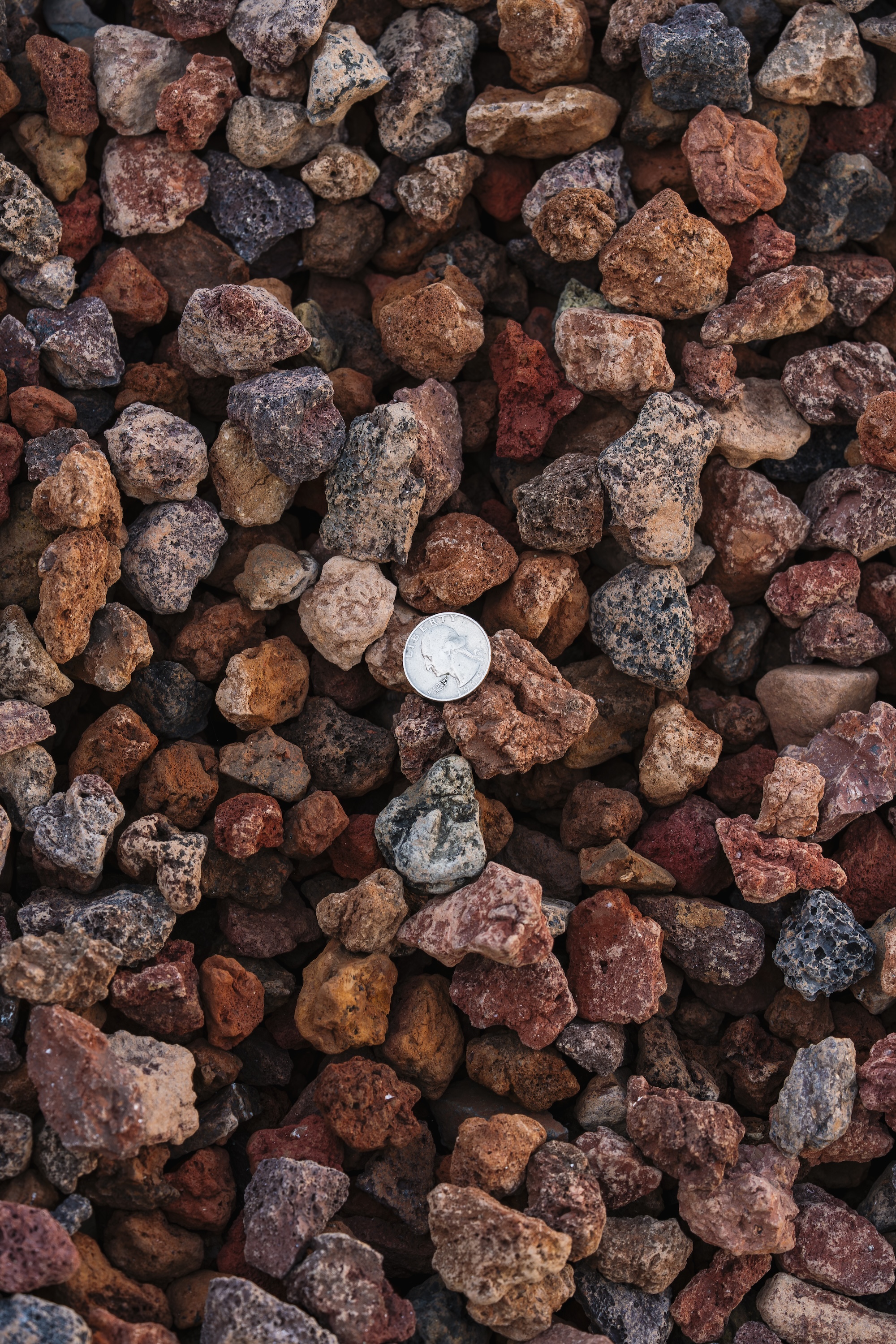
3/4" Red Lava
150 sqft per Yard @ 2″ Depth
Closed
Hours:
Mon-Sat: 6:30 AM - 4:00 PM
Sunday: Closed
Why 3/4" Red Lava? Use Cases and Performance
3/4" red lava is a lightweight volcanic rock with a deep rust-red to brick color, sold at our Fresno yard by the yard as a decorative ground cover. It is scoria, a porous, air-cooled volcanic stone, so it is roughly a third the weight of a comparable volume of crushed granite or river rock. That weight difference, along with the color, is what drives most of the decisions people make around it.
The color comes from iron oxide in the parent rock, not a dye or a coating, so it does not wash off or wear through the way a painted or tinted product can. The porous, vesicular surface, full of small air pockets from when the rock cooled, is what makes it light. That same texture also means it drains water instantly and does not compact into a firm surface the way angular granite or base rock does. Red lava is a top-dress material, not a structural one.
Where 3/4" red lava is the right call
- Decorative ground cover in beds and borders where you want strong, warm color rather than a neutral gray or tan tone.
- Around succulents, cactus, and other drought-tolerant plantings that benefit from fast-draining top cover and do not want moisture sitting against the crown.
- Accent bands and color breaks against gray granite, tan bark, or concrete hardscape, used to define zones without adding a wall or edging.
- Raised planters and potted arrangements, where the light weight matters for structural loading or for anything that gets moved.
- Fire-adjacent landscaping and defensible-space beds, since it is mineral rock rather than combustible mulch.
- Low-traffic accent areas around mailboxes, signage, HOA entry monuments, and other small focal beds where color impact matters more than square footage.
Where it is not the right call
Do not use red lava anywhere that carries foot or vehicle traffic. It is soft and porous compared to granite or base rock, so repeated weight crushes the individual pieces into smaller fragments and eventually a reddish grit. It is also a poor choice for driveways, walkways, and dog runs for the same reason, and its light weight means it is easier for wind and irrigation runoff to move than a heavier aggregate. If you need a walkable or drivable surface, look at 3/4" Crush Granite or 3/4" Crush River Rock instead. If you want the volcanic-rock look with less color intensity, 3/4" Black Lava is the same material family in a dark charcoal tone.
Not sure how much you need?
Run your square footage and depth through our material coverage calculators before you call. Lava rock is sold by the yard, and because it is lightweight, a yard covers more ground than the same volume of granite or river rock at the same depth.
Buying it in Fresno
We sell 3/4" red lava by the yard out of our yard at 3562 South Elm Avenue in Fresno, Monday through Saturday, 6:30 AM to 4:00 PM. You can load it yourself, we can load your truck or trailer, we can rent you a dump trailer to self-haul, or we can deliver and dump it where you want it. Call 559-233-6603 to confirm current pricing and availability, since aggregate pricing is quoted live rather than published.
3/4" Red Lava: Guidance for Your Situation
Pick the description that fits you best. Specs, steps, and pricing questions differ for a weekend project versus a bid or a compliance inspection.
For homeowners and designers
Installing and Designing With Red Lava Rock
Red lava is one of the easier decorative rocks to install yourself because it is light, but that same lightness means the prep work matters more than it does for a heavier product. Skipping edging or landscape fabric is the single most common reason a red lava bed looks great on install day and scattered six months later.
How much depth do I actually need?
| Application | Recommended depth | Notes |
|---|---|---|
| Decorative ground cover in beds | 2" | Standard depth for weed suppression and full soil coverage. |
| Accent bands and borders | 2"-3" | A little extra depth helps hide fabric and soil at the edges. |
| Around succulents and cactus | 2" | Keep rock pulled slightly back from stems and crowns. |
| Raised planters and pots | 1.5"-2" | Lighter loading is one of the reasons people choose lava here. |
| Slopes | 2", with erosion cloth on steep grades | Lava is light and will migrate on a steep, bare slope faster than heavier rock. |
Step-by-step: a DIY red lava bed
- Clear the bed. Remove weeds, grass, and debris down to bare soil. Any organic material left under the rock will decompose and settle unevenly.
- Grade lightly for drainage. You want water moving away from the house, not pooling in the bed.
- Lay landscape fabric. This is more important with lava than with heavier rock, since a fabric layer keeps soil from working up between the porous pieces and feeding weeds.
- Set your edging. Steel, aluminum, plastic, or a stone or concrete border keeps lightweight lava contained. Without it, sprinklers, wind, and foot traffic will walk it out of the bed over a season.
- Spread the lava rock. Pour and rake to an even 2" depth. Lava spreads easily by hand or with a wide rake because it is so light.
- Water it in lightly. A light hose-down settles dust and fines without disturbing the layer.
- Keep it off hardscape edges. A slight recess below a walkway or patio edge stops rock from spilling over and being tracked or mowed.
Design: what red lava looks like in a Fresno yard
Red lava reads as a saturated brick-red to rust color, more intense in bright sun than in a photo. It is one of the few high-color options in the yard that is not a painted or dyed product, which matters to people who do not want a color that fades or scuffs through to a gray base underneath.
- Against white or light stucco, red lava gives strong, warm contrast that reads well from the street on entry beds and corner plantings.
- With drought-tolerant plantings such as agave, aloe, yucca, and ornamental grasses, the warm red plays well against silver-green and blue-green foliage.
- As an accent band, a strip of red lava between gray 3/4" Crush Granite and a planting bed creates a clean color break without a hardscape edge.
- Paired with 3/4" Black Lava, red and black lava together create a strong two-tone look for modern or desert-style front yards.
- Around a fire feature, mineral rock like lava is non-combustible ground cover, though keep it back from direct flame contact since prolonged intense heat can crack or discolor the porous stone.
What DIY installs typically cost
Lava is priced by the yard and quoted live, so call 559-233-6603 for a current number. Budget separately for landscape fabric, edging, and either a delivery fee or a trailer rental. Because it is light, one yard goes further than a yard of granite or river rock, which is worth factoring in when you compare per-yard prices between products.
The single most common DIY mistake
Skipping edging because the rock looks like it will stay put. Lava is the lightest rock in the yard, and without contained edges, sprinklers and wind move it onto lawns and walkways faster than any other decorative aggregate we sell.
Maintenance
- Wind and irrigation drift: check sprinkler heads so they are not blasting rock out of the bed, and expect to rake stray pieces back in occasionally near edges.
- Leaf litter: use a leaf blower on the lowest setting, since higher settings will scatter the lava along with the leaves.
- Fines and breakage: lava is softer than granite, so foot traffic or dropped tools will crack pieces over time. Avoid walking or setting heavy pots directly on it.
- Top-dressing: expect to add a light top-dress every two to four years in beds with regular foot traffic or wind exposure, less in sheltered areas.
For contractors, landscapers, and property managers
Specs, Bulk Ordering, and Job-Site Logistics
Red lava moves through the yard mostly on landscape design jobs and HOA color accents rather than bulk grading work, and it is priced and loaded a little differently than heavier aggregate because of its weight. Mon-Sat, 6:30 AM to 4:00 PM, call 559-233-6603 the day before on larger orders so it is staged and ready.
Working specs
| Property | Working value / behavior |
|---|---|
| Nominal size | 3/4" scoria, angular and porous |
| Weight | Significantly lighter per yard than granite, river rock, or base rock |
| Sold by | The yard (bulk); loaded at our Fresno yard or delivered |
| Color source | Natural iron oxide in the parent rock, not dyed or coated |
| Typical use | Decorative ground cover, planter beds, accent color, defensible-space landscaping |
| Compaction | Not a compacting or load-bearing product; top-dress use only |
| Drainage | Highly porous, drains instantly, does not hold surface water |
| Coverage | Calculated per yard at 2" depth, see our calculators for takeoffs |
Placement notes
- Prep the bed. Clear organics and grade for drainage, same as any decorative aggregate.
- Fabric is standard practice. Landscape fabric under lava is close to mandatory on commercial jobs, since without it soil migrates up between the porous pieces faster than with denser rock.
- Contain every edge. Specify steel, concrete, or masonry edging on all sides. Lightweight lava is the aggregate in the yard most likely to generate a callback for migration if edging is skipped or undersized.
- Spread by hand or light equipment. Lava is easy to move with a wheelbarrow and rake and does not need compaction equipment; running a heavy machine over it will crush pieces unnecessarily.
- Protect it during the rest of the job. On active construction sites, place lava beds after other trades are done in the area. It is easy to track, kick, and crush during ongoing work.
Job-site logistics and hauling
- Yard pickup: we load trucks and trailers on site at 3562 South Elm Avenue, Fresno, Mon-Sat 6:30 AM-4:00 PM.
- Delivery: dump truck delivery for bulk quantities, useful when a job needs several yards spread across multiple beds.
- Self-haul: dump trailer and truck rentals work well for lava since the light weight means more volume per trip than a heavier aggregate.
- Multi-material orders: lava plus bark plus a base rock or granite accent on the same delivery is common on design-build jobs. Bundle the order and we will sequence loads to match your placement plan.
- Access: flag tight side-yard gates or narrow HOA entries when ordering, since lava is often placed in smaller accent beds that a full-size dump truck cannot always reach directly.
Bulk and account pricing
We quote bulk and repeat-account pricing directly rather than publishing rates, since aggregate cost moves with quarry and fuel pricing. Call 559-233-6603 or send us the job details and we will price the material and the freight together. If you run repeat design-build or HOA maintenance work that uses lava as a standard accent material, ask about standing pricing so you are not re-quoting every job.
Commercial and HOA applications
Red lava shows up often in HOA entry monuments, model-home landscaping, and commercial accent beds where a property wants strong seasonal color without live plantings that need constant maintenance. The trade-off property managers should plan for up front is that lava needs more frequent top-dressing than granite or heavier rock in high-traffic or high-wind common areas, so budget a maintenance cycle into the contract rather than treating it as a one-time install.
Contractor accounts
If you buy from us regularly, see our contractor page for how accounts, staged loads, and repeat pricing work.
For gardeners, growers, and succulent and cactus enthusiasts
Using Red Lava Around Plants, Pots, and Raised Beds
Beyond its color, red lava has two properties that matter directly to plant health: it drains fast and it holds almost no water itself. That makes it a useful top-dress for plants that rot if moisture sits against the crown, and a poor choice as a soil amendment or a water-retention mulch.
Top-dressing succulents and cactus
A 1 inch to 2 inch layer of red lava around succulents and cactus keeps the crown of the plant dry between waterings, reflects some heat away from the base stem, and suppresses weed germination without holding moisture against the soil the way bark mulch does. Keep a small gap between the rock and the stem itself rather than piling it directly against the plant, since even a fast-draining rock can trap a little moisture right at the point of contact after a heavy watering.
Raised beds and container plantings
Because lava weighs so much less than granite or river rock, it is a common choice for top-dressing raised planters, large container arrangements, and rooftop or balcony gardens where structural load is a real constraint. It also will not settle and compact into the soil surface the way a denser material can, which keeps air exchange at the soil surface more open.
Do not use it as a soil amendment
Lava rock is sometimes suggested online as a mix-in for potting soil to improve drainage. In our experience this is more trouble than it is worth for most home gardeners: the pieces are too coarse to blend evenly through a small container mix, and a true drainage layer at the bottom of a pot does less for a plant than well-drained soil throughout. If you need better-draining potting soil, look at Potting Soil Mix formulated for the purpose, and save the lava for the visible top-dress layer.
Heat and reflected light near tender plants
Red lava is a mid-to-dark colored rock, so it absorbs more solar heat than a light gravel and radiates it back at night and into the surrounding air. That is an advantage for heat-loving succulents and Mediterranean plantings and a disadvantage right up against tender annuals or vegetables that prefer cooler root zones. Keep a buffer of bark mulch or bare soil between a red lava bed and any heat-sensitive planting.
Weed control without chemicals
A 2 inch layer of lava over landscape fabric blocks most weed germination by cutting off light to the soil, the same mechanism as any rock mulch. What lava does not do is suppress weeds that germinate in windblown dirt that settles into the porous surface over time, so an occasional light rinse and a hand-pull of anything that sprouts on top keeps a bed clean without herbicide.
Buying small quantities
If you only need a few bags' worth for pots or a small bed, call 559-233-6603 to ask about scoop or partial-yard pricing rather than assuming you have to buy a full yard.
How 3/4" Red Lava Compares to the Alternatives
Red lava competes mostly with other decorative ground covers rather than with structural aggregate. The right comparison is color, weight, and drainage behavior against the other products people put in a bed for the same purpose.
| Material | Weight | Best for | Trade-off vs. red lava |
|---|---|---|---|
| 3/4" Red Lava | Light, porous volcanic rock | Color accents, succulent and cactus beds, planters, defensible space | N/A |
| 3/4" Black Lava | Light, same family | Dark, modern color accents, desert landscaping | Same lightweight and drainage traits, dark charcoal instead of red, absorbs more heat in full sun |
| 3/4" Crush California Gold | Heavy, angular crushed stone | Warm-toned beds and paths that also see some foot traffic | Heavier and more stable underfoot, but a tan-gold tone rather than red |
| 3/4" Crush Granite | Heavy, angular crushed stone | Driveways, parking, walkable and drivable surfaces | Compacts into a firm surface lava cannot match, but a neutral gray instead of red and no color option |
| 1"-1.5" River Rock | Heavy, rounded stone | Dry creek beds, drainage channels, rounded natural look | Far heavier and more stable in water flow, mixed earth tones rather than solid red |
Red lava vs. black lava, which color do I need?
Both products come from the same type of volcanic stone and behave identically in terms of weight, drainage, and installation. The choice is purely about color and how much heat you want the bed to absorb.
| Question | Red Lava | Black Lava |
|---|---|---|
| Color | Warm brick-red to rust | Dark charcoal to black |
| Heat absorption in full sun | Moderate | Higher, darker surfaces run hotter |
| Best paired stucco tones | White, tan, terracotta | White, gray, modern neutral palettes |
| Weight and drainage | Light, porous, fast-draining | Same |
| Typical use | Accent color, succulent beds | Accent color, modern desert landscaping |
Red lava vs. dyed or painted mulch
Dyed red mulch products exist and cost less up front, but the color is a surface coating on wood chips that fades with UV exposure and washes toward gray as the coating wears through, typically within a year or two in full Fresno sun. Red lava is colored all the way through the mineral, so the color does not fade, and it does not decompose the way wood mulch does. The trade-off is weight and handling: lava is heavier to move by hand than bagged mulch and is a permanent hardscape-style material rather than something you till back into the soil each season.
Red lava vs. heavier crushed rock for a driveway
This comparison comes up when someone likes the color and asks whether they can use lava on a driveway or parking strip. The answer is no. Lava crushes under vehicle weight because it is soft and porous by nature, and it does not compact into a load-bearing surface the way angular granite or base rock does. If color matters more than gray or tan for a drivable surface, 3/4" Crush California Gold is a better middle ground: warmer than granite, structurally sound under vehicle traffic.
Red Lava in Central Valley Conditions
Material behavior is local. Fresno's combination of extreme summer heat, low but concentrated winter rainfall, clay-heavy soil, and periodic strong wind affects a lightweight, porous rock like red lava differently than it affects heavy, dense aggregate. Here is what that means in practice.
Summer heat
Fresno regularly sees surface temperatures well over 100 degrees Fahrenheit in July and August, and any rock in full sun gets hot to the touch. Red lava, being mid-to-dark in tone, absorbs and radiates more heat than a light-colored rock like 3/4" White Rock, though less than solid black lava. Keep it out of areas where bare feet or paws will contact it directly, and give heat-sensitive plants a buffer of shade or mulch rather than placing them right against a large lava bed on a west-facing exposure.
Clay soil and hardpan
Much of the Fresno-Clovis area sits on clay-heavy soil with hardpan layers not far below the surface. Because red lava is a top-dress product rather than a structural fill, it does not interact with subgrade the way base rock or crush granite does, but drainage still matters. If a bed sits over compacted clay or hardpan that does not drain, water can pool under the fabric layer even though the lava itself drains instantly, which eventually rots plant roots and sours the soil. Break up hardpan and improve drainage in the planting area itself before topping it with rock.
Wind and lightweight rock migration
Fresno gets seasonal wind events, particularly in spring, and red lava is the lightest rock product we sell. Loose, uncontained lava on an exposed bed will migrate under sustained wind in a way granite or river rock will not. Solid edging on every side of the bed is not optional here the way it might be for a heavier rock; it is the main defense against losing material off a windy corner lot or an elevated planter.
Winter rain and drainage
Fresno's rain arrives in a handful of concentrated winter storms rather than steady rainfall through the season. A red lava bed drains essentially instantly because the rock itself is porous, so it does not pond the way a fine or compacted material can. The risk in a heavy storm is not the rock holding water, it is loose lava washing downhill on a slope or off a poorly graded bed. Grade beds so water sheets off gently rather than concentrating into a channel through the rock, and consider erosion cloth under lava placed on any real slope.
Tule fog and irrigation overspray
Winter tule fog leaves a fine, persistent moisture on outdoor surfaces, and combined with sprinkler overspray it can leave mineral deposits and dust residue on any rock surface over time. This shows up as a dulling of the red color rather than fading, since the pigment is in the stone itself. A periodic hose rinse and adjusting sprinkler heads so they are not spraying directly onto the bed keeps the color looking fresh.
Water conservation and rock landscaping
Rock ground cover is the default response to Central Valley water restrictions, and red lava fits that role well for accent beds around drought-tolerant plantings, since it does not need replacing on a decomposition cycle the way bark mulch does. The honest trade-off is that rock does not feed the soil, so plantings that benefit from organic matter still need a mulch ring of something like Black Humus or Red Humus worked into the soil, with the lava as a decorative top layer rather than the only soil covering.
Local delivery area
We deliver red lava throughout Fresno, Clovis, Sanger, Selma, Kingsburg, Madera, and the surrounding Central Valley. Call 559-233-6603 to confirm delivery to your address, or rent a trailer and haul it yourself.
3/4" Red Lava: Frequently Asked Questions
Have questions? We've got answers. If you don't see your question below, give us a call at (559) 233-6603.