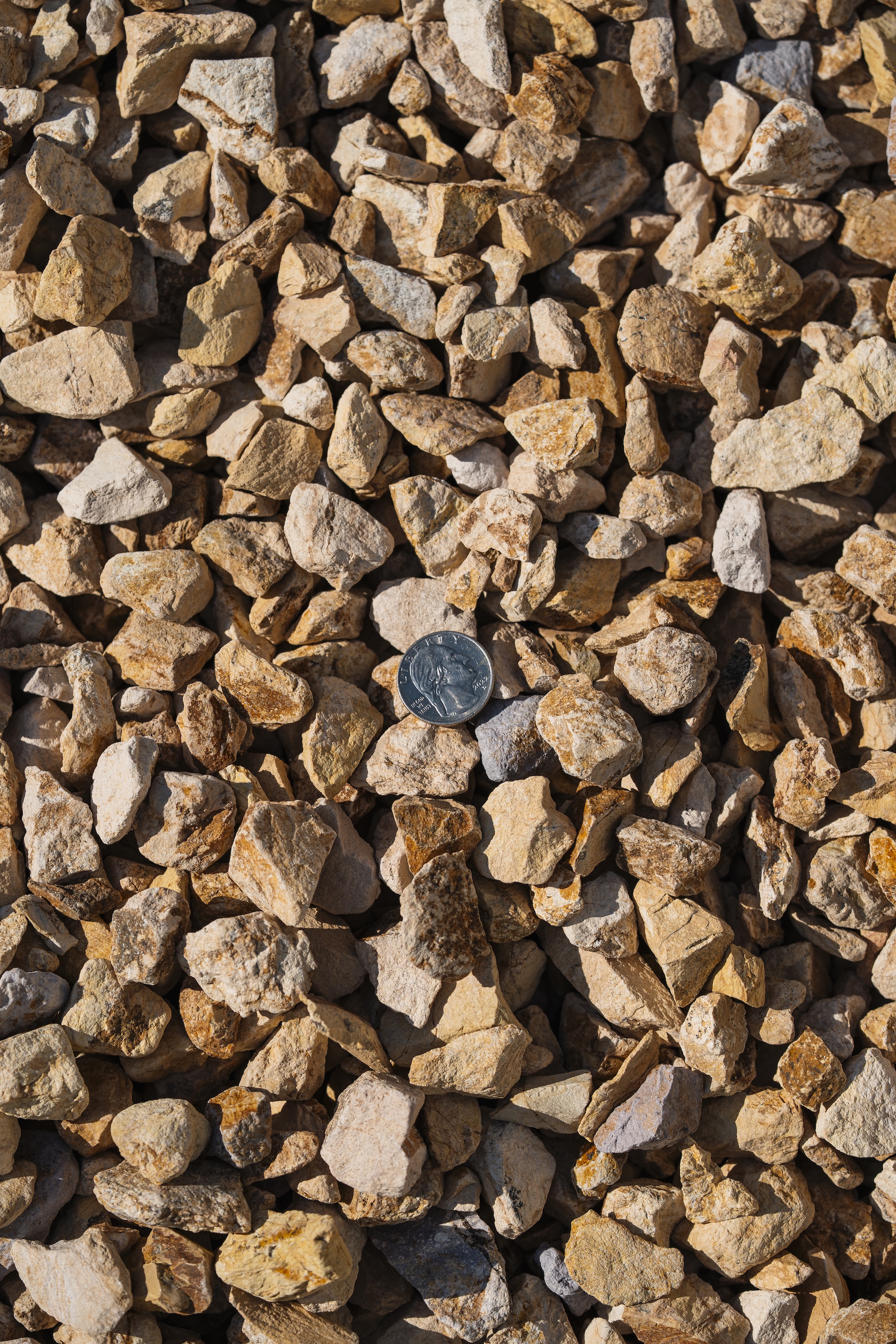
3/4" Crush California Gold
120 sqft per ton @ 2″ Depth
Closed
Hours:
Mon-Sat: 6:30 AM - 4:00 PM
Sunday: Closed
Why 3/4" Crush California Gold? Use Cases and Performance
3/4" Crush California Gold is a crushed, angular aggregate in warm gold and tan tones with rust-colored flecks running through it. It occupies the same structural role in the yard as our other 3/4" crushed rock products, meaning it compacts into a stable surface for driveways, pathways, and traffic areas, but customers pick it specifically for the color. Where 3/4" Crush Granite reads neutral gray and 3/4" Black Lava reads dark and dramatic, California Gold reads warm, sun-baked, and distinctly Californian against tan and terracotta stucco.
The performance side comes from the same physical property that makes any crushed rock work well underfoot and under wheels: angularity. Crushing fractures the stone along multiple faces, and those angular faces lock together when the material is compacted. Rounded material like 3/4" Crush River Rock rolls and migrates under repeated traffic; angular material like California Gold interlocks and stays put. That is why crushed rock, not river rock, is the standard recommendation for a driveway or a parking pad, and why California Gold in particular shows up so often on Fresno and Clovis properties where the owner wants that structural performance without the cooler gray tone.
Where 3/4" Crush California Gold is the right call
- Driveways and parking pads where you want a warm, tan-gold surface instead of gray granite or dark lava, especially against stucco, adobe-style block, or desert landscaping.
- Decorative ground cover in beds and side yards, where the gold tone pairs naturally with drought-tolerant plantings and warm-toned hardscape.
- Pathways and walking surfaces that see light foot traffic and benefit from a surface that locks in place rather than shifting.
- Erosion control on slopes and drainage swales, since angular rock resists rolling downhill the way rounded rock does.
- HOA and commercial common areas where a warm color scheme is part of the design and the surface still needs to hold up to a maintenance crew and foot traffic.
Where it is not the right call
The same angularity that locks California Gold into a firm surface makes it a poor choice underfoot for bare feet or pets. Pool decks, dog runs, and play areas do better with a rounded product such as 3/4" Crush River Rock. If you need a finer material for jointing between pavers, a decomposed-granite-style patio, or a comfortable walking surface with a matching gold tone, look at 3/8" Minus California Gold DG instead, which is the fines version of this same color family sized for exactly that job.
Not sure how much you need?
Run your square footage and depth through our material coverage calculators before you call. It saves time on the phone and heads off the most common ordering mistake, which is quoting square footage without a depth.
Buying it in Fresno
We sell 3/4" Crush California Gold by the ton out of our yard at 3562 South Elm Avenue in Fresno. You can load your own truck or trailer, we can load for you, we can rent you a dump trailer to self-haul, or we can deliver and dump it where you need it. Call 559-233-6603 to confirm current pricing and availability. Aggregate pricing tracks quarry and fuel costs, so we quote it live rather than publishing a figure that goes stale.
3/4" Crush California Gold: Guidance for Your Situation
Pick the description that fits you best. Specs, steps, and pricing questions differ for a weekend project versus a bid or a compliance inspection.
For homeowners and designers
Installing and Designing With California Gold
A weekend DIY install with California Gold succeeds or fails on the same three things as any crushed aggregate job: depth, edge containment, and what sits underneath it. Get those right and the surface looks intentional for years. Skip any one of them and the rock migrates or ruts, and the color gets blamed for a base problem.
How much depth do I actually need?
| Application | Recommended depth | Notes |
|---|---|---|
| Decorative ground cover in beds | 2" | Standard depth for weed suppression and even coverage. |
| Side yards and utility strips | 2"-3" | Go deeper if the area sees foot traffic or a wheelbarrow. |
| Walking paths (occasional use) | 3" | Consider 3/8" Minus California Gold DG instead for a finer, more comfortable surface. |
| Residential driveway (over base) | 3"-4" over a compacted base | The base layer is not optional. See the install steps below. |
| Parking pad | 4" over a compacted base | Heavier, more concentrated loads need more structure underneath. |
Step-by-step: a DIY California Gold driveway or path
- Strip the organics. Remove grass, weeds, and topsoil down to firm subgrade. Leftover organic matter decomposes and settles, which is what causes dips in a new surface within the first year.
- Grade for water. Build in a slight crown or slope away from the house. Fresno rain is infrequent but can arrive hard, and water with nowhere to go will carve a channel through loose rock.
- Compact the subgrade. A rented plate compactor handles this. Lightly wetting the subgrade first helps it compact instead of just bouncing under the plate.
- Install a base course for anything carrying a vehicle. Put down 3"-4" of 3/4" Blue Base Rock and compact it in lifts before you place the gold rock. A decorative wearing course over a real base lasts; the same rock dumped on bare dirt does not.
- Set your edges. Steel edging, a concrete curb, treated timber, or a soldier course of larger rock all work. Without containment, gravel spreads outward and you are re-topping the edges every season.
- Spread California Gold in lifts. Two 2" lifts compact tighter than one 4" dump. Rake it level as you go and pull stray rock off any planting beds you want kept clean.
- Compact the surface. Running a plate compactor over the final lift locks the angular pieces into a firm surface rather than leaving a loose pile that shifts underfoot.
- Water it in. A light watering after compaction settles fines into the voids and helps knit the surface together.
Design: what California Gold looks like in a Fresno yard
California Gold reads warm, tan, and gold with visible rust-colored flecks, closer to sand and sun-worn stone than to a cool gray aggregate. It is one of the warmer-toned rocks in the yard, and it tends to get picked specifically to match or complement stucco, block, and desert-style plantings rather than to disappear into the background the way granite does.
- Against tan, sand, and terracotta stucco, the color reads as one continuous warm palette rather than a hard contrast. This pairing is common on ranch-style and Spanish-influenced homes across Fresno and Clovis.
- Against white or light gray stucco, California Gold provides a warmer accent than a gray aggregate without the visual weight of a dark rock like 3/4" Black Lava or 3/4" Red Lava.
- With drought-tolerant plantings such as agave, yucca, red yucca, lavender, and ornamental grasses, the gold tone plays well with silver, blue-green, and burgundy foliage.
- As a border material, banding California Gold against walk-on bark or a darker rock creates clear zoning between a planting bed and a walking or driving surface without adding hardscape.
- Around a fire pit or seating wall, the warm tone matches the palette of most stacked-block or flagstone seating without competing with it visually.
What DIY installs typically cost
Aggregate is priced by the ton and moves with market conditions, so call 559-233-6603 for a current figure. What we can tell you without a call is where the rest of the budget goes: edging material, a base course if the area carries vehicles, a one-day plate compactor rental, and either a delivery fee or a trailer rental. For a yard or two, self-hauling in a rented dump trailer is usually the cheapest route; past about three yards, delivery generally wins on cost and effort.
The single most common DIY mistake
Ordering by square footage alone and forgetting depth. A 300 sq ft area at 2" deep and the same area at 4" deep are two very different tonnages. Nail down your depth before you confirm your order quantity.
Maintenance
- Weeds: California Gold does not feed weeds on its own, but windblown dirt collects in the voids over time and eventually will. A pre-emergent applied in spring and fall handles most of it.
- Leaf litter: a leaf blower on a low setting clears leaves without scattering the rock. High settings will move gravel along with the leaves.
- Top-dressing: with proper edging in place, expect to add a light top-dress every three to five years on a driveway, less often on decorative beds.
- Sprinkler overspray: mineral deposits from hard water can dull the gold tone over time. Adjusting heads so they are not spraying directly onto the rock, and an occasional hose rinse, keeps the color bright.
For contractors, landscapers, and property managers
Specs, Bulk Ordering, and Job-Site Logistics
California Gold moves in real volume on landscape design-build jobs and HOA turnover work where color matching to an existing palette matters as much as performance. Yard hours are Monday through Saturday, 6:30 AM to 4:00 PM, and first loads go out early. Call 559-233-6603 the day before on anything over a few yards so we can have it staged and ready.
Working specs
| Property | Working value / behavior |
|---|---|
| Nominal size | 3/4" crushed, angular |
| Color | Warm gold and tan with rust-colored flecks |
| Sold by | The ton (bulk); loaded at our Fresno yard or delivered |
| Fracture | Angular on multiple faces, interlocks under compaction |
| Typical use | Driveway wearing course, decorative ground cover, paths, drainage |
| Compaction | Place in lifts and compact each lift; do not place a single deep lift |
| Drainage | Free-draining as a clean product; use a base rock section below for structural loads |
| Coverage | Calculated at 2" depth, see our calculators for takeoffs |
Placement and compaction
- Prep the subgrade. Strip organics, proof-roll, and correct soft spots before placing any rock. Central Valley clay subgrade holds moisture and pumps under load if you place aggregate over a wet, unproofed section.
- Place the base course first on vehicular work. Compact a base-rock section before placing California Gold as the wearing course. Decorative rock over an inadequate base fails at the base, not at the surface.
- Build lifts. Place in 2"-3" compacted lifts rather than one deep lift. A full-depth single lift leaves the bottom uncompacted.
- Watch moisture during compaction. Bone-dry angular rock in a Fresno July will vibrate under the plate without locking together. A light water pass makes a measurable difference in surface tightness.
- Specify edge restraint on every vehicular installation. Without containment, you will be back out for top-dress calls within a season.
Job-site logistics and hauling
- Yard pickup: we load trucks and trailers on site at 3562 South Elm Avenue, Fresno, Monday through Saturday, 6:30 AM to 4:00 PM.
- Delivery: dump truck delivery for bulk quantities, including staged multi-load deliveries on larger jobs.
- Self-haul: dump trailer and truck rentals when your own equipment is tied up on another site.
- Multi-material orders: California Gold alongside base rock and edging material on the same run is normal. Tell us the placement order and we will sequence the loads.
- Access: flag tight residential access, low overhangs, or gated HOA entries at order time, not when the truck shows up.
Bulk and account pricing
We quote bulk and repeat-account pricing directly rather than publishing rates, since aggregate cost moves with fuel and quarry pricing and since volume, haul distance, and load count all change the number. Call 559-233-6603 or send us the job details and we will price the material and the freight together. If you are bidding recurring work such as HOA maintenance or production landscape installs, ask about standing pricing so you are not re-quoting every draw.
Commercial and HOA color matching
A large share of our California Gold volume goes to HOA and commercial landscape maintenance accounts replacing or extending an existing gold-toned rock bed. Quarry runs vary slightly in tone from load to load, which is normal for a natural crushed product, so on a visible match-critical job, order the full quantity for the phase in one purchase rather than topping off later with a separate load. If a large property is phased over multiple seasons, call ahead and we can flag it so we pull from a consistent stockpile where possible.
Contractor accounts
If you buy from us regularly, see our contractor page for how accounts, staged loads, and repeat pricing work.
For landscape designers and property owners planning a full renovation
Designing a Palette Around California Gold
California Gold gets specified as much for color coordination as for structural performance. Designers working on desert-modern, Spanish colonial, or drought-tolerant renovation projects use it as the base tone that ties hardscape, planting, and architecture together, so the design decisions around it deserve as much attention as the install specs.
Building a cohesive palette
- Pair with warm-toned hardscape such as tan flagstone, buff pavers, or stacked block seating walls rather than cool gray concrete pavers, which will visually fight the gold tone.
- Use a darker rock, such as 3/4" Black Lava, as a contrast band or accent bed rather than mixing it throughout, since the two colors read as separate zones rather than a blend.
- Layer plant material with silver, blue-green, or burgundy foliage, such as agave, blue fescue, and Texas ranger, to keep the warm ground plane from reading flat.
- Reserve 3/8" Minus California Gold DG for pathways and patios in the same project so the color carries through at a walkable scale without mixing two different rock types visually.
- On larger properties, break up a big expanse of gold rock with planting islands, boulders, or a change in material, both for visual interest and because a single unbroken rock field raises surface temperature more than a broken-up one.
Specifying for phased or multi-area projects
On renovation work that touches a front yard now and a backyard or side yard later, order enough California Gold for the full visible palette in one purchase where the budget allows. Quarry runs shift slightly in tone between deliveries, which is normal for a natural crushed stone, and matching a six-month-old bed to a fresh load is harder than matching two loads pulled close together. If phasing is unavoidable, tell us at order time so we can try to source from a consistent run.
Working with property managers and HOA boards
For association common areas, California Gold is an easier sell to a board than a cooler gray or dark rock because it reads as warm and low-maintenance rather than institutional, and it photographs well for marketing material on new developments. The structural argument still matters: angular rock over a compacted base handles a landscape crew's foot traffic and light equipment far better than a rounded decorative rock, so it holds its finished look between maintenance visits instead of needing constant grooming.
Planning a larger renovation?
Bring us your square footage by area and we will help size the order across beds, paths, and any driveway or parking sections. Call 559-233-6603 or use our calculators to rough out quantities before the first site visit.
How 3/4" Crush California Gold Compares to the Alternatives
The choice usually comes down to color and texture first, since several of the crushed and decorative products in the yard behave similarly once compacted. Here is how California Gold stacks up against the products it gets cross-shopped with most.
| Material | Color | Surface stability | Best for |
|---|---|---|---|
| 3/4" Crush California Gold | Warm gold and tan with rust flecks | High, angular, compacts and locks | Driveways, paths, decorative beds, warm-toned palettes |
| 3/4" Crush Granite | Neutral gray with light speckling | High, angular, compacts and locks | Same structural jobs, cooler or more architecturally neutral look |
| 3/8" Minus California Gold DG | Same gold and tan family, finer texture | Moderate to high once compacted, walkable | Patios, pathways, jointing, comfortable walking surface in the same color |
| 3/4" Crush River Rock | Mixed earth tones, rounded | Moderate, rounded pieces shift more | Dry creek beds, pool and pet areas, softer look |
| 3/4" Blue Base Rock | Blue-gray, utilitarian | High as a compacted base | Structural base layer under pavers, slabs, and driveways, not a finish surface |
3/4" vs. 3/8" California Gold, which one do I need?
Both come from the same color family, so the decision is about scale of use, not appearance. Size changes the job.
| Question | 3/8" Minus California Gold DG | 3/4" Crush California Gold |
|---|---|---|
| Comfortable to walk on? | Yes, finer texture, packs smoother | Passable but coarser underfoot |
| Vehicle traffic? | Not on its own | Yes, over a compacted base |
| Jointing between pavers or flagstone? | Yes | No, too coarse |
| Decorative bed cover? | Yes, finer look | Yes, coarser texture, slightly better weed suppression |
| Slopes and drainage swales? | Washes more readily | Holds better on grade |
California Gold vs. Crush Granite
Structurally these two behave almost identically since both are angular 3/4" crushed rock that compacts and interlocks the same way under the same installation steps. The decision is nearly always color. California Gold pairs with tan, sand, and terracotta stucco and desert-style plantings; granite pairs with white, gray, and more contemporary color schemes. If you are extending an existing rock bed on a property, match to whichever is already down rather than mixing the two, since side-by-side they read as visibly different materials.
California Gold vs. decomposed granite pathways
For a walkway or patio, the 3/4" size is too coarse to be comfortable, which is why we point that job toward 3/8" Minus California Gold DG rather than the crushed product on this page. Reserve 3/4" California Gold for driveways, parking areas, and larger decorative beds where the coarser texture and stronger interlock earn their keep, and let the finer DG product handle anywhere people are walking regularly in bare or sandaled feet.
California Gold in Central Valley Conditions
Material behavior is local. Fresno's combination of extreme summer heat, low but concentrated winter rainfall, heavy clay soil in much of the valley floor, and periodic tule fog and wind changes how any aggregate performs compared to a milder or wetter climate. Here is what that means specifically for California Gold.
Summer heat
Any rock surface in direct Fresno sun gets hot in summer, which is a function of full sun and dark ground cover generally, not a defect specific to this product. A gold and tan aggregate sits in the middle of the catalog for radiant heat, absorbing less than a dark rock like 3/4" Black Lava and more than 3/4" White Rock. Keep large rock fields away from areas where bare feet or paws will cross in July, avoid placing a big expanse directly against a south- or west-facing window, and give plants a mulch ring instead of running rock straight up against tender stems.
Clay soil and subgrade behavior
Much of the Fresno and Clovis area sits on soil with a heavy clay fraction, and clay expands when wet, shrinks when dry, and pumps under load when saturated. That behavior, not the rock itself, is the most common cause of a failed aggregate driveway locally. Placing California Gold directly on native clay without a compacted base course is asking for ruts and low spots within a year. On sites with heavy, poorly draining clay, a geotextile separation fabric under the base course, not between the base and the wearing surface, is inexpensive insurance against the base working its way into the clay over time.
Winter storms and drainage
Fresno gets most of its annual rainfall in a handful of winter storms rather than steady rain through the year, so the design case is a short, intense volume of water rather than a slow drizzle. Angular California Gold holds its position on grade better than rounded rock in that scenario, and a properly compacted section drains instead of ponding. Grade the surface so water has somewhere to go, keep a defined path such as a swale or drain for it, and never let a driveway or path drain toward a garage slab or foundation wall.
Tule fog and moisture cycling
Winter tule fog keeps surfaces damp for extended stretches without producing much actual rainfall. That moisture cycling does not damage a hard, mineral-stable aggregate like California Gold the way it can degrade organic mulch, but it does mean dust and dirt on the surface stay damp longer and can settle into the voids between rock pieces, which is one of the more common sources of localized weed germination on an otherwise well-installed bed.
Wind, dust, and air quality
The Central Valley has real air-quality constraints, and windblown dust is part of that picture during dry, windy stretches. A hard, angular aggregate generates fewer fines over time than a soft aggregate that grinds down under traffic, which is a point in favor of California Gold for driveways and access paths. Compacting the surface properly and keeping vehicle speeds low on longer aggregate drives reduces dust more than any single product choice does.
Water conservation and rock landscaping
Rock ground cover is the default answer to Central Valley water-use restrictions, and California Gold is a durable long-term choice for it because it does not decompose or need replacing on a cycle the way organic mulch does. Two honest caveats apply: rock does not feed the soil biologically, so keep organic material such as walk-on bark or black humus around plantings that need it, and a very large unbroken rock field raises local surface temperature, so break it up with plantings, shade, or a band of a different material.
Local delivery area
We deliver California Gold throughout Fresno, Clovis, Sanger, Selma, Kingsburg, Madera, and the surrounding Central Valley. Call 559-233-6603 to confirm delivery to your address, or rent a trailer and haul it yourself.
3/4" Crush California Gold: Frequently Asked Questions
Have questions? We've got answers. If you don't see your question below, give us a call at (559) 233-6603.