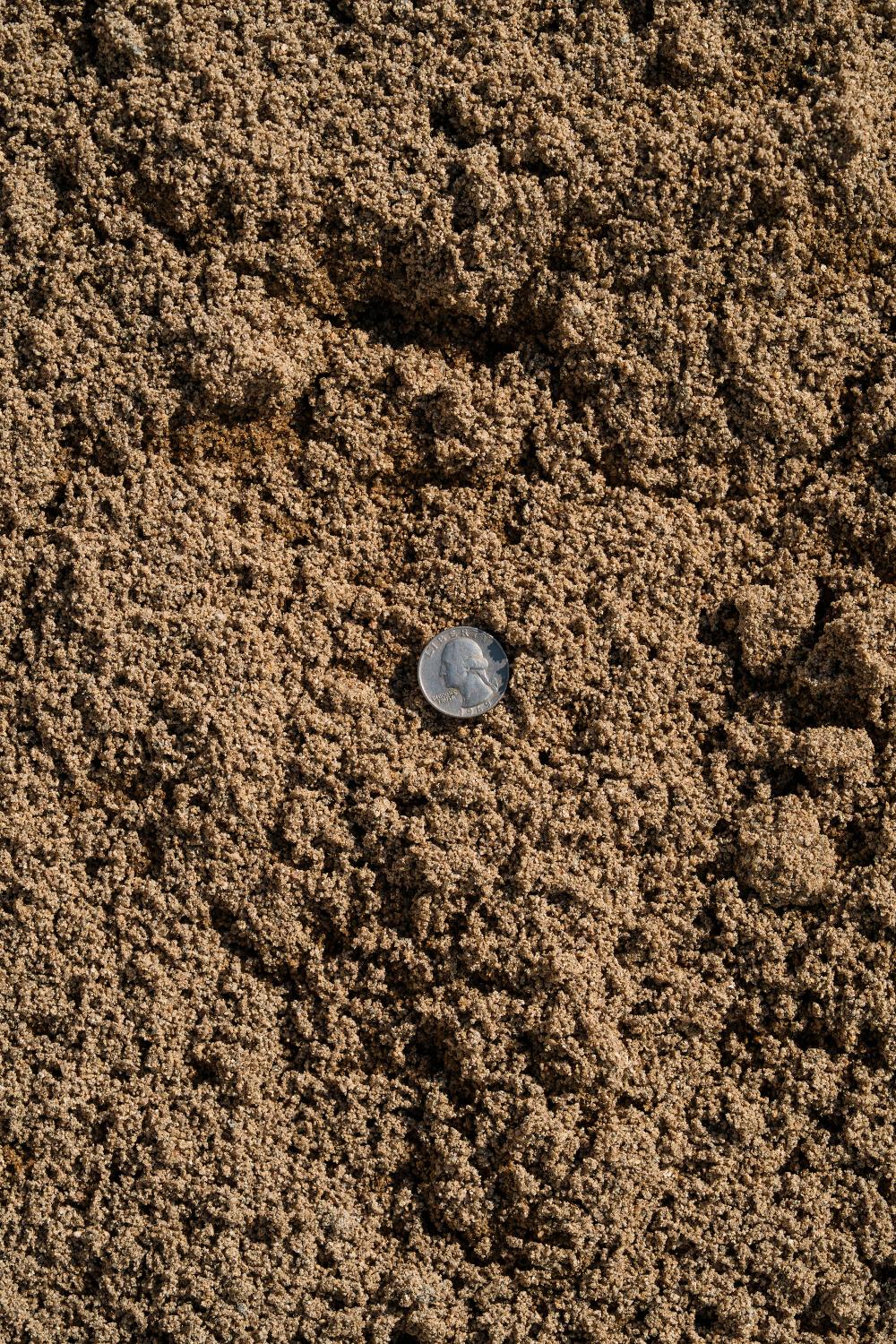
Plaster Sand
90 sqft per ton @ 2″ Depth
Closed
Hours:
Mon-Sat: 6:30 AM - 4:00 PM
Sunday: Closed
Why Plaster Sand? Use Cases and Performance
Plaster sand is a washed, finely graded sand produced specifically for stucco, pool plaster, mortar, and other finish-coat applications where the sand becomes part of a visible, troweled surface. It is not the same product as the fill sand sitting a few bins over in the yard, and mixing the two up on a job is one of the more expensive mistakes a crew can make. Fill sand is a bulk, unwashed backfill material sized for compaction and volume. Plaster sand is washed to remove clay, organics, and silt fines, and screened to a consistent, fine gradation so it blends into a smooth, workable finish coat rather than sitting in the mix as visible grit or contaminating the cure.
That washing and screening step is the whole story. Clay and silt left in a sand throw off water demand in a mix, weaken the bond, and can show up as discoloration or pitting once a stucco or plaster coat cures. A clean, well-graded fine sand mixes predictably, trowels smooth, and does not fight the plasterer or the mason. Contractors specify plaster sand by name because the alternative, a cheaper unwashed sand, causes callbacks that cost far more than the sand ever saved.
Where plaster sand is the right call
- Stucco base coat and finish coat mixes on residential and commercial exteriors, where a clean fine sand keeps the mix workable and the cured finish free of grit and discoloration.
- Pool plaster and pool deck finish coats, where a washed, uniform sand is standard in the mix that gets troweled against the shell.
- Masonry mortar for block and brick work, where a fine, clean sand produces a workable, consistent joint.
- Concrete finish topping and float coats where a fine aggregate is needed rather than a coarse structural sand.
- Sand-based traction and leveling courses under thin-set tile or pavers where a clean, fine, predictable material matters more than bulk volume.
Where it is not the right call
If the job is backfilling a trench, bedding a pipe, filling a low spot, or building bulk volume under a slab, plaster sand is the wrong product and the wrong price. That work calls for fill sand or fill dirt, both sold at a lower cost per yard because they skip the washing and fine screening a finish sand needs. Plaster sand is also not a landscaping ground cover or a paver base material; it is too fine to compact into a load-bearing base and too fine to serve as decorative cover. Save it for mix designs where the finished, troweled surface actually shows.
Not sure how much you need?
Run your square footage through our material coverage calculators before you call, and confirm the mix ratio your plaster or mortar spec calls for. It speeds up the quote conversation and avoids a second trip for a top-off bag.
Buying it in Fresno
We sell plaster sand by the yard or ton out of our yard at 3562 South Elm Avenue in Fresno. You can load it yourself, we can load your truck or trailer, we can rent you a dump trailer to self-haul, or we can deliver and dump it where you want it. Call 559-233-6603 to confirm current pricing and availability. Sand pricing moves with fuel and supplier costs, so we quote it live rather than publishing a number that goes stale.
Plaster Sand: Guidance for Your Situation
Pick the description that fits you best. Specs, steps, and pricing questions differ for a weekend project versus a bid or a compliance inspection.
For homeowners tackling a repair or small patch job
Using Plaster Sand for Patch and Repair Work
Most homeowners meet plaster sand through a small repair rather than a whole-house re-stucco: a cracked patch on an exterior wall, a chip in a pool deck, or a mortar joint that needs pointing. The volumes are small, but getting the sand right still matters, because a patch made with the wrong sand cures a different color and texture than the surface around it.
Typical small-job mixes
| Job | Rough mix approach | Notes |
|---|---|---|
| Stucco patch (finish coat) | Match existing coat, typically a cement-lime-sand ratio per product instructions | Follow the bagged cement or plaster product's mix directions, not a generic ratio. |
| Pool plaster touch-up | Pre-mixed pool plaster product plus plaster sand per manufacturer spec | Color and texture match is difficult on a small patch; expect a visible seam on white plaster. |
| Mortar for tuck-pointing | 1 part cement to 3 parts plaster sand, roughly, adjusted to match existing mortar | Match the color of the existing mortar with sand color, not just cement type. |
| Sand bed under pavers or tile | 1/2" to 1" screeded layer | Screed and compact lightly; this is a leveling course, not a load-bearing base. |
Step-by-step: a small stucco or mortar patch
- Clean out the area. Remove loose material, dust, and any old caulk or paint film so the new mix bonds to sound substrate.
- Dampen the substrate. A dry wall or block pulls moisture out of the new mix too fast and weakens the cure. Mist it first, do not soak it.
- Mix small batches. Plaster and mortar set up faster than most people expect, especially in Fresno heat. Mix only what you can place in fifteen to twenty minutes.
- Match the texture as you finish. Whether you are floating, sponging, or dashing the finish, work the surrounding area lightly at the edges so the patch blends rather than reading as a hard-edged rectangle.
- Cure slowly. Mist the patch lightly once or twice a day for the first two to three days, especially in summer, so it does not flash-dry and crack.
Getting the color and texture to match
Plaster and stucco color comes from the cement, the sand, and any added pigment together, so a small patch rarely matches the surrounding wall perfectly, even with the identical sand. Sun exposure, age, and mineral efflorescence all shift the color of the original coat over time in ways a fresh patch cannot replicate exactly. Set expectations accordingly on a visible wall, and consider a full-elevation re-coat instead of a patch if the location is prominent and the color match matters.
Small quantities are fine
You do not need a full yard for a patch job. Call 559-233-6603 and describe the repair; we can help you size a small quantity so you are not storing leftover sand in a bucket for years.
Common DIY mistakes
- Using leftover fill sand or play sand from another project instead of a proper plaster sand. The clay and silt content in a general-purpose sand shows up as gritty texture or color blotching in a finish coat.
- Mixing too dry to save material. A stiff, dry mix is harder to trowel smooth and more likely to crack as it cures.
- Skipping the damp-cure step in summer. A patch that dries too fast in Fresno heat cracks or dusts off within days.
- Ignoring the manufacturer's mix ratio and eyeballing proportions. Small variations matter more on a patch than on a large batch, because there is no room for the mix to average itself out.
For stucco contractors, plasterers, pool builders, and masons
Specs, Bulk Ordering, and Job-Site Logistics
Most of our plaster sand volume moves through stucco crews, pool plaster subs, and masonry contractors running repeat orders, so the yard is set up for fast turnarounds rather than retail hand-holding. Monday through Saturday, 6:30 AM to 4:00 PM, first load out the gate early. Call 559-233-6603 the day before on anything over a few yards and we will have it staged.
Working specs
| Property | Working value / behavior |
|---|---|
| Description | Washed, screened fine sand for plaster, stucco, and mortar mixes |
| Sold by | The yard or ton (bulk); loaded at our Fresno yard or delivered |
| Gradation | Fine, consistent, screened for finish-coat and mortar use |
| Fines / clay content | Washed to remove clay, silt, and organics that a fill sand retains |
| Typical use | Stucco base and finish coats, pool plaster, masonry mortar, float and topping coats |
| Not suited for | Bulk backfill, trench bedding, or paver base, where fill sand is the correct and lower-cost material |
Mixing and placement notes
- Store sand covered or on a clean pad. Windblown dirt or debris settling into an open sand pile adds contamination back into a material that was already washed once.
- Batch consistently. Use a consistent measuring method, box or bucket, rather than shovel counts that vary between crew members, so color and strength stay uniform across a wall or a pour.
- Watch moisture content day to day. Sand that sat out overnight after a watering or a light rain carries more moisture than a dry stockpile, which changes your water demand at the mixer.
- Sequence deliveries with your lath and weather barrier schedule on stucco jobs, so sand is not sitting exposed on site for weeks before scratch coat.
- Coordinate pool plaster pours around ambient temperature. Fresno summer heat accelerates set time on troweled finishes; plan crew size and pour sequencing accordingly.
Job-site logistics and hauling
- Yard pickup: we load trucks and trailers on site at 3562 South Elm Avenue, Fresno, Monday through Saturday 6:30 AM–4:00 PM.
- Delivery: dump truck delivery for bulk quantities, including staged multi-load deliveries timed to your pour or scratch-coat schedule.
- Self-haul: dump trailer and truck rentals when your own equipment is committed on another site.
- Multi-material orders: plaster sand plus cement plus concrete mix on the same run is normal. Bundle it and we will sequence the loads to match your placement order.
- Access: tell us about tight residential access, low lines, or gated HOA entries when you order, not when the truck arrives.
Bulk and account pricing
We quote bulk and repeat-account pricing directly rather than publishing rates, because sand cost moves with fuel and supplier pricing and because volume, haul distance, and load count all change the number. Call 559-233-6603 or send us the job details and we will price the material and the freight together. If you run recurring stucco, pool plaster, or masonry work, ask about standing pricing so you are not re-quoting on every draw.
Contractor accounts
If you buy from us regularly, see our contractor page for how accounts, staged loads, and repeat pricing work.
For pool plaster subs and masonry crews
Pool Plaster and Masonry Applications
Pool plaster and masonry work share a demand that stucco crews also care about: a sand that behaves the same way batch after batch, so the finish looks uniform across an entire shell or an entire wall. Inconsistent sand shows up as mottling, streaking, or hot and cold spots in a cured pool finish, and as visible color banding in a mortar joint run.
Pool plaster considerations
- White and colored pool plaster finishes are unforgiving of contamination. Even a small amount of clay or organic material in the sand can show as discoloration once the shell cures and fills with water.
- Consistency matters across a full pour. A single large shell is typically plastered in one continuous push, so sand consistency across the whole batch affects the finished look of the entire pool, not just one section.
- Aggregate and pebble finishes still rely on a plaster sand base coat underneath, even when the visible top layer is a different material entirely.
- Curing and startup water chemistry affect the finished look as much as the mix does; that part is outside what a sand supplier controls, but it is worth coordinating with your plaster sub and your startup chemical schedule.
Masonry mortar considerations
- Match sand color to the existing mortar on any repair or addition to an established block or brick wall, since sand color is a major driver of finished mortar color.
- Fine, clean sand produces a more workable mortar that holds a tooled joint profile without crumbling at the edges.
- Retempering mortar on a hot day is common in Fresno summer heat; keep sand and water proportions consistent when you retemper so strength does not drop off on the later batches of the day.
- Block fill and grout applications typically call for a coarser aggregate than plaster sand; confirm which product your spec calls for before ordering, since the two are easy to mix up by name alone.
Ordering for a pool or masonry job
Pool shells and larger masonry jobs use enough sand that timing the delivery to your plaster or mason's schedule matters more than the sand itself. Order early enough that a load is staged and ready rather than holding a crew waiting on material, and confirm quantity against your plasterer's or mason's own takeoff rather than estimating from square footage alone, since coat thickness and joint width both change the actual volume needed.
Coordinating a pour or plaster day
Call 559-233-6603 a few days ahead of a scheduled pool plaster or large masonry pour so we can stage the load and confirm delivery timing against your crew's start time.
How Plaster Sand Compares to the Alternatives
The most common mistake on this material is not choosing the wrong sand for lack of options, it is grabbing a cheaper bulk sand for a finish-coat job because the two look similar in a pile. Here is how plaster sand stacks up against the sands and mixes most likely to get confused with it.
| Material | Washed / screened | Best for | Trade-off vs. plaster sand |
|---|---|---|---|
| Plaster Sand | Yes, washed and fine-screened | Stucco, pool plaster, mortar, finish topping coats | N/A |
| Fill Sand | No, bulk unwashed | Backfill, trench bedding, bulk volume under slabs | Cheaper by the yard, but clay and silt content make it unsuitable for a visible finish coat |
| 1" Concrete Mix | Blended aggregate and sand | Structural concrete pours, footings, slabs | A pre-blended structural mix, not a finish sand; wrong particle size and composition for plaster |
| 3/8" Concrete Mix | Blended aggregate and sand | Thinner structural pours, small slabs, flatwork | Same story as the 1" mix, coarser and structural rather than a finish-coat sand |
| Fill Dirt | No | Grading, bulk fill, low-spot leveling | Not a sand at all; contains soil fines that a finish mix cannot tolerate |
Plaster sand vs. fill sand, the comparison that matters most
These two sit near each other in the yard and are easy to confuse on a delivery ticket, so it is worth being explicit about the difference. Fill sand is a bulk, unwashed product sized and priced for volume work: backfilling trenches, building up grade, bedding pipe, filling voids under slabs. It carries natural clay and silt content, which is fine and even helpful for compaction in a backfill application, but it is exactly what a finish coat cannot tolerate. Plaster sand costs more per yard because it has been washed to remove that clay and silt, then screened to a consistent fine gradation for troweled and mixed work. Ordering fill sand for a stucco job to save money is a common and costly mistake: the finish coat can discolor, resist proper cure, or develop a rough, gritty texture that a plasterer cannot trowel out.
Plaster sand vs. concrete mix
Concrete mix products are pre-blended structural aggregates, combining sand with coarser crushed rock sized for compressive strength in a slab, footing, or driveway pour. Plaster sand is a single fine material meant to be combined with cement, lime, or a plaster product at a specific ratio for a troweled finish coat, not poured as a structural element on its own. If the job involves forms, rebar, and a structural pour, you want a concrete mix. If the job involves a trowel, a hawk, and a finish surface, you want plaster sand.
Plaster Sand in Central Valley Conditions
Material behavior in a mix is shaped as much by the climate it cures in as by the sand itself. Fresno's heat, dry air, and occasional winter storms all change how a stucco, plaster, or mortar mix behaves on the wall or in the shell, and a few adjustments to timing and technique matter more here than in a milder climate.
Summer heat and fast set times
Cement-based mixes set faster in Fresno's 100°F-plus summer afternoons than the same mix would in a cooler climate, and low humidity accelerates surface drying on top of that. Crews working stucco or pool plaster in July and August typically start earlier in the day, mix smaller batches, and schedule finish work before the wall or shell is in direct afternoon sun. A mix that flash-sets on the trowel produces a rougher, less workable finish and a higher risk of cracking as it cures.
Curing in dry, low-humidity air
Cement needs moisture to cure properly, and Fresno's dry summer air pulls water out of a fresh coat quickly. Misting a new stucco or plaster surface once or twice a day for the first two to three days, and more often in peak summer heat, keeps the cure slow and even instead of flash-dried and prone to hairline cracking. Pool plaster curing is a more specialized process tied to fill and startup chemistry, but the same principle applies: a slower, controlled cure produces a better finish than a fast, uncontrolled one.
Winter rain and moisture management
Fresno's rain arrives concentrated in winter storms rather than steady year-round drizzle. Stored sand left uncovered picks up moisture unevenly during a storm, which throws off water ratios at the mixer if a crew does not check moisture content before batching. Keeping sand covered or on a well-drained pad, and checking it after a rain event rather than assuming it matches the last dry delivery, avoids inconsistent batches on the first job after a storm.
Clay subgrade and site drainage
Much of the Fresno-Clovis area sits on clay-heavy soil that holds water and drains slowly. This mostly affects sand storage and site access rather than the mix itself: a sand pile sitting on unimproved clay after a storm can become difficult to load from, and truck access to a wet site can be limited for a day or two after significant rain. Planning deliveries around forecasted storms, rather than the day of, avoids a delayed pour or plaster day.
Wind and dust
Valley wind events move fine, dry material quickly, and an uncovered sand stockpile loses fines to wind and picks up windblown dirt in return, working against the whole point of using a washed, screened sand in the first place. Covering stockpiled sand between uses, especially on multi-day jobs, protects the material you already paid to have washed.
Local delivery area
We deliver plaster sand throughout Fresno, Clovis, Sanger, Selma, Kingsburg, Madera, and the surrounding Central Valley. Call 559-233-6603 to confirm delivery to your address, or rent a trailer and haul it yourself.
Plaster Sand: Frequently Asked Questions
Have questions? We've got answers. If you don't see your question below, give us a call at (559) 233-6603.