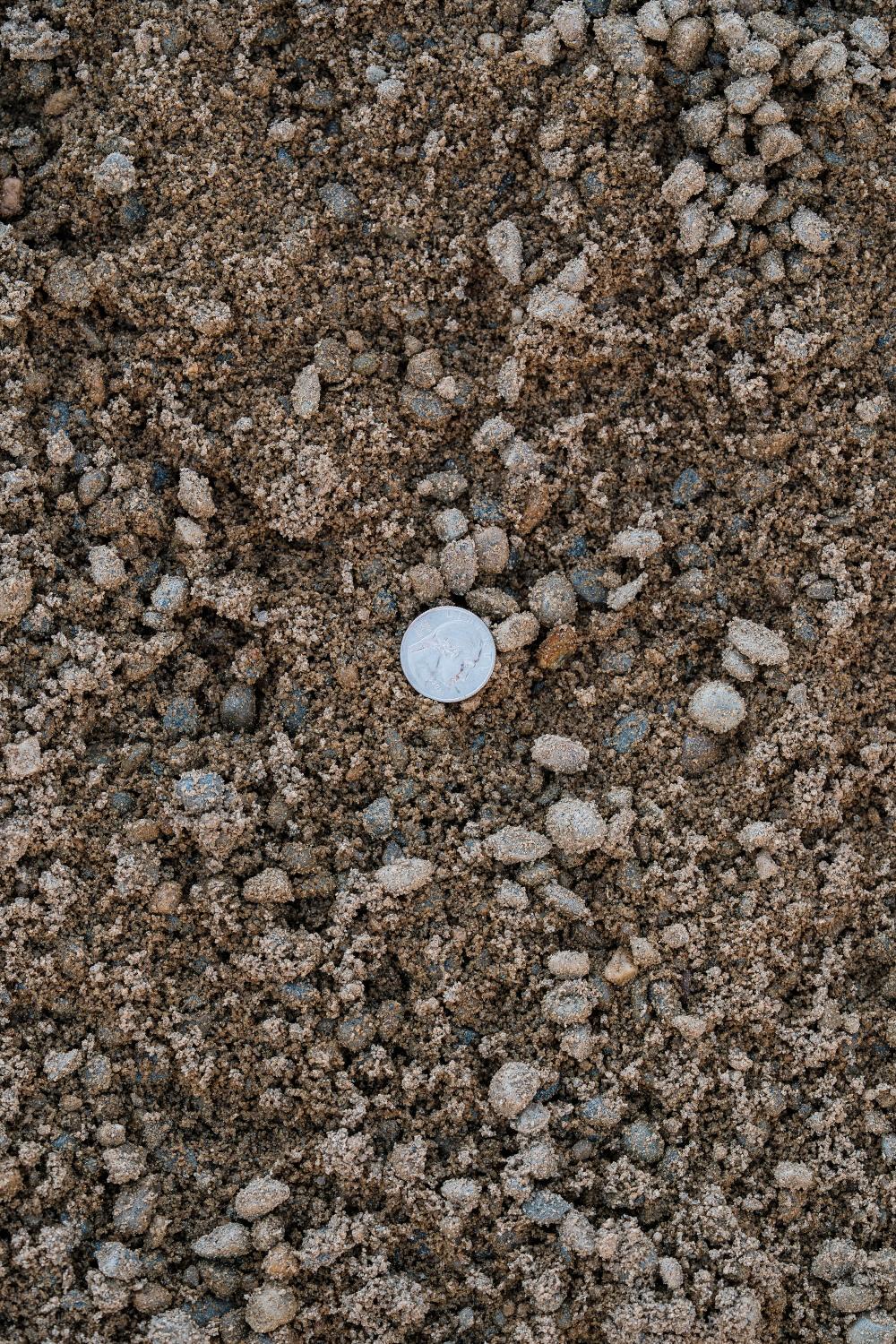
3/8" Concrete Mix
90 sqft per ton @ 2″ Depth
Closed
Hours:
Mon-Sat: 6:30 AM - 4:00 PM
Sunday: Closed
Why 3/8" Concrete Mix? Use Cases and Performance
3/8" concrete mix is a pre-blended aggregate of small crushed rock and sand, sized and proportioned to go into a mixer for site-mixed concrete. It is not a decorative rock and it is not a base material. It is a batching product, built so a contractor or a homeowner pouring a small slab does not have to buy sand and 3/8" rock separately and blend them by eye. The name describes the top size of the coarse aggregate in the blend, three eighths of an inch, which is the fraction typically used for thinner pours, tight forms, and anywhere a smooth finished surface matters as much as raw strength.
The reason a 3/8" blend exists alongside coarser aggregate blends comes down to how concrete finishes. Coarse rock adds compressive strength and stretches cement further per yard, but it also makes the surface harder to trowel smooth and harder to work into tight forms, edges, and thin sections. A 3/8" blend trades some of that bulk strength for a mix that flows into detail work, finishes smoother, and hand-places more easily through narrow forms. For most flatwork around a house, garage, or small commercial pad, that trade is the right one.
Where 3/8" concrete mix is the right call
- Sidewalks, walkways, and thin decorative slabs where a smooth, finishable surface matters more than maximum load rating.
- Steps, curbs, and small architectural pours where the mix needs to move into detail and hold a crisp edge.
- Fence post footings and small footings where a narrow form makes coarse rock more likely to bridge and jam.
- Patching and repair work on existing slabs, steps, and curbs, where a finer aggregate blends into the existing surface texture.
- Mow strips, small patio slabs, and DIY pours where a homeowner is hand-mixing or using a rented mixer rather than ordering a full truck of ready mix.
- Any pour under roughly 4 inches thick, where a larger aggregate does not have enough cover and tends to show at the surface.
Where it is not the right call
Two situations call for a different approach. The first is any large structural pour, a driveway slab, a foundation, or a heavy footing, where the job calls for a full ready-mix truck with an engineered mix design and, often, rebar or wire mesh. A yard aggregate blend that you hand-mix on site is not a substitute for an engineered structural pour, and we will say so directly if you describe a job that size. The second is any application that actually wants loose, compacted aggregate for base or drainage rather than a cement binder, in which case you want 3/4" Blue Base Rock or plain crushed rock, not a concrete mix at all. If your project is a compacted base under pavers or a driveway section, this material is the wrong one entirely.
Not sure how much you need?
Run your square footage and slab thickness through our material coverage calculators before you order. Concrete volume is unforgiving of guesswork, and running short mid-pour on a slab you have already screeded is a real problem, not just an inconvenience.
Buying it in Fresno
We sell 3/8" concrete mix by the ton out of our yard at 3562 South Elm Avenue in Fresno. You can load it yourself, we can load your truck or trailer, we can rent you a dump trailer to self-haul, or we can deliver and dump it where you want it. Call 559-233-6603 to confirm current pricing and availability. This is a bulk sand and aggregate blend you combine with cement and water on site, not a pre-mixed or bagged concrete product, so plan your cement purchase and mixing method before the load arrives.
3/8" Concrete Mix: Guidance for Your Situation
Pick the description that fits you best. Specs, steps, and pricing questions differ for a weekend project versus a bid or a compliance inspection.
For homeowners doing a small pour themselves
Mixing and Pouring 3/8" Concrete Mix Yourself
Most homeowners who buy this product are pouring something small: a walkway section, a set of steps, a mow strip, a mailbox footing, or a patch in an existing slab. The material itself is forgiving. What separates a pour that lasts from one that cracks or crumbles is almost always the mix ratio, the water, and the curing, not the aggregate.
What you actually need to buy
| Item | Notes |
|---|---|
| 3/8" concrete mix | Sold by the ton at our yard, this is the sand and aggregate, not the cement. |
| Portland cement | Sold separately in bags. A common starting ratio is roughly 1 part cement to 5 or 6 parts of this aggregate blend by volume, adjusted for the strength your project needs. |
| Water | Added at the mixer gradually, not dumped in all at once. Too much water is the single biggest cause of weak, cracking concrete. |
| Reinforcement | Wire mesh or rebar for anything that will see vehicle weight or that spans more than a few feet unsupported. |
| Forms | Lumber, stakes, and release oil or form spray if you are building your own forms rather than using an existing edge. |
Step-by-step: a small DIY pour
- Prep the base. Excavate to firm subgrade, remove organics, and compact. For walkways and small slabs, 2 to 4 inches of compacted 3/4" Blue Base Rock under the slab reduces cracking from soil movement, which matters on Fresno's clay-heavy soils.
- Build and brace your forms. Set them to the finished height and slope the surface slightly away from structures so water sheds instead of pooling.
- Place reinforcement if the pour calls for it. Wire mesh sits on chairs so it ends up in the middle of the slab thickness, not on the bottom.
- Mix in small batches you can place and finish before the concrete starts to set. In Fresno summer heat that window is shorter than the bag directions assume, so plan on smaller batches than you think you need.
- Place the concrete and work it into the corners and edges of the form with a shovel or rod to remove air pockets.
- Screed the surface level using a straight board dragged across the top of the forms.
- Float, then finish. A wood or magnesium float smooths the surface, and a steel trowel gives a harder, smoother finish for walkways. Do not over-trowel or you draw too much water and fines to the surface.
- Cut control joints at regular intervals, roughly every 4 to 6 feet for a typical walkway width, so cracking happens at a joint you planned rather than randomly across the slab.
- Cure it properly. Keep the surface damp for several days with regular light watering, wet burlap, or a curing compound. Skipping this step in Fresno's dry heat is the most common reason a DIY slab ends up weak and dusty on top.
Working around Fresno heat
Concrete cures through a chemical reaction, not simple drying, and that reaction runs too fast in 100 degree heat if you let it. Pour early in the morning when you can, keep your mix cooler by shading the mixer and using cool water, and have your curing plan ready before you finish the surface, not after. A slab that dries out on the surface while the interior is still curing ends up with surface cracking and a chalky, weak top layer, and that damage cannot be undone after the fact.
What DIY pours typically involve for cost
Aggregate is priced by the ton and moves with market conditions, so call 559-233-6603 for a current number. Beyond the mix itself, budget for cement, form lumber, a mixer rental if you do not own one, and either a delivery fee or a trailer rental for hauling the aggregate. For most homeowner-sized jobs, one trip in a rented dump trailer covers it. For anything approaching the size of a driveway, ordering ready mix from a concrete supplier is a better path than hand-mixing this product on site.
The most common DIY mistake
Adding too much water to make the mix easier to pour. Extra water weakens the finished concrete significantly and is the leading cause of surface dusting, scaling, and early cracking. Mix it stiffer than feels comfortable and work it into place with tools rather than thinning it out.
Maintenance after the pour
- Sealing a finished walkway or patio every couple of years helps resist staining and surface wear, particularly near planting beds where irrigation and fertilizer overspray hit the concrete.
- Hairline cracks in a properly jointed slab are cosmetic, not structural, and can be left alone or filled with a concrete crack sealant.
- Efflorescence, a white powdery residue, comes from moisture moving salts to the surface and is common on new concrete. It generally fades on its own within a season.
- Avoid deicing salts on any finished concrete; they are rarely needed in Fresno winters but can pit and scale a surface if used.
For flatwork contractors, builders, and remodelers
Specs, Bulk Ordering, and Job-Site Logistics
Contractors buy 3/8" concrete mix for the same reasons a homeowner does, just at a larger scale: sidewalks, flatwork repair, small footings, curb and gutter patching, and any pour where a finer aggregate speeds up finishing and reduces surface rock exposure. Monday through Saturday, 6:30 AM to 4:00 PM, first load out the gate early. Call 559-233-6603 the day before on anything over a couple of tons and we will have it staged.
Working specs
| Property | Working value / behavior |
|---|---|
| Nominal aggregate size | 3/8" coarse aggregate, blended with sand |
| Sold by | The ton, loaded at our Fresno yard or delivered |
| Typical use | Sidewalks, steps, curbs, small footings, patching, thin decorative slabs |
| Cement | Sold and mixed separately; this product is the aggregate and sand component only |
| Finish behavior | Finer aggregate finishes smoother and works into tight forms more readily than coarser blends |
| Structural pours | Not a substitute for engineered ready mix on driveways, foundations, or load-bearing slabs |
| Coverage | Figured by tonnage against your slab volume, see our calculators for takeoffs |
Batching and placement notes
- Confirm your mix ratio before the load arrives. Crews sizing cement to tonnage rather than the other way around waste less material and avoid a mid-pour cement run.
- Stage aggregate close to the mixer or pump. Double-handling a ton of wet aggregate across a job site costs more labor than the material itself.
- Batch consistently. Variation in water and cement ratio between batches on the same pour shows up as visible color and texture differences once the slab cures.
- Sequence pours around Fresno heat. On summer jobs, an early start avoids flash-set problems and gives the crew a full working window before the surface skins over.
- Cure per spec. Whatever curing method the job calls for, wet cure, curing compound, or membrane, apply it immediately after finishing, not at the end of the day.
Job-site logistics and hauling
- Yard pickup: we load trucks and trailers on site at 3562 South Elm Avenue, Fresno, Monday through Saturday 6:30 AM–4:00 PM.
- Delivery: dump truck delivery for bulk quantities, including staged multi-load deliveries on larger flatwork jobs.
- Self-haul: dump trailer and truck rentals when your own equipment is committed on another site.
- Multi-material orders: concrete mix plus base rock plus plaster sand on the same delivery run is common on remodel and repair jobs. Bundle it and we will sequence the loads to match your placement order.
- Access: tell us about tight residential access, low lines, or gated entries when you order, not when the truck arrives.
Bulk and account pricing
We quote bulk and repeat-account pricing directly rather than publishing rates, because aggregate cost moves with fuel and supplier pricing and because volume and haul distance both change the number. Call 559-233-6603 or send us the job details and we will price the material and the freight together. If you run recurring flatwork, patch, or repair work, ask about standing pricing so you are not re-quoting on every job.
When to switch to ready mix
There is a real crossover point where site-mixing this product stops making sense and calling a ready-mix supplier starts. Once a pour gets into the range of a full driveway, a garage slab, or anything requiring an engineered strength specification, the labor of hand or mixer batching, the difficulty of maintaining a consistent water-cement ratio across dozens of batches, and the risk of cold joints from a slow pour all argue for a truck. For sidewalks, small footings, steps, and patch work, this bulk aggregate remains the more economical and more practical choice.
Contractor accounts
If you buy from us regularly, see our contractor page for how accounts, staged loads, and repeat pricing work.
For property managers and HOA maintenance teams
Repair and Maintenance Programs Using 3/8" Concrete Mix
For HOAs and property managers, this product mostly shows up in the repair and maintenance column rather than new construction. Cracked and settled sidewalk panels, spalled step edges, deteriorated curb sections, and small utility pad patches are the recurring line items, and a 3/8" mix is well suited to all of them because it finishes into an existing surface without leaving an obviously different texture.
Common HOA and commercial repair jobs
- Trip-hazard sidewalk panels that need to be removed and repoured rather than ground down, which is often the safer long-term fix and the one that holds up to liability review.
- Curb and gutter sections damaged by vehicle impact or root intrusion from mature street trees.
- Small utility pads for irrigation controllers, transformers, or mechanical equipment where a full ready-mix order is not cost-effective for the volume needed.
- Step and stair nosing repair on common-area stairs, where a fine aggregate mix rebuilds a crisp edge that matches the original finish.
- Mow strip and edging repair between turf and hardscape, an easy source of tripping and mower damage complaints when it deteriorates.
Planning a repair program
Small concrete repairs are easy to defer individually and expensive to defer collectively, because each cracked panel or spalled step is a liability exposure and a maintenance call. Batching several small repairs into one order, one delivery, and one crew day is more efficient than reacting to each complaint separately. We can price and deliver in tonnage sized to a repair list rather than a single job, and stage multiple partial loads across a property if your crew is working several locations in one visit.
Root causes matter as much as the patch. Sidewalk panels lifted by tree roots, or curb sections cracked from expansive clay subgrade movement, will fail again in the same spot unless the underlying cause is addressed, whether that is root barrier installation, subgrade correction, or better surface drainage away from the section. A repair crew that just repours the same panel on the same unaddressed subgrade is signing up for the same call again in a year or two.
Standing pricing for repeat maintenance
If your team handles ongoing common-area repairs, call 559-233-6603 or send us your maintenance schedule to set up standing pricing rather than re-quoting each repair individually.
How 3/8" Concrete Mix Compares to the Alternatives
The comparison most people actually need is not concrete mix versus some unrelated product. It is this blend versus the other aggregate options in the yard that get confused with it, plus the honest comparison to ordering a ready-mix truck.
| Material | What it is | Best for | Trade-off vs. 3/8" concrete mix |
|---|---|---|---|
| 3/8" Concrete Mix | Pre-blended sand and 3/8" aggregate for site-mixed concrete | Sidewalks, steps, footings, patching, thin decorative slabs | N/A |
| 1" Concrete Mix | Coarser blend with 1 inch top-size aggregate | Thicker structural pours, driveways, larger footings | Stronger per yard, but harder to finish smooth and less workable in tight forms |
| 3/4" Blue Base Rock | Compacted structural base rock, no cement | Base course under slabs, pavers, and driveways | Not a binder at all, this is what goes under the concrete, not instead of it |
| Plaster Sand | Fine, washed sand with no coarse aggregate | Stucco, mortar, sand-set pavers, playground sand base | No coarse rock at all, cannot be used alone as a structural concrete mix |
| Ready-mix concrete (truck delivered) | Engineered, batch-plant mixed concrete delivered wet | Driveways, foundations, large or structural slabs | Higher cost per yard for small jobs, and delivered on the plant's schedule rather than yours |
3/8" vs. 1" concrete mix, which one do I need?
The top-size number describes the largest aggregate in the blend, and it changes both strength and finish behavior. This is worth getting right before you order, because switching mid-job means starting the batch over.
| Question | 3/8" Concrete Mix | 1" Concrete Mix |
|---|---|---|
| Thin slabs and walkways? | Yes, this is the standard choice | Coarse aggregate can show through a thin section |
| Smooth trowel finish? | Easier to finish smooth | Rougher, more effort to achieve a smooth surface |
| Structural driveway or foundation work? | Not recommended without an engineered design | Better suited, still generally a ready-mix job at that scale |
| Tight forms, steps, and detail work? | Flows into detail more easily | Can bridge and jam in narrow forms |
| Cost per ton? | Comparable, confirm with a call for current pricing | Comparable, confirm with a call for current pricing |
Site-mixed concrete vs. ready mix
For a small job, sidewalks, footings, patches, and steps, buying this aggregate by the ton and mixing on site is usually cheaper and more flexible than ordering a ready-mix truck, which typically has a minimum load size that does not make sense for a half-yard repair. For a large job, a driveway, a slab-on-grade for a structure, or anything with an engineered strength requirement, a ready-mix truck with a certified mix design is the right tool, and trying to hand-batch that much material consistently is a losing proposition. If you are not sure which side of that line your job falls on, call 559-233-6603 and describe the pour; we would rather point you to a ready-mix supplier for a job that is too big for bulk aggregate than sell you material for a pour that will not perform.
Concrete Work in Central Valley Conditions
Concrete performance is heavily influenced by climate and soil at the time of the pour, and Fresno's conditions, extreme summer heat, low humidity, clay-heavy subgrade, and a concentrated winter rain season, all affect how a slab cures and how long it lasts. Here is what that means specifically for a 3/8" mix pour.
Summer heat and fast set times
Fresno regularly sees 100 degree days for weeks at a stretch in summer, and heat speeds up the chemical reaction that hardens concrete. A mix that would give a crew 45 minutes to finish in mild weather can start setting up in half that time on a hot afternoon. Plan pours for early morning, keep the aggregate and mix water as cool as practical, mist the surface if it starts to skin over before finishing is complete, and have your curing method ready to apply immediately, not after cleanup.
Clay soil and subgrade movement
Much of the Fresno and Clovis area sits on soil with a significant clay fraction, which expands when wet and contracts when dry. A slab poured directly on unprepared clay subgrade will move with that seasonal swing, and the most common result is cracking along the weakest section of the slab rather than at a planned control joint. A compacted base course under any slab, even a small walkway, reduces this movement significantly, and control joints cut at reasonable intervals give the concrete a planned place to crack instead of an unplanned one.
Winter rain and curing
Fresno's rain arrives concentrated in a handful of winter storms rather than as steady year-round moisture. A pour scheduled just ahead of a storm risks surface damage if rain hits before the concrete has enough initial set, while a pour during a cold snap cures more slowly and needs extra time before forms come off or traffic is allowed. Check the forecast before scheduling any outdoor pour between November and March, and protect a fresh pour with plastic sheeting if rain is a real possibility within the first day.
Tule fog and slow winter cures
Central Valley tule fog brings cold, damp, low-light conditions that slow concrete curing without the dramatic risk of a hard freeze. Slabs poured during foggy winter stretches take longer to reach working strength, so extend your form-stripping and load-bearing timelines accordingly rather than working off summer-pour expectations.
Irrigation, staining, and long-term wear
Sprinkler overspray hitting a finished slab repeatedly leaves mineral staining over time and, in some cases, contributes to surface scaling near the wetted edge. Adjusting irrigation heads so they do not spray directly onto concrete, and sealing exposed walkways and patios every couple of years, keeps a Fresno-area slab looking like new construction well past its first few summers.
Local delivery area
We deliver 3/8" concrete mix throughout Fresno, Clovis, Sanger, Selma, Kingsburg, Madera, and the surrounding Central Valley. Call 559-233-6603 to confirm delivery to your address, or rent a trailer and haul it yourself.
3/8" Concrete Mix: Frequently Asked Questions
Have questions? We've got answers. If you don't see your question below, give us a call at (559) 233-6603.