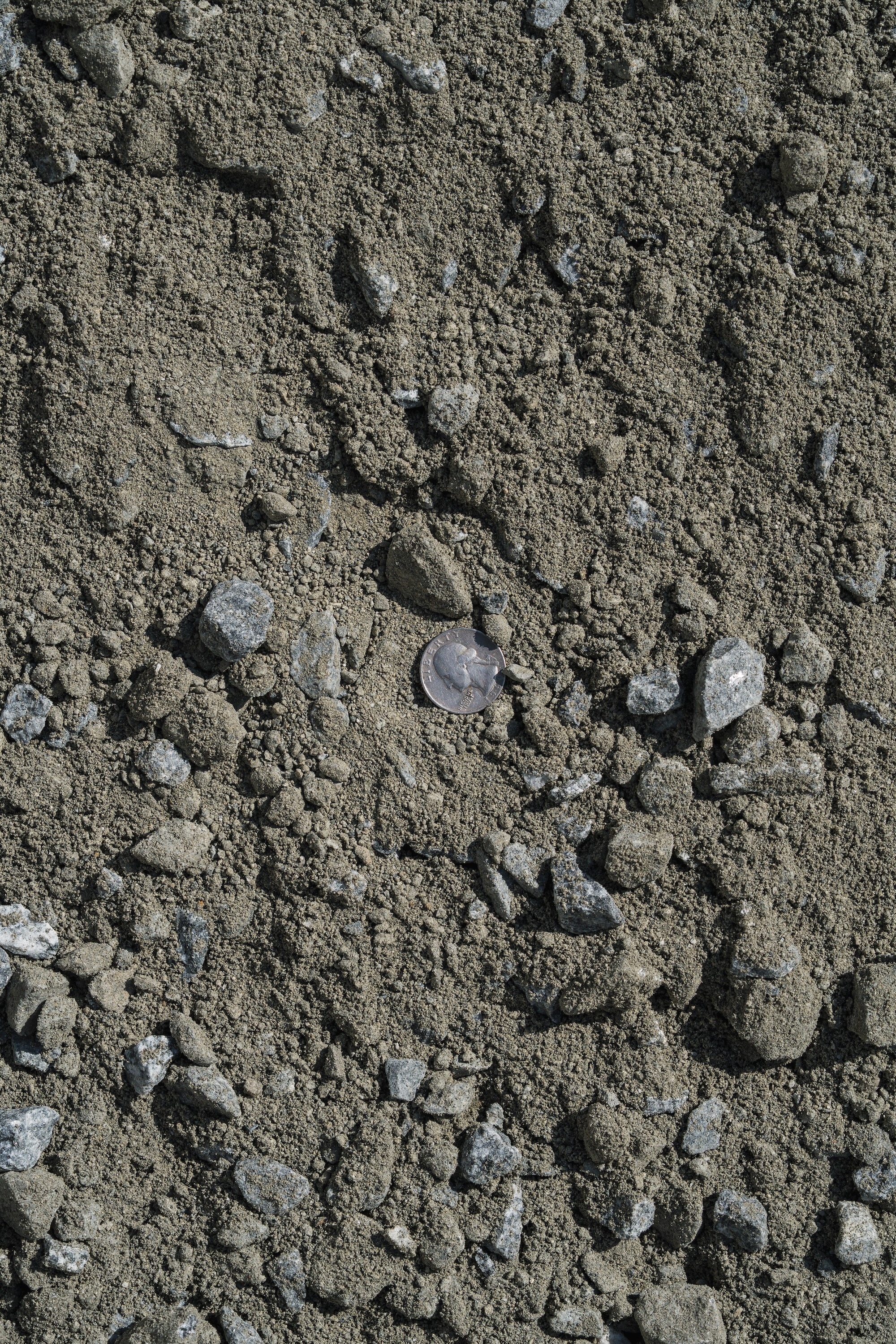
3/4" Blue Base Rock
120 sqft per ton @ 2″ Depth
Closed
Hours:
Mon-Sat: 6:30 AM - 4:00 PM
Sunday: Closed
Why 3/4" Blue Base Rock? Use Cases and Performance
3/4" Blue Base Rock is the structural workhorse of our Fresno yard. It is a graded, crushed aggregate that runs from 3/4" down through fines, styled after the Class 2 road base gradation used on driveways, roads, and pads across California, though we do not sell it as a certified spec product. Buy it when you need a section that carries load and does not move, not when you want something decorative sitting on top.
The word graded is what separates base rock from the single-size crushed rock products in the yard, like 3/4" crush granite or 3/4" white rock. A single-size product is mostly one particle size with air gaps between the pieces. Base rock is engineered the opposite way: a spread of particle sizes, from 3/4" rock down to sand-size fines, so the small pieces fill the voids between the large ones. Once it is compacted, there is very little open space left in the section, which is exactly what you want under a slab, a driveway, or a road. Less void space means less water infiltration, less settlement, and a stiffer load-bearing layer.
Where 3/4" blue base rock is the right call
- Driveway and parking pad base sections, placed and compacted before a decorative wearing course such as crush granite, DG, or pavers goes on top.
- Under concrete slabs, sidewalks, patios, and garage floors, where a compacted base controls settlement and gives the slab a consistent bearing surface.
- Road base and access road construction, including ranch roads, ag roads, and unpaved rural driveways that need to carry regular vehicle and equipment traffic.
- Under pavers and flagstone, as the structural layer beneath the bedding sand, not as the finished surface itself.
- Utility trench backfill and compacted fill under footings, where a well-graded material compacts predictably in lifts.
- Building pads and equipment pads that need a stable, load-bearing surface before construction starts.
Where it is not the right call
Base rock is not a finished, walk-on-it surface. It has a duller, dustier gray-blue color, a rougher texture with visible fines, and it tracks fine dust and mud when it rains, none of which reads as a finished patio or path. If you want the look of stone with a clean surface, choose a decorative single-size product such as 3/4" Crush Granite or 3/4" White Rock instead, and put the base rock underneath it, out of sight. Base rock also is not the product for drainage layers or French drains: the fines that make it compact so well are the same fines that clog a drain rock section. For that job, use a clean, single-size product like 3/8" Pea Gravel or crushed granite instead.
Not sure how much you need?
Run your square footage and depth through our material coverage calculators before you call. Base sections are usually specified by compacted depth, so account for compaction loss when you order, typically 15 to 25 percent more loose volume than the final compacted depth.
Buying it in Fresno
We sell 3/4" blue base rock by the ton out of our yard at 3562 South Elm Avenue in Fresno. You can load it yourself, we can load your truck or trailer, we can rent you a dump trailer to self-haul, or we can deliver and dump it where you want it. Call 559-233-6603 to confirm current pricing and availability. Aggregate pricing moves with fuel and quarry costs, so we quote it live rather than publishing a number that goes stale.
3/4" Blue Base Rock: Guidance for Your Situation
Pick the description that fits you best. Specs, steps, and pricing questions differ for a weekend project versus a bid or a compliance inspection.
For homeowners tackling a driveway, patio, or shed pad
Installing Blue Base Rock Yourself
Base rock projects fail for one of two reasons: skipping compaction, or placing too thick a lift and expecting a hand tamper or foot traffic to do the work of a real compactor. Neither shortcut shows up on day one. Both show up as ruts, dips, or a cracked slab within a year.
How much depth do I actually need?
| Application | Compacted depth | Notes |
|---|---|---|
| Shed or storage pad | 3"–4" | Compact in one or two lifts depending on total depth. |
| Under a concrete patio or walkway slab | 4" | Standard residential slab base. |
| Residential driveway base | 4"–6" | Add more depth over soft or clay-heavy subgrade. |
| Under pavers | 4"–6" base, plus 1" bedding sand on top | Base rock is not the bedding layer, it goes underneath the sand. |
| Rural or ranch access road | 6"–8" | Heavier and less frequent traffic still needs real depth to avoid rutting. |
Step-by-step: a DIY base rock section
- Strip organics and topsoil down to firm native subgrade. Anything organic left underneath will decompose and settle later.
- Grade for drainage. Build in a slope away from structures before you place any rock; correcting drainage after the base is compacted means tearing it back out.
- Proof the subgrade. Walk it, drive a wheelbarrow over it, or run a plate compactor over the bare subgrade first. Soft spots that pump or flex need to be corrected now, not covered up.
- Place base rock in lifts. For anything over 4" total depth, place and compact in two lifts rather than one deep dump. A single thick lift will compact well at the top and stay loose at the bottom.
- Wet it lightly. Base rock compacts best at or near optimum moisture. Bone dry material vibrates without locking together; a light hose pass before compacting makes a real difference.
- Compact with a plate compactor. Rent one for the day. Hand tamping a driveway or patio base is not adequate; you need vibratory compaction to get the fines to lock the larger stone in place.
- Check the surface. It should feel firm and unyielding when you walk or drive on it, not springy or loose. A springy surface means it needs another compaction pass or more moisture.
- Build on top. Add your wearing course, whether that is decorative rock, pavers with bedding sand, or a concrete pour, once the base tests firm.
What DIY base rock projects typically cost
Aggregate is priced by the ton and moves with market conditions, so call 559-233-6603 for a live number. Budget separately for a plate compactor rental for the day, edging or forms if you are prepping for concrete, and either a delivery fee or a trailer rental. For most homeowners doing a patio or shed pad, self-hauling one or two tons in a rented dump trailer is the cheapest path; for a full driveway, delivery usually wins on cost and effort.
The single most common DIY mistake
Skipping compaction, or compacting only the top of a deep single lift. Base rock that has not been mechanically compacted in reasonable lifts will settle unevenly under the first heavy rain or the first vehicle load, no matter how good it looked on install day.
What blue base rock looks like once placed
It is not a decorative material and it will not read as one. Expect a dull gray-blue tone with visible fine material mixed through it, a rougher and dustier surface than any single-size decorative rock, and dust that turns to a thin film of mud in wet weather until something is placed over it. None of that is a defect. It is the nature of a well-graded base product doing its job below whatever finished surface goes on top.
For general contractors, concrete crews, and paving crews
Specs, Bulk Ordering, and Job-Site Logistics
Base rock is one of our highest-volume products, and most of it moves out for slab prep, driveway sections, and road base rather than retail decorative use. Monday through Saturday, 6:30 AM to 4:00 PM, first loads out early. Call 559-233-6603 the day before on anything over a few loads so we can stage it.
Working specs
| Property | Working value / behavior |
|---|---|
| Nominal size | 3/4" minus, graded with fines |
| Style | Class 2 style road base gradation; not sold as a certified spec product |
| Sold by | The ton; loaded at our Fresno yard or delivered |
| Compaction behavior | Fines fill voids between larger stone; compacts to a dense, low-permeability section |
| Typical use | Driveway and road base, under-slab base, paver base, backfill |
| Placement | Place and compact in lifts, generally 4" to 6" loose per lift depending on equipment |
| Coverage | Figured on square footage and compacted depth, see our calculators for takeoffs |
Placement and compaction
- Prep and proof the subgrade. Strip organics, proof-roll with loaded equipment, and correct soft or pumping sections before placing rock. Fresno-area clay subgrade holds moisture and will telegraph through an undersized or poorly compacted base.
- Place in controlled lifts. Loose lift thickness depends on your compactor, generally 4" to 6" loose per lift for a plate or roller compactor, less for hand equipment.
- Compact at optimum moisture. Dry base rock will not lock together under vibratory compaction. A water truck pass or hose application before rolling makes a measurable difference in density.
- Test if the spec requires it. For jobs with a compaction spec, use a nuclear density gauge or a proctor comparison rather than eyeballing firmness.
- Crown or slope every section. Even a base layer under a slab benefits from a slight fall away from structures in case water reaches it during construction.
Job-site logistics and hauling
- Yard pickup: we load trucks and trailers on site at 3562 South Elm Avenue, Fresno, Monday through Saturday 6:30 AM–4:00 PM.
- Delivery: dump truck delivery for bulk quantities, including staged multi-load deliveries on driveway and road jobs.
- Self-haul: dump trailer and truck rentals when your own trucks are committed elsewhere.
- Multi-material orders: base rock plus a decorative wearing course, or base rock plus concrete sand for a paver job, are common. Bundle the order and we will sequence loads to match your placement schedule.
- Access: flag tight residential access, low utility lines, or gated job sites when you order, not when the truck shows up.
Bulk and account pricing
We quote bulk and repeat-account pricing directly rather than publishing rates, because tonnage, haul distance, and load count all move the number. Call 559-233-6603 or send us the job details and we will price the material and freight together. If you run recurring work, such as production home pads, HOA driveway repairs, or ag road maintenance, ask about standing pricing so you are not re-quoting every draw.
Concrete and paver crews
For slab work, base rock is the layer that controls whether the finished concrete cracks and settles evenly or develops isolated low spots. A consistently compacted 4" base under a residential slab is cheap insurance against callbacks. For paver crews, remember base rock is a structural layer, not the bedding layer: place and compact the base first, then add a leveling course of plaster sand or concrete sand under the pavers themselves.
Contractor accounts
If you buy from us regularly, see our contractor page for how accounts, staged loads, and repeat pricing work.
For property managers, HOAs, and facilities crews
Roads, Pads, and Common-Area Base Work
Base rock shows up on the property manager's radar for two recurring jobs: repairing potholed or rutted access roads and drive aisles, and replacing failed sections under sidewalks or slabs that have heaved or settled. In both cases, the fix is rarely just adding more decorative rock on top. The problem is almost always in the base layer that never got compacted correctly the first time.
Common-area and access road repair
Gravel drive aisles, RV storage lots, and back-of-property access roads on ag and rural properties take repeated vehicle loading with no structural pavement underneath them. When they rut or pothole, patching with loose decorative rock is a temporary fix that fails again within a season. The durable repair is to scarify or remove the failed section, place a proper base rock layer in compacted lifts, and cap it with a wearing course suited to the traffic, whether that is more base rock, asphalt grindings for a lower-cost surface, or crush granite for a cleaner look.
Sidewalk, slab, and pad settlement
When a section of sidewalk, a dumpster pad, or a utility pad settles or heaves, the underlying base rarely drains or compacted correctly during original construction. Repairs done right pull the failed slab, correct the subgrade, place a properly compacted base section, and repour, rather than mudjacking a slab that sits on an unstable base. For HOAs budgeting repairs, ask your contractor whether the base is being rebuilt or just the surface, since that is the difference between a permanent fix and a repeat call in two years.
Planning and budgeting base work
- Base rock is priced and ordered by the ton, so get accurate square footage and target compacted depth from your contractor before requesting bids.
- Compaction equipment and labor typically cost more than the material itself on a small repair; factor that into repair-versus-replace decisions.
- Bundling several small repair locations into one delivery and one contractor mobilization is usually far cheaper per square foot than addressing them one at a time as complaints come in.
- For recurring maintenance across a large property or portfolio, ask about standing pricing and a preferred delivery schedule rather than one-off quotes.
Bidding a base repair job
Send us the square footage, target depth, and access details for your site through our contact page or call 559-233-6603, and we will help your contractor size the order and coordinate delivery around your schedule.
How 3/4" Blue Base Rock Compares to the Alternatives
The comparison that matters most with base rock is not one decorative product against another. It is understanding which layer of your project each material belongs in, since base rock, decorative aggregate, and drain rock solve different problems even when they sit next to each other in the yard.
| Material | Compaction / stability | Best for | Trade-off vs. blue base rock |
|---|---|---|---|
| 3/4" Blue Base Rock | High, graded with fines, compacts dense and low-void | Structural base under slabs, driveways, roads, and pavers | N/A |
| 3/4" Crush Granite | High, angular, but single-size with more void space | Decorative driveway and parking wearing course, ground cover | Cleaner look and finished surface, but does not compact as densely or drain as little as a graded base |
| 3/8" Crush Granite | Moderate, fine and walkable | Walking paths, patio jointing, fine decorative cover | Comfortable underfoot but not a structural base for vehicle loads |
| Asphalt Grindings | High once compacted and bound | Budget driveways, ranch roads, back-of-house wearing surfaces | Lower cost finished surface, but not a substitute for a clean base layer under concrete |
| Fill Dirt | Low to moderate, depends on soil type | Rough grading, low-value fill away from structures | Cheaper for bulk fill, but not engineered for load-bearing or drainage the way base rock is |
Blue base rock vs. decorative crushed rock
Decorative crushed rock like crush granite or white rock is single-size, which leaves air gaps between the pieces even after compaction. That is fine, even desirable, for a wearing surface, since it keeps the product free-draining and lets it look clean. Base rock is the opposite on purpose. The graded mix of sizes down to fines fills those gaps, producing a dense, low-permeability layer that resists settlement under load. Use decorative rock where people look at it and walk or park on it. Use base rock underneath, where its job is to not move.
Blue base rock vs. drain rock or clean crushed rock
Do not substitute base rock where a spec calls for clean, single-size drain rock, and do not substitute drain rock where a spec calls for base. The fines in base rock that make it compact so well are the same fines that will clog a French drain or a drain rock trench over time. For drainage applications, use a clean, single-size product such as 3/8" Pea Gravel or crushed granite instead, and reserve base rock for load-bearing sections that are meant to shed water off the top rather than pass it through.
Blue base rock vs. concrete or asphalt paving
Base rock by itself, well compacted, functions as a driveway or road surface at a much lower installed cost than a paved section, and that is a legitimate long-term choice for ranch roads, ag access, and low-budget driveways willing to accept periodic top-dressing and grading. Where it earns its keep either way is underneath the pavement: every durable concrete or asphalt section starts with a properly compacted base rock layer, and skipping that step is the most common reason paved surfaces crack and settle early.
Blue Base Rock in Central Valley Conditions
Material behavior is local. A base course that performs well over sandy, well-drained soil can behave very differently over Fresno's heavy clay, and a base section built for a mild coastal climate needs to handle 100 degree summer heat and concentrated winter rain here instead. Here is what that means for blue base rock specifically.
Clay soil and hardpan subgrade
Much of the Fresno and Clovis area sits on soils with a significant clay fraction, and some lots have hardpan close enough to the surface to affect drainage. Clay expands when saturated and shrinks as it dries, and it pumps under load when wet, which is the single biggest cause of local driveway and slab failures. A properly compacted base rock section spreads load over a wider area and reduces how much that movement telegraphs up to the finished surface, but it does not eliminate a bad subgrade. On sites with heavy clay or known hardpan, plan on extra base depth and consider a geotextile fabric between the native soil and the base rock to keep the base from working its way down into the clay over seasons of wetting and drying.
Summer heat and compaction timing
Fresno summers regularly clear 100°F, and base rock placed bone dry in that heat will not compact well no matter how many passes a plate compactor makes. Moisture evaporates from the surface faster than it can be worked in, so schedule compaction for early morning when possible, and plan on a water truck pass or hose application on larger sections placed midday. This matters more for base rock than for decorative single-size aggregate, since base rock relies on moisture to help the fines lock the larger stone together.
Winter rain and drainage
Fresno gets most of its annual rainfall in a handful of concentrated winter storms rather than steady rain through the season, so the design case is a short burst of water looking for somewhere to go, not constant drizzle. A compacted base section sheds this water off the surface rather than absorbing it, which is why grading the base with a slight slope or crown matters even though it will be covered by a wearing course or a slab later. Base sections left uncovered and unprotected through a wet winter can develop soft, muddy spots at the surface; if a job stalls before the wearing course goes on, keep vehicle traffic light on an exposed base during and immediately after storms.
Tule fog and moisture cycling
Central Valley tule fog in December and January adds surface moisture through condensation even without measurable rainfall, which keeps an exposed base or road surface damp for days at a time in winter. This is generally an advantage for compaction and dust control during that season and a minor consideration for scheduling a pour, since a slab base should be reasonably dry and firm, not saturated, when concrete goes down.
Dust and access road maintenance
An exposed base rock surface used as an interim or permanent road, common on rural and ag properties, generates dust in dry months as fines work loose at the surface under traffic. Periodic light watering and occasional light grading or re-compaction control this better than adding more loose material on top, which just creates a new layer that has not compacted yet. Where dust is a persistent problem on a permanent access road, capping the base with a wearing course helps more than depth alone.
Local delivery area
We deliver blue base rock throughout Fresno, Clovis, Sanger, Selma, Kingsburg, Madera, and the surrounding Central Valley. Call 559-233-6603 to confirm delivery to your address, or rent a trailer and haul it yourself.
3/4" Blue Base Rock: Frequently Asked Questions
Have questions? We've got answers. If you don't see your question below, give us a call at (559) 233-6603.