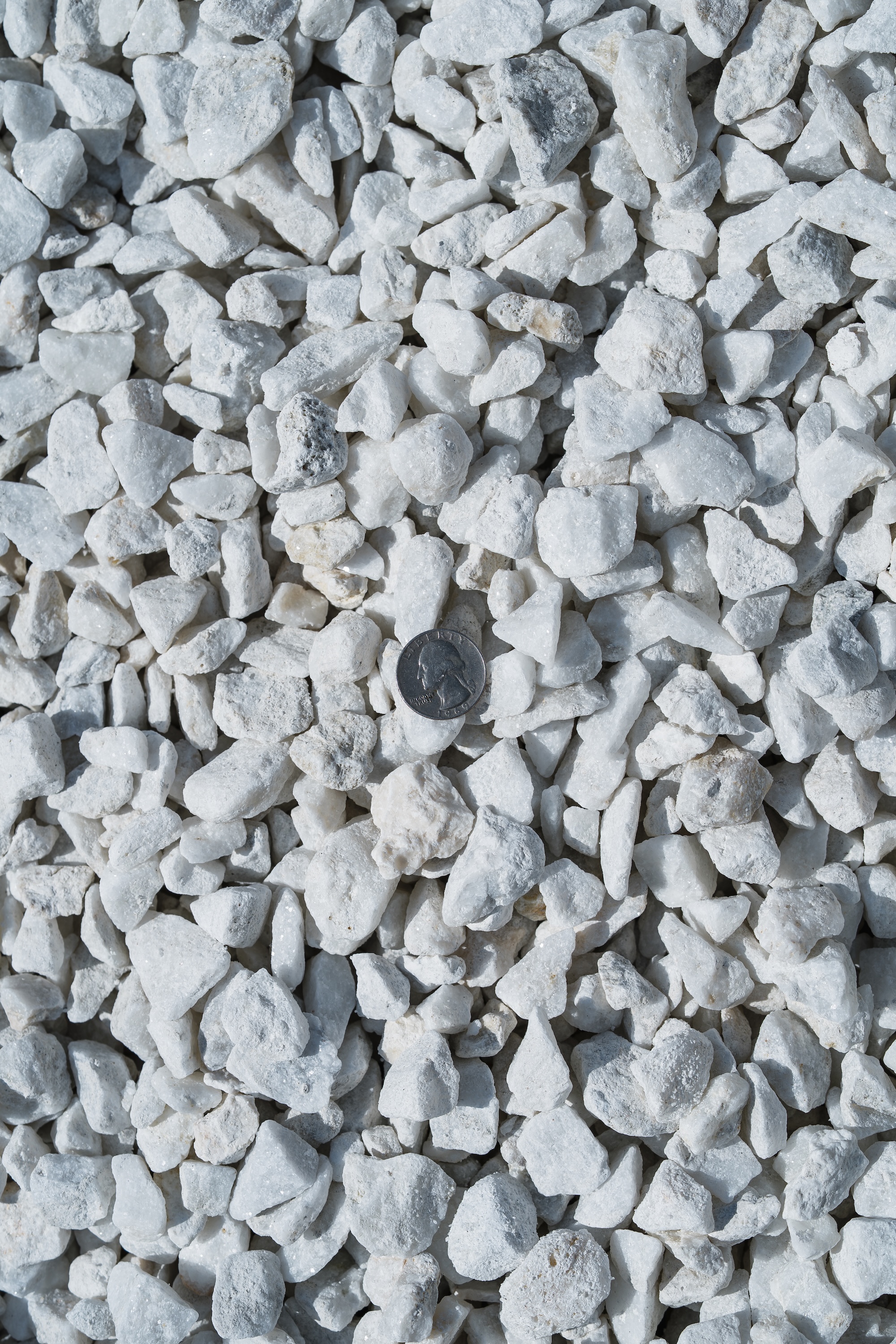
3/4" White Rock
120 sqft per ton @ 2″ Depth
Closed
Hours:
Mon-Sat: 6:30 AM - 4:00 PM
Sunday: Closed
Why 3/4" White Rock? Use Cases and Performance
3/4" white rock is the brightest decorative aggregate in our Fresno yard. It is a washed, rounded to sub-angular white stone sized to a nominal three-quarter inch, sold for its color as much as for anything structural. Where crushed granite and base rock get chosen for how they compact, white rock gets chosen because a customer stood in the yard, looked at the pile, and decided that bright white is exactly what the front bed or the pool deck border needed.
That does not make it a lightweight product. It still handles the basic jobs any 3/4" decorative rock handles: covering bare dirt, suppressing weeds, filling a dry creek bed, edging a planter. What sets it apart from the gray and tan aggregates next to it is reflectivity. White rock throws light back rather than absorbing it, which changes how it looks in a bed, how hot it gets underfoot at 2 PM in July, and how it reads against stucco, plants, and other rock.
Where 3/4" white rock is the right call
- Accent beds and focal points where the goal is contrast against dark mulch, dark stucco, or green plantings rather than a neutral background.
- Modern and coastal-style landscape design, where bright white rock reads clean against white or gray exteriors and simple architectural lines.
- Dry creek beds and drainage features that benefit from a bright, visually distinct channel rather than a rock that blends into the surrounding ground cover.
- Pool surrounds and water features where the reflective white plays off water and light rather than absorbing heat the way a dark rock would.
- Borders, edging bands, and small accent zones where a little goes a long way visually.
- Xeriscape and low-water landscaping as a non-organic ground cover that will not decompose or need replacing on a schedule.
Where it is not the right call
White rock shows dirt, dust, and organic litter more visibly than a mid-tone or dark aggregate. Under a large tree with heavy leaf or seed drop, or along a busy dirt-facing fence line where windblown soil settles constantly, white rock needs more upkeep to look bright than 3/4" Crush California Gold or 3/4" Crush Granite would in the same spot. It is also not a load-bearing or driveway product. If you need a surface that compacts and carries vehicle traffic, look at 3/4" Blue Base Rock or crush granite instead, and keep white rock for the decorative role it is built for.
Not sure how much you need?
Run your square footage and depth through our material coverage calculators before you call. It heads off the two most common ordering mistakes: guessing at depth and forgetting that a large bright bed reads even brighter once it is spread than it did in a small sample pile.
Buying it in Fresno
We sell 3/4" white rock by the yard out of our yard at 3562 South Elm Avenue in Fresno. You can load it yourself, we can load your truck or trailer, we can rent you a dump trailer to self-haul, or we can deliver and dump it where you want it. Call 559-233-6603 to confirm current pricing and availability. Aggregate pricing moves with fuel and quarry costs, so we quote it live rather than publishing a number that goes stale.
3/4" White Rock: Guidance for Your Situation
Pick the description that fits you best. Specs, steps, and pricing questions differ for a weekend project versus a bid or a compliance inspection.
For homeowners and designers
Installing and Designing With White Rock
White rock projects live or die on prep work more than most decorative aggregates, because every flaw underneath shows through a bright white surface the way a dark carpet hides stains and a white one does not. A little extra care at the edging and weed-barrier stage pays off for years.
How much depth do I actually need?
| Application | Recommended depth | Notes |
|---|---|---|
| Decorative ground cover in beds | 2" | Standard depth for full soil coverage and weed suppression. |
| Accent borders and small feature areas | 2"-3" | Deeper coverage reads brighter and hides fabric edges better. |
| Dry creek beds | 3"-4" | Depth varies with the visual effect, deeper channels look more natural. |
| Pool surrounds and decorative side yards | 2"-3" | Keep it shallow enough that it does not migrate onto the pool deck. |
| Erosion or drainage swales | 3"-4" | Rounded stone needs a defined channel and stable slope, it will not lock in place like an angular product. |
Step-by-step: a DIY white rock bed or accent area
- Clear the area completely. Remove grass, weeds, roots, and any construction debris. White rock exposes anything left behind far more than a darker product would.
- Grade for drainage. Slope the bed slightly away from the house or any structure so water does not pond in a bright white area and stain it with sediment.
- Lay landscape fabric. This step matters more here than with most aggregates, since fabric keeps soil from working up through the rock and dulling the white color from underneath.
- Set your edging. Steel edging, concrete curb, or a header board keeps the rock contained. Without it, white rock migrates onto lawns and walkways and is very visible doing so.
- Spread the rock evenly. Work from a pile toward the edges with a rake, keeping depth consistent so fabric does not show through thin spots.
- Rinse if needed. A light hose-down after spreading knocks off quarry dust and shows the true color faster than letting rain or wind do it over weeks.
Design: what white rock looks like in a Fresno yard
White rock reads as bright, high-contrast, and clean. It is one of the few materials in the yard where a little placed well outperforms a lot placed everywhere. Large unbroken fields of it can look stark and can be genuinely hard to look at in direct summer sun, so most successful designs use it as an accent rather than a blanket.
- Against dark stucco, charcoal fencing, or black metal railing, white rock creates the sharpest contrast available in the yard.
- Paired with dark mulch or a darker rock border, such as 3/4" Black Lava, a white rock band reads as an intentional design line rather than leftover material.
- With green foundation plantings, white rock makes foliage color pop more than a neutral gray background does.
- Around water features and pools, the reflective quality plays well with light off the water without competing with plant color.
- As a dry creek bed, white rock combined with a few larger accent boulders reads as a natural, sun-bleached wash rather than a construction material.
What DIY installs typically cost
Aggregate is priced by the yard and moves with market conditions, so call 559-233-6603 for a live number. Beyond the rock itself, plan for landscape fabric, edging material, and either a delivery fee or a trailer rental. Because white rock is usually installed in smaller accent quantities rather than covering an entire yard, most homeowner orders fit comfortably in a rented dump trailer for a single trip.
The single most common DIY mistake
Skipping fabric or edging because the area looks small. White rock shows soil bleed-through and rock migration faster than any other product in the yard, so the prep steps that feel optional on a gray gravel job are not optional here.
Maintenance
- Dust and staining: rinse periodically with a hose, especially after windy periods or heavy pollen season, since white shows both far more than a mid-tone rock.
- Leaf litter: pick or blow debris out regularly, it is far more visible against white than against darker aggregate.
- Sprinkler overspray: adjust heads so they are not hitting the rock directly, mineral deposits from hard water leave visible marks on white stone.
- Weeds: a pre-emergent in spring and fall handles most windblown-seed weeds before they root into any dust that has settled into the rock.
For landscape contractors and designers
Specs, Bulk Ordering, and Job-Site Logistics
White rock volume on our accounts runs smaller per job than base rock or crush granite, but it shows up constantly on design-build jobs, accent packages, and change orders where a client wants a specific look finalized after the main hardscape is in. Monday through Saturday, 6:30 AM to 4:00 PM, call 559-233-6603 the day before on anything over a couple of yards and we will have it staged.
Working specs
| Property | Working value / behavior |
|---|---|
| Nominal size | 3/4" washed, rounded to sub-angular |
| Sold by | The yard (bulk); loaded at our Fresno yard or delivered |
| Color | White, brightness varies slightly by run, call for current stock if matching an existing installation |
| Typical use | Decorative ground cover, accent beds, dry creek beds, pool and water feature surrounds |
| Structural use | Not a base or driveway product, use blue base rock or crush granite where compaction and load-bearing matter |
| Drainage | Free-draining as a clean washed product |
| Coverage | Calculated at 2" depth, see our calculators for takeoffs |
Placement notes
- Prep with fabric on any decorative install. It matters more here than on darker aggregate, since soil migration through the rock is visually obvious and clients notice it fast.
- Contain every edge. Rounded stone with no compaction value will migrate over time without steel edging, concrete curb, or a header.
- Sequence white rock last on multi-material jobs. Placing it after dirt work, base rock, and any darker aggregate is finished avoids tracking darker dust or debris into it.
- Rinse after placement on high-visibility jobs. A quick hose-down before a final walkthrough or client handoff shows the true color and removes quarry dust immediately rather than waiting on rain.
- Keep stockpile locations away from dirt work in progress. A pile of white rock sitting next to an active grading operation picks up color it never fully loses.
Job-site logistics and hauling
- Yard pickup: we load trucks and trailers on site at 3562 South Elm Avenue, Fresno, Monday through Saturday 6:30 AM–4:00 PM.
- Delivery: dump truck delivery for bulk quantities, staged to arrive after other materials on multi-material jobs if you tell us the sequence.
- Self-haul: dump trailer and truck rentals for smaller accent-quantity pickups.
- Multi-material orders: white rock plus fabric plus edging in the same order is common. Bundle it and we will confirm quantities against your takeoff.
- Access: tell us about tight side-yard access, pool equipment in the path, or gated HOA entries when you order.
Bulk and account pricing
We quote bulk and repeat-account pricing directly rather than publishing rates, because aggregate cost moves with fuel and quarry pricing and volume affects the number. Call 559-233-6603 or send us the job details and we will price the material and the freight together. If white rock is a recurring line item on your design packages, ask about standing pricing so you are not re-quoting on every job.
Commercial and HOA applications
White rock shows up on commercial jobs mostly as a signature accent rather than a general ground cover, marking an entry monument, a sign base, or a courtyard feature where a property wants a distinct look against a broader landscape of granite or bark. For HOA common areas that need something durable across large square footage, 3/4" Crush Granite or 3/4" Crush California Gold generally hold up better to maintenance crew traffic and hide dust better between service visits, with white rock reserved for the smaller accent zones a maintenance contract calls out specifically.
Contractor accounts
If you buy from us regularly, see our contractor page for how accounts, staged loads, and repeat pricing work.
For designers and property owners planning a look
Using White Rock as a Design Element
White rock gets specified for one reason more than any other: brightness that no other stone in the yard matches. Designers reach for it when a project needs a strong visual anchor, a way to make a small space feel more open, or a material that will not fade or discolor the way an organic mulch does over a multi-year maintenance cycle.
Where it earns its place in a design
- Entry monuments, mailbox beds, and small high-visibility zones where a concentrated bright accent reads better than blending into a larger neutral field.
- Modern and Mediterranean-style properties where white rock pairs with white or light stucco, wrought iron, and simple architectural planting.
- Small side yards and narrow spaces, where a light-colored ground cover can make a tight area feel less enclosed than a dark aggregate would.
- Water-adjacent design, since the reflective surface complements pools, fountains, and other water features without competing for visual attention.
- Contrast banding, using white rock as a border or dividing line between two other materials, such as bark and granite, to define zones without hardscape.
Where a designer should steer a client away from it
Large, unbroken fields of white rock in full Central Valley sun get genuinely uncomfortable to look at and can create glare in a way a mid-tone or darker aggregate does not. It also shows every bit of dust, leaf litter, and irrigation overspray, which raises the maintenance conversation for a client who wants a low-upkeep yard. For whole-yard ground cover on a low-maintenance property, granite or a tan aggregate like 38" Minus California Gold DG is usually the better full-coverage recommendation, with white rock brought in as the accent that makes the rest of the palette look intentional.
Pairing white rock with plant material
Silver and gray-green foliage, such as lavender, rosemary, and dusty miller, reads as soft and cohesive against white rock rather than washed out. Deep green foliage and dark-leaved plants like New Zealand flax create the strongest contrast. Avoid pairing white rock directly against very pale or variegated foliage in full sun, since the combined brightness can flatten the planting visually instead of highlighting it.
Sampling before a full order
Because color and brightness carry so much of this material's appeal, it is worth seeing a sample in your actual site lighting before committing to a large order. Stop by the yard at 3562 South Elm Avenue or call 559-233-6603 to confirm current stock color before finalizing a design package.
How 3/4" White Rock Compares to the Alternatives
White rock is a color-first product, so the honest comparison is less about performance and more about what job you are actually trying to do. Here is how it stacks up against the decorative aggregates it most often gets cross-shopped with.
| Material | Color / brightness | Best for | Trade-off vs. white rock |
|---|---|---|---|
| 3/4" White Rock | Brightest option in the yard, reflective | Accents, borders, dry creek beds, pool surrounds | N/A |
| 3/4" Crush California Gold | Warm tan and gold | Full-coverage beds, warmer stucco pairings, lower maintenance visibility | Less contrast, but hides dust and litter far better across large areas |
| 3/4" Crush Granite | Neutral gray with warm flecks | Driveways, parking, long-term decorative ground cover | Compacts and locks under traffic, white rock does not |
| 3/4" Black Lava | Dark charcoal to black | High-contrast accents, modern design, fire-resistant plant beds | Opposite end of the color spectrum, absorbs more heat, pairs as a contrast partner rather than a substitute |
| 3/4" Red Lava | Rust red | Warm-tone accents, desert and southwestern design themes | Different palette entirely, another accent-first option rather than a full-coverage product |
| 1"-1.5" River Rock | Mixed earth tones, rounded | Dry creek beds with a more natural, mixed-stone look | Blends rather than contrasts, softer look than a monochrome white bed |
White rock vs. crushed products for compaction and traffic
White rock is washed and rounded to sub-angular rather than crushed, so it does not interlock and compact the way 3/4" Crush Granite or 3/4" Blue Base Rock does. That is not a defect, it is simply not the job this material is built for. If a project needs a walkable or drivable surface, plan on a crushed product for the structural layer and reserve white rock for the areas where appearance, not load-bearing, is the priority.
White rock vs. organic mulch
Compared to bark or humus products such as walk-on bark or black humus, white rock never breaks down, never needs replacing on a multi-year cycle, and does not feed weeds through decomposition. What it gives up is any soil benefit: it does not add organic matter, does not moderate soil temperature the way mulch does, and reflects heat back up into plant canopies rather than shading roots. Most well-designed Fresno beds mix the two, using mulch immediately around plant crowns and rock for the open field or accent zones around it.
White Rock in Central Valley Conditions
Material behavior is local. A bright white stone that looks crisp in a mild coastal climate faces a different set of conditions in Fresno, where summer sun is intense and prolonged, rainfall arrives in a handful of concentrated winter events, and the native soil is heavy on clay. Here is what that means for white rock specifically.
Summer heat and reflected light
White rock reflects more solar radiation than any other rock in our yard, which cuts both ways. It stays cooler underfoot than dark aggregate like black lava in direct sun, which matters for pool surrounds and pet areas, but the glare it throws off in full Fresno summer sun is genuinely intense and can bounce reflected heat and light up onto a nearby wall or window. Keep large white rock fields away from south- and west-facing windows where reflected glare and re-radiated heat can add to a room's cooling load, and consider using it as an accent rather than a full-yard blanket for exactly this reason.
Clay soil and subgrade behavior
Much of the Fresno–Clovis area sits on soils with a significant clay fraction that compacts hard and drains slowly. Since white rock is a decorative, non-structural product, clay subgrade is less of a compaction concern here than it is under a driveway. It still matters for drainage: a clay-based bed with poor grading will pond water after a storm, and standing water under white rock accelerates staining from sediment and algae far more visibly than it would under a darker stone. Grade beds to shed water before spreading rock rather than relying on the rock layer to solve a drainage problem.
Winter storms and drainage
Fresno gets most of its annual rainfall in a short list of winter storms rather than steady rain through the season, so beds need to handle a concentrated volume of water at once. White rock is rounded and does not lock together under compaction, so on a slope or in a concentrated drainage path it can shift more than a crushed product would. Keep white rock out of steep grades and active drainage channels unless it is contained by edging or larger accent boulders, and reserve it for flatter beds, borders, and gently sloped features.
Water conservation and rock landscaping
Rock ground cover is the default answer to Central Valley water restrictions, and white rock is a reasonable long-term choice for accent zones within that strategy because it never decomposes or needs replacing on a cycle. The honest caveat is the same one that applies to any rock: it adds no organic matter to soil, so plants that need biological activity still want a mulch ring, not rock pressed against the crown.
Dust, tule fog, and staining
Central Valley dust and windblown soil settle into any rock bed over time, and white rock shows that buildup faster and more visibly than a mid-tone or dark aggregate. Winter tule fog leaves fine mineral residue as it settles and evaporates, which compounds the same visible dulling effect. A periodic hose rinse, especially after windy spring conditions and heavy fog weeks, keeps a white rock bed looking like it did on install day rather than gradually drifting toward gray.
Local delivery area
We deliver white rock throughout Fresno, Clovis, Sanger, Selma, Kingsburg, Madera, and the surrounding Central Valley. Call 559-233-6603 to confirm delivery to your address, or rent a trailer and haul it yourself.
3/4" White Rock: Frequently Asked Questions
Have questions? We've got answers. If you don't see your question below, give us a call at (559) 233-6603.